
THIS CASE IS NOT A FINAL ORDER OF THE REVIEW COMMISSION AS IT IS PENDING COMMISSION REVIEW
This case arose from an anhydrous ammonia (NH3) release that occurred on May 23, 2017, at a Power Plant. OSHA conducted an investigation and subsequently issued a two-item citation for alleged violations with proposed penalties of $18,108. In this case, the OSHRC discussed when a response to a release is an emergency response, what the contents of the Emergency Response Plan must be, and what type of respirators must be worn by the first responders on scene.
SAFTENG NOTE: some references to Pressure Relief Valves (PRV) appear to be more like Pressure Control Valves (PCV); however, the actual RV’s do discharge into the water sump.
The company operates a coal-fired power plant and uses anhydrous ammonia in its Selective Catalytic Reduction (“SCR”) system to lower the amount of NOx emitted from its boilers. Instead of storing large quantities of NH3, they receive it on an as-needed basis via a pipeline from a Pipeline Company. The ammonia skid is the portion of the site where the pipeline comes above ground and the NH3 is reduced in pressure and then heated to form a vapor to be used in the SCR. The consists of two identical ‘trains’ (A train and B train). Typically, only one train is in use at a time. All of the pressure relief devices associated with the ammonia skid have their discharge sides hard piped into a water-filled sump. The ammonia system is continuously monitored and remotely controlled by the distributed control system (“DCS”). Its displays/interfaces are seen by the operators in the control room. The entire skid rests on expanded metal decking and is several feet above the ground. There are atmospheric ammonia detectors installed in several locations on the skid. There are emergency breathers located at the top of each of the three sets of stairs leading up to the skid. There is also a windsock at the northwest comer of the skid. The water-filled sump is located below ground level and beside the southwest stairs. There is a remotely-operated emergency shutoff valve located just after the piping emerges from underground to the north of the raised skid. There is another emergency stop station across the street from the south side of the skid.
The NH3 supplied by the pipeline is in liquid form and at a pressure too high for the facility’s SCR system to use. The purpose of the ammonia skid is to first reduce the pressure of the liquid ammonia and then heat up the liquid to form an ammonia vapor suitable for the SCR system. Each train on the skid has two pressure relief valves (“PRV”). The purpose of a PRV is to provide a controlled outflow of process material during a high-pressure surge event. Instead of rupturing the pipe resulting in an uncontrolled release, the seat of the PRV will lift until the system pressure falls below its setpoint and then it will reseat. In this case, the outlet of each vent is hard-piped to a water-filled sump. Since ammonia is soluble in water, this system design will capture ammonia coming from the PRVs.
On the morning of May 23, 2017, the ammonia pipeline supply pressure was fluctuating. The B train was in service but was having problems maintaining appropriate supply pressure for the SCR’s. The A train was also brought on-line at approximately 5 a.m., to help control the system pressure. According to the facility process data, at approximately 11:18 a.m. the supply pressure jumped from 250 psig to 375 psig and then settled out at about 350 psig. During this spike, a pressure relief valve in B train lifted and ammonia was discharged through the piping into the sump.
At approximately 12:06 p.m. the overhead alarm came in on the common alarm screen in the control room from point OAAHG 108A, indicating the atmospheric ammonia detector on the southwest comer of the skid, beside the sump vent had detected ammonia. The common DCS system had just been upgraded and the audible alarm was not yet in service, therefore, the control room operators did not immediately recognize the alarm had triggered. When this alarm tripped at the skid, a local, audible horn sounds, as well.
[redacted], a Critical Intervention Services (“CIS”) employee assigned to Gate 50, heard the alarm at approximately 12:30 p.m. Instead of returning to Gate 50 to notify the facility, [redacted] drove his vehicle to the south side of the ammonia skid and parked it. [redacted] incorrectly assumed the audible alarm was for a door to the small building on the skid. [redacted] left his vehicle to investigate and walked up the southwest stairs right beside the sump vent. [redacted] inhaled the ammonia vapors present in the sump vent gases and immediately returned to his truck. [redacted] then notified his supervisor.
[redacted], his supervisor, and another CIS employee made several trips to and from the skid, Gate 50 and Gate 32. A CIS employee called the local fire department. The plant’s control room was notified of the alarm. The control room operator determined the pressure control valve on B train had lifted and vented ammonia into the sump. He radioed to plant operator (a rover) to go to the skid, assess the situation, and stop the leak. Three operators helped close a relief valve located at Train B at the ammonia skid even though none of them had any ammonia detection equipment on them and were not wearing positive pressure respirators.
ANALYSIS
Section 1910.120(q) of the Hazardous Waste Operations and Emergency Response (“HAZWOPER”) standard “covers employers whose employees are engaged in emergency response no matter where it occurs” and requires employers to develop and implement an
emergency response plan “to handle anticipated emergencies prior to the commencement of emergency response operations.” 29 C.F.R. § 1910.120(q)(1).
The facility admits the HAZWOPER standard applies to its facility since its rovers are designated to engage in emergency responses. The facility was cited with two separate violations of § 1910.120(q).
Item 1 alleges a serious violation of § 1910.120(q)(2), which establishes the minimum required elements of an emergency response plan, which the facility calls an “Integrated Contingency Plan” (“ICP”).
Item 2 alleges a serious violation of § 1910.120 (q)(3)(iv), which requires the use of positive pressure self-contained breathing apparatus while engaged in an emergency response involving an inhalation hazard.
Item 1
Section 1910.120(q)(2) requires the employer to develop an emergency response plan for emergencies that address, as a minimum, the following elements to the extent that they are not addressed elsewhere:
(i) Pre-emergency planning and coordination with outside parties.
(ii) Personnel roles, lines of authority, training, and communication.
(iii) Emergency recognition and prevention.
(iv) Safe distances and places of refuge.
(v) Site security and control.
(vi) Evacuation routes and procedures.
(vii) Decontamination.
(viii) Emergency medical treatment and first aid.
(ix) Emergency alerting and response procedures.
(x) Critique of response and follow-up.
(xi) PPE and emergency equipment.
(xii) Emergency response organizations may use the local emergency response plan or the state emergency response plan or both, as part of their emergency response plan to avoid duplication. Those items of the emergency response plan that are being properly addressed by the SARA Title III plans may be substituted into their emergency plan or otherwise kept together for the employer and employee’s use.
As amended, the Secretary alleges in Item 1 the facility’s ICP did not have all of the following minimum requirements:
iv. Safety distances and places of refuge;
vi. Evacuation routes and procedures;
vii. Decontamination;
xi. PPE and emergency equipment.
Whether Cited Standard Applied
The facility admits the requirements of § 1910.120(q)(2) applied to its operations and its ICP was required to meet §1910.120(q)(2). Therefore, § 1910.120(q)(2) applied to the cited conditions.
Whether Requirements of Standard Met
To determine the meaning of a standard, the Commission and the courts consider the language of the standard, the legislative history, and, if the drafter’s intent remains unclear, the reasonableness of the agency’s interpretation.
Citing to OSHA Instruction CPL-02-02-073 (“Directive”), the Secretary asserts “[the facility] did not comply with four of the twelve subparts listed by § 1910.120(q)(2).” Assuming, arguendo, this Directive is OSHA’s construction of its own regulations, the Secretary must first show the meaning of the standard is ambiguous, that is, the meaning of the standard “is not free from doubt.” He has made no such showing and his brief makes no mention of any ambiguity in the cited portions of the HAZWOPER standard. Further, even if the standard is ambiguous, the Secretary’s interpretation must “sensibly conform[] to the purpose and wording of the regulations,” Martin, 499 U.S. at 150–51, which, as indicated infra, it does not.
There is no question that § 1910.120(q)(2) is a “performance” standard. It identifies an objective— the development of an emergency response plan for emergencies that addresses the minimum requirements related to the four cited elements—but does not specify the means for accomplishing it. Cent. Fla. Equip. Rentals, Inc., 25 BNA OSHC 2147, 2150 (No. 08-1656, 2016). “Such broad standards may be given meaning in particular situations by reference to objective criteria, including the knowledge of reasonable persons familiar with the industry.” Siemens
Energy & Automation, Inc., 20 BNA OSHC 2196 (No. 00-1052, 2005). “Because performance standards … do not identify specific obligations, they are interpreted in light of what is reasonable.” Thomas Indus. Coatings, Inc., 21 BNA OSHC 2283, 2287 (No. 97-1073, 2007); see also McGraw Constr. Co., 15 BNA OSHC 2144, 2148 (No. 89-2220, 1993) (applying reasonable person test); Siemens, 20 BNA OSHC at n. 8 (employer’s exercise of discretion is judged by reasonable person or “reasonably prudent employer” standard).
In promulgating this performance standard, the Secretary clearly recognized that a “one size fits all” approach would not work. He cannot come back now and say he put in the Directive what he affirmatively chose not to put in this performance standard, which by its nature provides the facility “with a certain degree of discretion in determining what … is appropriate to ensure that its program meets the standard’s stated objective.” To the extent the Secretary now seeks to identify specific obligations vis- à-vis the Directive, he is attempting to improperly convert this performance standard to a specification standard. Therefore, the Court concludes since the Directive imposes specific obligations, it is an unreasonable interpretation of § 1910.120(q)(2) since it does not “sensibly conform” to the purpose of that provision, which is to be a performance standard.
Under Commission precedent, the Secretary can prove a violation of a broadly-worded standard by showing that a reasonable person familiar with the situation, including any facts unique to the particular industry, would recognize a hazardous condition requiring the use of protective measures. The Commission has held that evidence as to current industry practice is relevant but is not dispositive. However, binding Fifth Circuit precedent differs from that of the Commission’s reasonable person test. While Commission precedent holds that industry custom and practice are useful points of reference but are not controlling, the Fifth Circuit has stated that, when a reasonable person test is used to determine what is required under a general standard, there should be a close identification between the projected behavior of the reasonable person and the customary practice of employers in the industry.
With respect to §§ 1910.120(q)(2)(iv), 1910.120(q)(2)(vi), and 1910.120(q)(2)(xi), the Secretary proffered no evidence that employers in The facility’s industry would customarily include in their emergency response plans the specific obligations imposed by OSHA in the Directive.
Likewise, the Secretary proffered no evidence The facility’s emergency response plan was not “reasonable” under the circumstances. Instead, the only evidence the Secretary offered was that the facility did not implement the specific obligations imposed in OSHA’s Directive.
Thus, the Court concludes the Secretary has failed to establish the facility violated §§ 1910.120(q)(2)(iv), 1910.120 (q)(2)(vi), and 1910.120(q)(2)(xi).
As to § 1910.120(q)(2)(vii), “decontamination” is defined in the HAZWOPER standard as “the removal of hazardous substances from employees and their equipment to the extent necessary to preclude the occurrence of foreseeable adverse health [e]ffects.” 29 C.F.R. § 1910.120(a)(4).
Appendix C, the Compliance Guidelines to § 1910.120, indicates:
Decontamination procedures should be tailored to the specific hazards of the site, and may vary in complexity and number of steps, depending on the level of hazard and the employee’s exposure to the hazard. Decontamination procedures and PPE decontamination methods will vary depending upon the specific substance, since one procedure or method may not work for all substances. Evaluation of decontamination methods and procedures should be performed, as necessary, to assure that employees are not exposed to hazards by re-using PPE.
29 C.F.R. § 1910.120, App. C.
The Secretary argues the emergency response plan “has no provisions for decontaminating emergency responders” and “discusses decontamination of equipment in only the broadest of terms—that equipment should be refitted for its intended use and contaminated consumables will be ‘disposed of as hazardous wastes.’ There is no explanation of how equipment should be cleaned or what equipment should be decontaminated rather than disposed of.” The facility asserts its emergency response plan addresses decontamination of people and equipment, since it provides 8-hour HAZWOPER Refresher Training, its ICP contains first aid measures, and it has a safety data sheet for anhydrous ammonia, all of which the facility asserts, cover decontamination.
The facility’s ICP provides:
In the affected area(s) of the facility, the cleanup response team must ensure that no material and/or waste that may be incompatible with the released material are brought onsite until cleanup procedures are completed. Confirmatory testing may be required to determine the area is safe for direct human contact. The fire protection system, secondary containment, and emergency equipment must be cleaned or otherwise fit for its intended use before operations are resumed to normal. The determination that the facility can be safely reoccupied will be made by the Incident Commander. All equipment will be decontaminated after its use.
(Ex. R-4 § 2.2.)
Further it provides, the environmental coordinator will ensure that all XXX-owned equipment listed in the contingency plan is cleaned and fit for its intended use before being placed back into inventory. Consumables will be restocked. Contaminated consumables will be handled and disposed as solid or hazardous wastes, depending on the nature and extent of contamination. The contractor is responsible for ensuring that the equipment used in recovery and cleanup is decontaminated before being moved to unaffected locations.
(Ex. R-4 Annex 3 § A.3-4.6.)
The facility’s Checklist CP-18 Chemical Specific Response: Anhydrous Ammonia in its ICP also has a first aid provision indicating: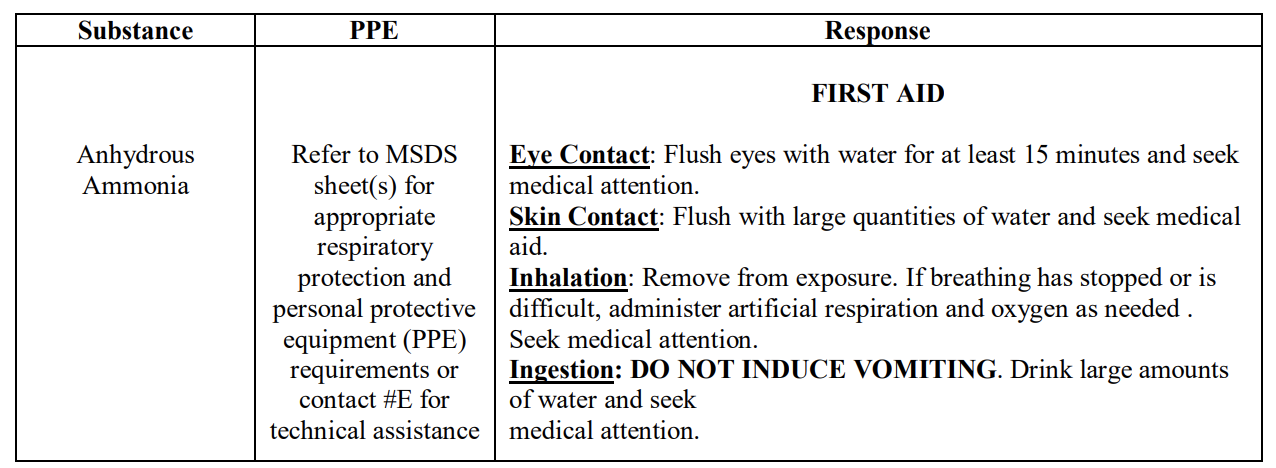
(Ex. R-4 p. 65)
Without any supporting authority, the Secretary argues, “first aid procedures are not the same as decontamination procedures. An emergency responder who wears appropriate personal protective equipment may never need first aid but could still need decontamination. Conversely, a responder receiving first aid could unintentionally harm those trying to assist him if he is not properly decontaminated.” (Compl’t’s Br. at 11 n. 8.)
The facility also maintains a Safety Data Sheet on ammonia (referenced in the ICP), which states:
Section 4. First-aid measures
Eye contact: Immediately flush eyes with excess, low-pressure potable water for at least 15 minutes; lift eyelids in process. Remove contacts ASAP. Seek immediate medical aid. Symptoms: Redness, severe burning & watering of the eyes. Liquid ammonia may cause frost bite. Effects: Possible permanent damage or even blindness.
Inhalation: Remove from exposure. If breathing is difficult or has stopped, provide oxygen or artificial respiration as appropriate. Seek immediate medical aid. Symptoms: Severe burning of nose & other parts of system. Effects: Possible permanent damage to system (including lungs) or even death.
Skin contact: Immediately flush body with excess, low-pressure potable water for at least 15 minutes while removing all contaminated clothing and shoes. Seek immediate medical aid. Symptoms: Burning sensation or even blistering.Liquid exposure may cause frostbite. Wash clothing & shoes before reuse. Effects: Potential severe blistering.
Ingestion: Do not induce vomiting. Have victim drink amount of potable water if conscious. Seek immediate medical aid. Symptoms/Effects: May burn mouth, throat & stomach.Summary: Potable water is preferred in all cases; but, any water is likely to be much better than no water.
(Ex. R-9 at the facility 000561).
The facility’s HAZWOPER Refresher Training also contains two slides providing a definition for decontamination and indicating it shall have a decontamination plan. (See Ex. R-11 at the facility_000025.)
The Court concludes the Secretary has not established the facility’s decontamination procedures were not reasonable under the circumstances, especially since the Secretary acknowledged in the Compliance Guidelines that decontamination procedures and PPE decontamination methods will vary depending upon the specific substance. Further, to the extent the facility’s ICP incorporates by reference information from other documents, such as its safety data sheet for anhydrous ammonia, the Secretary has failed to establish the incorporation was not reasonable under the circumstances. Again, the Secretary proffered no evidence that employers in the facility’s industry would customarily include in their emergency response plans anything more than what the facility has included in its plan. Therefore, the Secretary has not established The facility’s emergency response plan was not “reasonable” under the circumstances and thus, has failed to establish the facility violated § 1910.120(q)(2)(vii). Accordingly, Item 1 must be vacated.
Item 2
Item 2 alleges a violation of § 1910.120(q)(3)(iv) related to procedures for handling emergency response, which requires “[e]mployees engaged in emergency response and exposed to hazardous substances presenting an inhalation hazard or potential inhalation hazard shall wear positive pressure self-contained breathing apparatus while engaged in emergency response, until such time that the individual in charge of the [Incident Command System] determines through the use of air monitoring that a decreased level of respiratory protection will not result in hazardous exposures to employees.” 29 C.F.R. § 1910.120(q)(3)(iv).
The Secretary alleges in Item 2:
[E]mployees responded to an emergency, caused by the release of an unknown quantity of anhydrous ammonia, to the atmosphere. Employees were exposed to levels at or above 50.0 parts per million, on or about 05/23/2017. No positive pressure respirator and monitoring was available and/or provided during response.
Whether Cited Standard Applied
Under the HAZWOPER standard, an “emergency response” is “a response effort by employees … to an occurrence which results, or is likely to result, in an uncontrolled release of a hazardous substance.” 29 C.F.R. § 1910.120(a)(3). The facility argues on the day of the release, the
rovers did not engage in an “emergency response” within the scope of the HAZWOPER standard as “the incident did not result and was not likely to result in an uncontrolled release of anhydrous ammonia.” Instead, the facility argues the release was an “incidental release,” which was “absorbed, neutralized, and otherwise controlled at the time of release with no actual or potential inhalation hazards.” (Resp’t’s Br. at 15.) The Court finds no merit in The facility’s argument.
When an incidental release of a hazardous substance is involved, the HAZWOPER standard provides such responses are not considered to be emergency responses within the scope of this standard “where the substance can be absorbed, neutralized, or otherwise controlled at the
time of release by employees in the immediate release area ….” 29 C.F.R. § 1910.120(a)(3) (emphasis added). Assuming, arguendo, the release was an “incidental release,” the facility nonetheless admits “[s]ome of the ammonia discharged through the pressure relief valve did not
get absorbed into the water in the sump and was released into the atmosphere. Therefore, the release was within the scope of this standard since it was not completely “absorbed, neutralized, or otherwise controlled at the time of release.”
Therefore, § 1910.120(q)(3)(iv) applied to the cited condition.
Whether Employees had Access to Hazardous Condition
Responses to releases of hazardous substances are not considered to be emergency responses “where there is no potential safety or health hazard (i.e., fire, explosion, or chemical exposure)[.]” 29 C.F.R. § 1910.120(a)(3) (emphasis added). The facility argues “[t]he Secretary
presented no evidence that the facility’s rovers were exposed to any safety or health hazard[.]” The “permissible exposure limit” or “PEL” means “the exposure, inhalation or dermal permissible exposure limit specified in 29 CFR part 1910, subparts G and Z.” 29 C.F.R. §1910.120(a)(3). As indicated supra, the parties stipulated OSHA’s PEL for ammonia is 50 ppm averaged over an 8-hour workday. The facility’s expert opined the exposure level was 18.2 ppm over a time-weighted average of eight hours, which is significantly less than the PEL for anhydrous ammonia. She also opined the exposure level at the other ammonia sensors were close to zero given the small amount of anhydrous ammonia released.
The Secretary presented no evidence to rebut this expert testimony. As the Secretary acknowledged in his preamble to the interim final rule adopting the first version of § 1910.120, the established PEL term “is defined to give direction as to the appropriate degree of protection needed to be achieved by personal protective equipment and other similar purposes.” Hazardous Waste Operations and Emergency Response, 51 FR 45654-01. The Court concludes the Secretary has failed to establish the facility employees had access to a hazardous condition since he failed to establish The facility’s employees were exposed to any safety or health hazard, i.e., exposure above the established PEL for ammonia. Accordingly, Item 2 must be vacated.
ORDER
IT IS HEREBY ORDERED THAT Items 1 and 2 of the Citation 1 are VACATED and no penalty is assessed.
SO ORDERED.
/s/ John B. Gatto
First Judge John B. Gatto
CLICK HERE for the case file