
Process Safety and our pipe flanges (type of bolts, threads showing, etc.)

hex head cap screw

As I have said many times before, the world of process safety can be a very confusing and strange sandbox to play in.  There are so many rumors and innuendoes stemming from the fact that our PSM/RMP world is made up of a weave of RAGAGEPs, many of which practicing process safety professional can’t fully understand and apply.  Just recently I was told by a piping contractor that “hex head/cap screw bolts” are prohibited from being used on flanged joints in HAZMAT service (e.g. PSM/RMP processes).  This bolt is prohibited in PSM/RMP flanges?
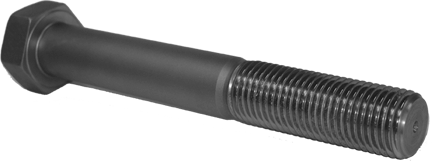
hex head cap screw

Now as you can imagine, my mind goes way back to my days working in chemical and petrochemical plants where the vast majority of our joints were flanged connections; so the statement that hex head/cap screw bolts are prohibited from use caught me off guard.  What was he talking about… “hex head/cap screw bolts are prohibited on chemical processes???”  Has the world gone mad?  Well, his statement does have quite a bit of support… although many will argue that hex head/cap screw bolts and nuts are NOT PROHIBITED – just not recommended either!  Let’s discuss…

First let’s look at ASME B16.5, PIPE FLANGES AND FLANGED FITTINGS for what it says about this:

(emphasis by me)

6.10.3 Bolting Recommendations.

For flange joints, STUD BOLTS WITH A NUT AT EACH END ARE RECOMMENDED FOR ALL APPLICATIONS and especially for high temperature service.


This is where “interpretation” of the word “recommended” comes into play with an ADOPTED RAGAGEP.  Do the “shoulds” become “shalls” in our adopted RAGAGEP?  Many will say yes and many will say no… me?  I always thought I was a “yes”, but then I would be a hypocrite as I have seen many flanged connections at my facilities that were closed with a “hex bolt and nut” and NOT “stud bolts with a nut at each end”. 

Here is an excellent visual from FlowStar showing the differences we are talking about:

flanges org

The image above also does an excellent job of showing us how “full engagement” can be quantified…

flanges modifiedjpg

S = 1/3rd X the bolt diameter (D)

As a worked example, let’s take a 150-pound flange on a 3″ pipe.  This is usually called a “4-bolt flange” as there are only 4 openings on the flange face for bolts to pass thru.  And on this 150-pound 4-bolt flange we will use a 5/8″ (0.625″) diameter bolt that will pass through the 0.75″ diameter hole(s) on the flange face.  So this is what our formula will look like:

S = 0.33 X 0.625

S = 0.206″ of the threaded bolt must be exposed

On this 5/8″ threaded bolt (coarse threads) there are eleven (11) threads per one-inch of the bolt.  This means that in this scenario we would need 2.2 threads showing to meet code.  This can assure us that we do not end up with “short threading” on our nuts.  This is also where the “3-thread showing” rule of thumb comes from.  I was always taught “3-threads showing”, but I worked with some Category M fluids and we just used this as our rule of thumb on all HAZMAT bolting – keeping in mind that having too many threads exposed can ALSO be a compliance/safety issue.


SAFTENG members should also read: 

http://www.safteng.net/index.php/free-section/safety-info-posts/chemical-process-safety-psmrmp/1633-how-many-threads-of-a-bolt-must-be-showing-outside-a-nut-to-meet-ragagep

Scroll to Top