
Sprinklers save lives and they save billions of dollars each year from fire losses; however, if a head is activated accidentally, we can suffer serious damage from all the water and the downtime. So protecting our heads from accidental discharge is as important as protecting them from contamination and delayed activation. In this article, I would like to discuss the question I get often… “What is allowed when I need to shield a sprinkler head from either contamination or hot work heat?” First thing though, before we get into what is allowed, let me demonstrate what is NOT ALLOWED…
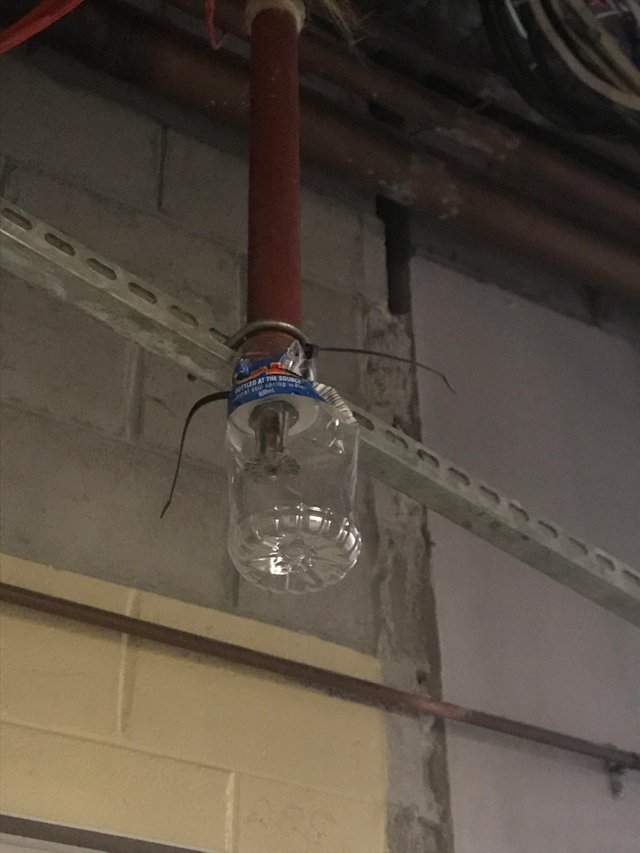
So why is this set up so bad? Well if we had a fire in the area, the heat will melt the plastic container and then shrink up around the fusible link and insulate it, cause a delayed response. So what does OSHA, NFPA, Fire Code(s) allow when we need to protect our heads from contamination or hot work sparks/slag/heat?
First let’s discuss what is allowed to protect sprinkler heads from contamination, such as overspray in a paint booth or in an area where some type of “overspray” is occurring. For years the thought was to use very thin paper bags, thinner than what we would consider a “brown paper lunch bag”. These bags were so thin that you could almost see thru them. But that is “old school” thinking, today we use Cellophane, NOT sandwich bags, but true cellophane bags. I will use my favorite codes and standards as examples of what is allowed:
NFPA 13, Standard for the Installation of Sprinkler Systems
NFPA 25, Standard for the Inspection, Testing, and Maintenance of Water-Based Fire Protection Systems
IFC, 2018, Chapter 35 Welding and Other Hot Work
NOTE: I know that the FM Data Sheets have some additional information, but for some reason, I am unable to access them from this wifi and so I am unable to include their guidance. If someone reminds me later on about this, I will correct and post the FM practice(s).
Let’s start with NFPA 25 and what it permits in spraying areas:
5.4.1.8 Protective Coverings.
5.4.1.8.1 * Sprinklers protecting spray areas and mixing rooms in resin application areas installed with protective coverings shall continue to be protected against overspray residue so that they will operate in the event of fire.
5.4.1.8.2 Sprinklers installed as described in 5.4.1.8.1 shall be protected using cellophane bags having a thickness of 0.003 in. (0.076 mm) or less or thin paper bags.
5.4.1.8.3 Coverings shall be replaced periodically so that heavy deposits of residue do not accumulate.
A.5.4.1.8.1 Typical sandwich bags purchased in a grocery store are generally plastic, NOT cellophane. Plastic bags have a tendency to shrink and adhere to the sprinkler prior to sprinkler activation, creating the potential for disruption of sprinkler spray patterns. Bags placed over sprinklers need to be true cellophane or paper.
NFPA 13:
16.2.4 Protective Coverings.
16.2.4.1 Sprinklers protecting spray areas and mixing rooms in resin application areas shall be protected against overspray residue so that they will operate in the event of fire.
16.2.4.2 * Where protected in accordance with 16.2.4.1, cellophane bags having a thickness of 0.003 in. (0.08 mm) or less or thin paper bags shall be used.
So we can see that NFPA covers the practice of protecting heads from overspray type of contamination, but the question I get most often is “what can I do when I need to protect a sprinkler head when I am doing hot work nearby?”
First, you may have noticed I phrased the question to read “Hot Work nearby” and this was done on purpose. Because NFPA 13, Chapter 29 Existing System Modifications PROHIBITS “torch cutting and welding” as a means to modify or repair sprinkler systems.
29.1.7 Torch cutting and welding shall not be permitted as a means of modifying or repairing sprinkler systems.
So when you get asked about the Hot Work requirement that the sprinkler MUST BE in service during the Hot Work and someone asks… “What if the hot work is on the sprinkler system?” We know have their answer… it will NEVER happen!
We have to turn to the International Fire Code (IFC 2015/2018), Chapter 35, Welding and Other Hot Work to find a permitted practice to shield the sprinkler head from hot work heat, sparks, slag. Here is what the IFC says:
3504.1.8 Sprinkler protection. Automatic sprinkler protection shall not be shut off while hot work is performed. Where hot work is performed close to automatic sprinklers, NONCOMBUSTIBLE BARRIERS or DAMP CLOTH GUARDS shall shield the individual sprinkler heads AND SHALL BE REMOVED WHEN THE WORK IS COMPLETED. If the work extends over several days, the SHIELDS SHALL BE REMOVED AT THE END OF EACH WORKDAY.
The fire code official shall approve hot work where sprinkler protection is impaired.