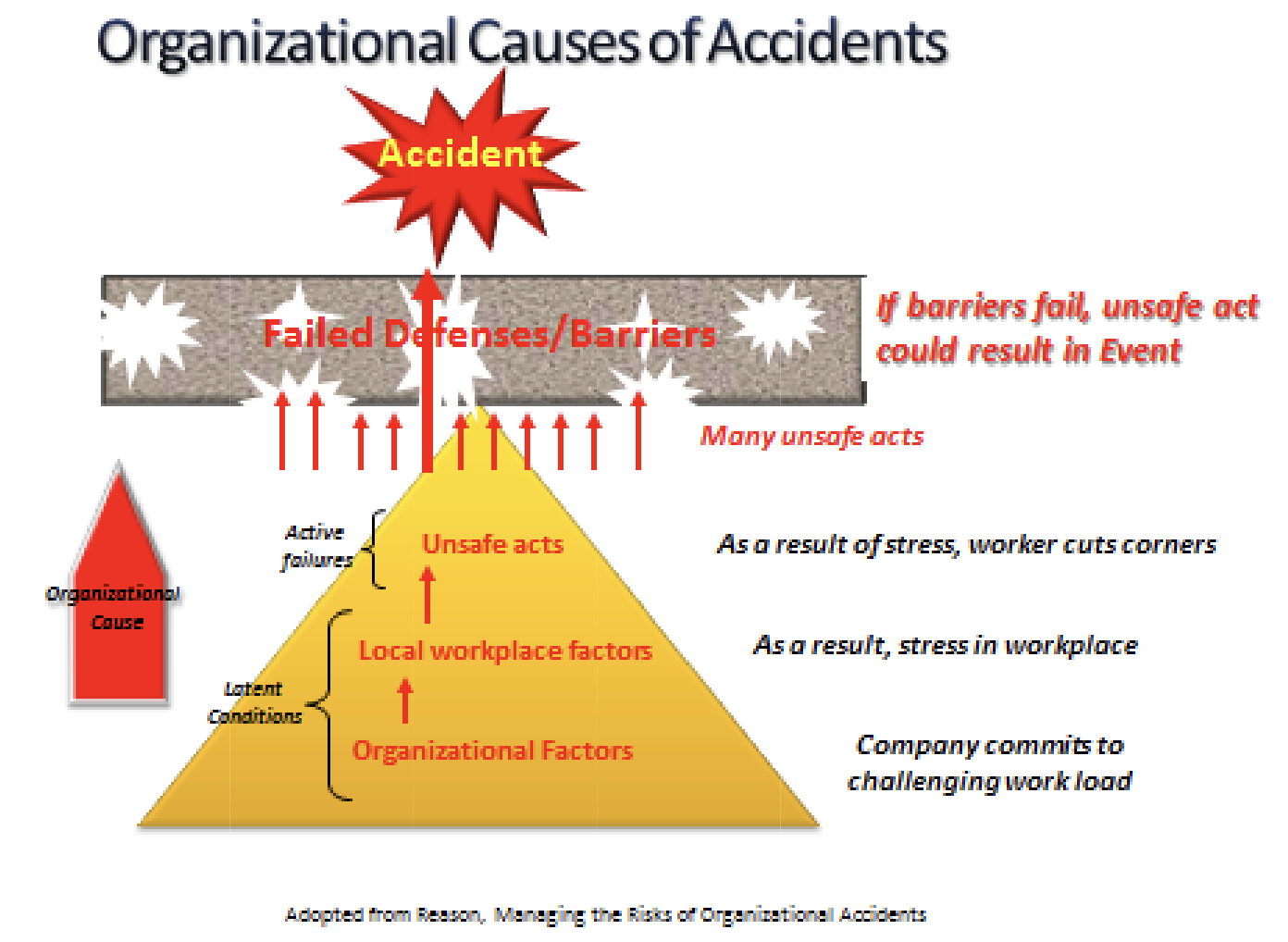
The “Swiss Cheese” model developed by James Reason is an example of the epidemiological model. This is a complex, linear cause-and-effect model where accidents are seen as the result of a combination of
- active failures (unsafe acts) and
- latent conditions (unsafe conditions)
These are often referred to as epidemiological models, using a medical metaphor that likens the latent conditions to pathogens in the human body that lay dormant until triggered by the unsafe act. In this model, accidents are prevented by strengthening barriers and defenses. This model views the accident as the result of long-standing deficiencies triggered by active failures. The focus is on the organizational contributions to the failure and VIEWS HUMAN ERROR AS AN EFFECT INSTEAD OF A CAUSE.
The epidemiological models differ from the sequential models on four (4) main points:
- Performance Deviation – The concept of unsafe acts shifted from being synonymous with human error to the notion of deviation from the expected performance.
- Conditions – The model also considers the contributing factors that could lead to the performance deviation, which directs analysis upstream from the worker and process
deviations. - Barriers – Considering barriers or defenses at all stages of the accident development.
- Latent Conditions – The introduction of latent or dormant conditions present within the system well before any recognizable accident sequence.
The epidemiological model allows the investigator to think in terms other than causal series, offers the possibility of seeing some complex interaction, and focuses on organizational issues. The model is still sequential, with a clear trajectory through the ordered defenses. Because it is linear, it tends to oversimplify the complex interactions between the multitude of active failures and latent conditions. The limitation of epidemiological models is that they rely on “failures” up and down the organizational hierarchy but does nothing to explain why these conditions or decisions were seen as normal or rational before the accident. The recently developed systemic models start to understand accidents as unexpected combinations of normal variability.
[Hollnagel, 2004] [Dekker, 2006]