
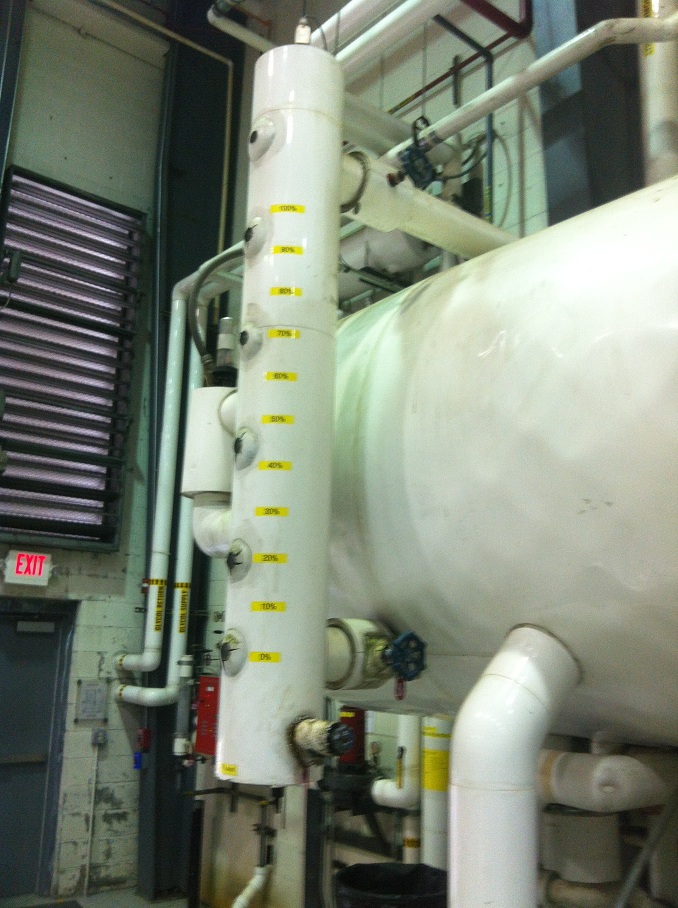
 Car Seal programs have gained some attention in the refrigeration industry over the years, but there is still a significant debate over whether such a program is needed in the industry. A past incident at a client’s facility and the root cause of that incident shine a bright light on the need for a Car Seal program in the industry. This incident occurred during start-up AFTER a shutdown for maintenance on a vessel. Granted, one of the causes of this incident was a poorly written start-up procedure, which should have called out these two (2) safety critical valves, even without a Car Seal program in place. Look at this picture and see if you can identify the two (2) valves involved in this NH3 release via the RVs on a compressor…
The incident went down like this:
When the vessel was emptied and degassed, the two (2) valves used to isolate the sight glass (shown below in the green circles) were closed. Of course, no one remembers closing them, but when the vessel was returned to service, the sight glass remained isolated with these two valves closed. This vessel has a similar design found across the industry, in that the Hi-Level Alarm and Interlock are built into the sight glass, meaning this valving error took out BOTH the manual level indicator and the safety instrumented system (SIS). This is problematic, as the level in this vessel is a critical operating parameter, as in TOO MUCH LEVEL, which leads to liquid carrying over to a compressor, which leads to severe damage and an NH3 release via the compressor(s). And that is precisely what happened.
Although the team assumed the vessel was empty and gas-free, it was later determined that, in fact, the sight glass valves had been closed during the shutdown of this vessel. This was NOT in the SOP but was stated as being a “standard practice” for the facility. This led to the sight glass indicating a level inside the vessel that was the same level that was actually in the vessel when the two valves were closed. This also meant that we unknowingly had trapped liquid in a sight glass while work was being done on a vessel verified as “emptied and gas-free”.
So when the vessel was returned to service, no one thought to OPEN these two valves, and of course, the personnel responsible pointed to the lack of any procedural steps telling them to OPEN these valves or to verify they were OPEN. Forget that there was no procedural step to CLOSE either of these valves, yet we know from video footage that they were indeed closed by a senior technician. As the vessel was put into service, an operator took a level reading and wrote it down on the rounds sheet; however, this level reading was NOT the actual level. Less than 1 hour later, a leak was detected inside the engine room, and substantial damage was found on a compressor.
Here are the two (2) valves that should be considered for Car Sealing OPEN (Green), and the Drain Valve should be considered for Car Seal CLOSED*.
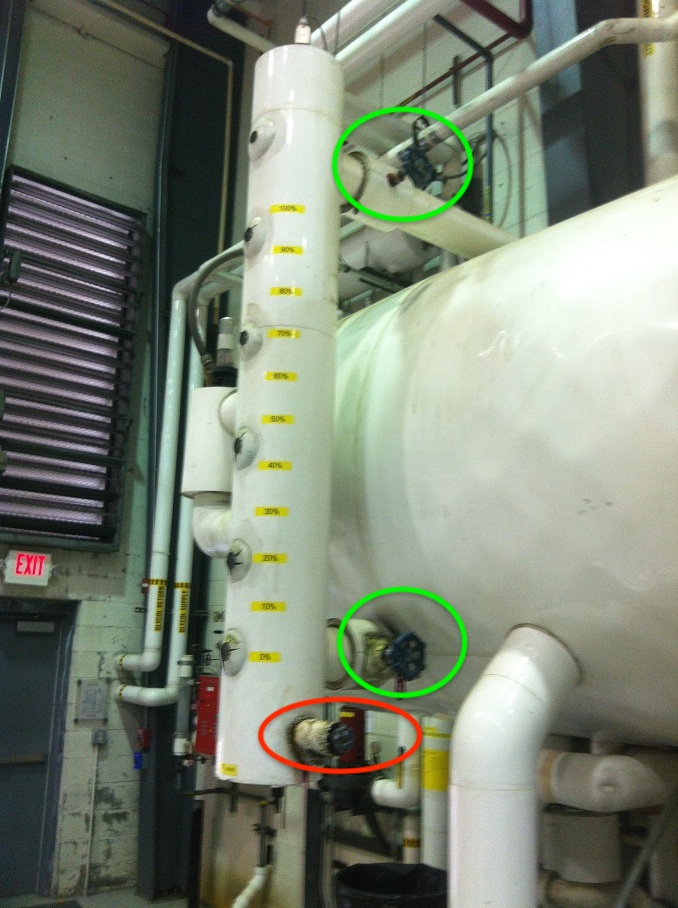
*if deviating the valve’s position leads to an LOPC event, then the valve got car sealed in its SAFE position. In the organizations I worked for as a Safety Engineer/Manager, we car-sealed drains and vents if they were 1/4 turn ball valves, even though we also required plugs/caps on the end of the drain/vent. At one of my plants, we changed out all our vent/drain valves on two extremely hazardous substances from 1/4 turn valves to gate valves to reduce the number of Car Seals that had to be managed. The valve shown in the accident pic below is a gate valve, so in all fairness, we would NOT have CS’ed that valve CLOSED.