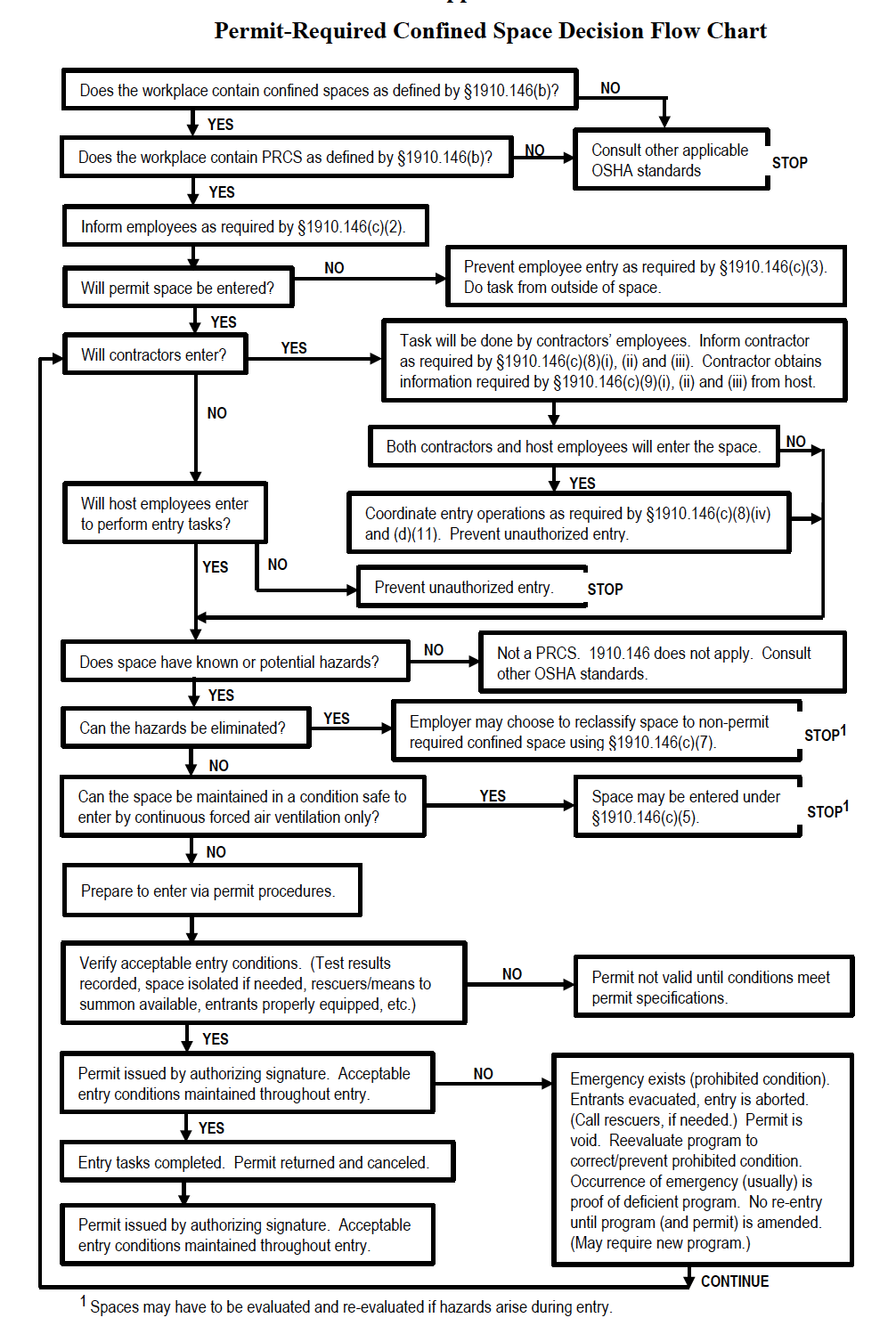
One of the biggest mistakes I see in my auditing and the biggest frustration I have when facilities state they treat all of their confined spaces as PRCS is that most have not recognized the fact that a roll-off trash compactor and/or large palletizers are actually Permit-Required Confined Spaces. For example, we have a large palletizer as shown below, ask yourself… is inside this machine a “Confined Space” and does this Confined Space contain a hazard which would make it a “Permit-Required Confined Space”? Let’s discuss…

I think we can all agree (well most of us) that inside this palletizer we have a space that meets:
(1) Is large enough and so configured that an employee can bodily enter and perform assigned work; and
(2) Has limited or restricted means for entry or exit; and
(3) Is not designed for continuous employee occupancy.
But does this CS have a hazard that makes it a Permit-Required Confined Space?
Watch this video from the manufacturer, paying close attention to their hazard warning signs/labels and the motions (i.e. hazardous energies) within the equipment.
After watching the video, I hope that we can all agree that BEFORE opening any of these doors (i.e. guards) and BEFORE anyone would “break the plane” of these openings that the palletizer would be LOCKED OUT! NOTE: PLEASE do not allow workers under a suspended part of this machine without the PROPER cribbing and being part of the “energy isolation”!!! Many of these newer models have pins/arms that are built into the equipment for this very purpose – KNOW the manufacturer’s “means to isolate” and FOLLOW their instructions!
But how many facilities recognize this type of equipment as a CS/PRCS and would issue an “entry permit” for an employee/worker to break the plane to clear a jammed pallet or correct a package placement?
Remember… this equipment is clearly a CS, AND the simple fact that it will eat anyone alive if they enter it without following LOTO practices makes it a PRCS. Just the fact that the employer places warning signs to “Keep Out” and fully encloses the equipment and on large openings they use light-curtains, tells us that this equipment contains…
(4) Contains any other recognized serious safety or health hazard.
It is this type of mechanical/physical hazard that OSHA intended to address with #4 above in their definition of PRCS.
Some will argue that OSHA did not intend this type of equipment to be covered by 1910.146 and the simply complying the LOTO (1910.147) would apply to this type of equipment. And the history of OSHA compliance and this type of equipment shows no PRCS citations related to accidents where employees were injured/killed inside this type of equipment. So OSHA has shown a pattern of NOT using 1910.146 when employees are injured inside this type of equipment; they use 1910.212 and 1910.147 to cite for the hazards. Why this is, I’m not sure; other than it is an obvious violation of either guarding standards and/or LOTO standard depending on what the employee/worker was doing at the time of the accident.
My position is… this space is a PERFECT candidate for one that can be RECLASSIFIED to a non-PRCS status via LOTO practices. But how many follow 1910.146(c)(7) when employees enter this type of space? Are we following 1910.146(d) – (k)? Are we just locking it out like other machinery? From a safety perspective I would push LOTO, as that is essentially all we would do to “reclassify” the space; however, if our “evaluation of the space” determined the space was indeed a PRCS, then 1910.146(c)(7)(iii) would require us to certify the reclassification and post the certificate at the entry portal (or make available to those entering the space).
So the decision is your’s to make… PRCS? Not a PRCS. Reclassify? Just LOTO. Either way – ENSURE the safety of the worker!