
Incident overview
In an industrial food processing facility, an ammonia leak occurred from the thermal expansion valve diaphragm, that required replacement.
Site, system and components
The thermal expansion valve and diaphragm control the rate of flow of liquid ammonia that feeds the spiral freezer. The freezing temperatures are obtained when liquid ammonia evaporates to vapor in the series of evaporators within the spiral freezer and draws heat energy from within the room. This expansion valve maintains the exact freezing temperatures needed for the quick freeze of a variety of frozen food products that move along a conveyor within the freezer.
Failure scenario(s)
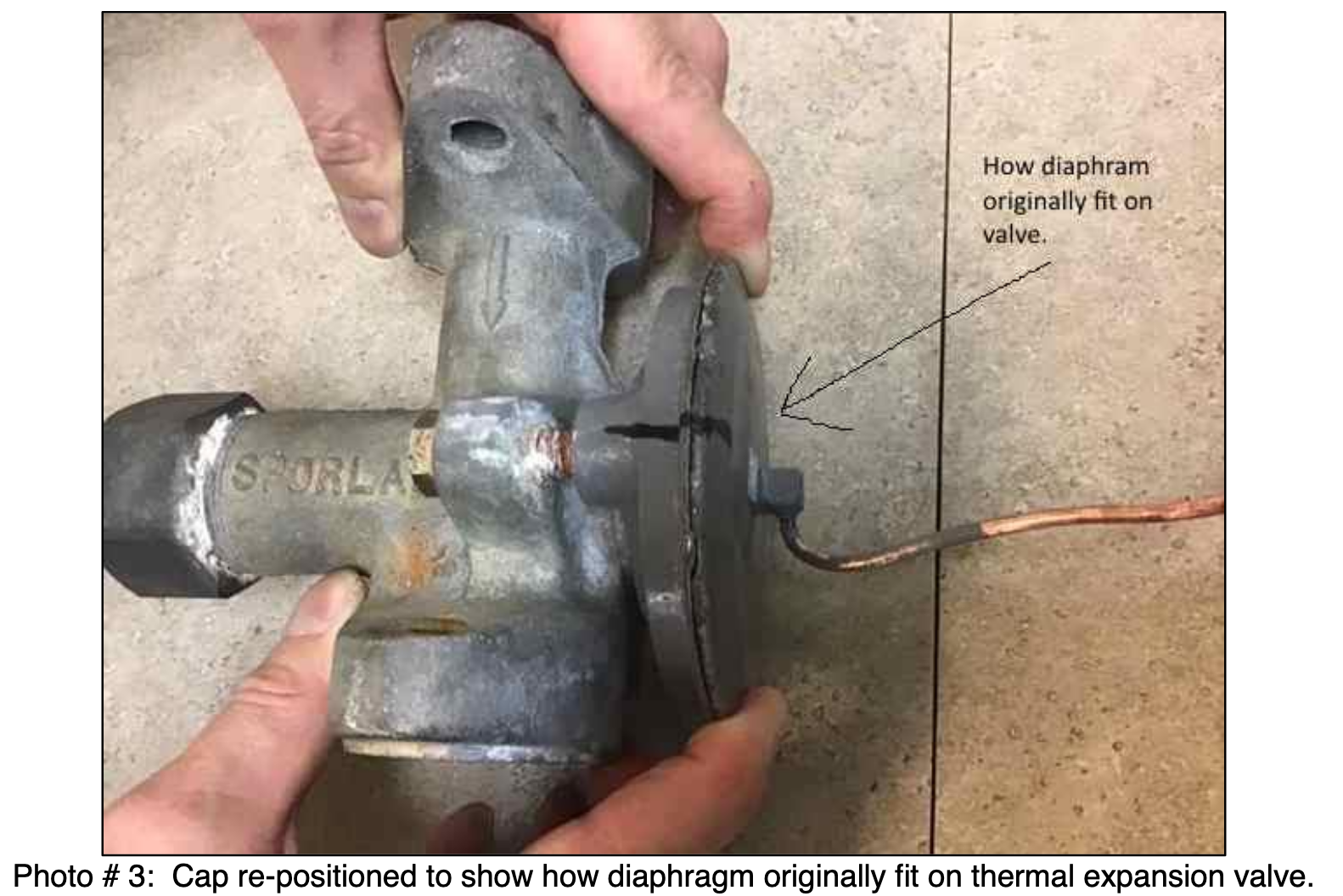
As a result of scheduled maintenance on a liquid ammonia line, ammonia was trapped within an isolated piping line on the downstream side on the thermal expansion valve under the diaphragm. During this maintenance, the trapped ammonia boiled off within the control valve diaphragm increasing the pressure. This increased pressure caused the diaphragm to split apart on the weld as shown in Photo # 2.Photo #3 shows the diaphragm cap in its original position for reference.
Facts and evidence
The Chief Engineer and qualified licensed refrigeration contractor were performing scheduled maintenance on the ammonia line that feeds the expansion valve and diaphragm. Isolation valves on each end were closed and the ammonia removed from the line and captured to be added back later. When maintenance was completed the ammonia supply line and the isolation valves were opened up slowly to re-pressurize the ammonia piping. The Chief Engineer reported there was a delay from the time of pressurization to the actual time a leak was detected by the room sensors. Ammonia sensors then alerted staff by sirens and lights that a leak had occurred in the spiral freezer. The ammonia piping, including the thermal expansion valve, was then isolated to prevent more ammonia from leaking into the spiral freezer. Only after the residual ammonia subsided with the help of ventilation fans in 2 to 3 hours did the qualified refrigeration contractor technicians enter the freezer to assess the repairs required. The expansion valve was replaced and the freezer was back in service within 24 hours.
Photo# 1shows evidence of existing diaphragm corrosion that appears as dark spots compared to the areas of shiny metal that are recent fractures. The presence of corrosion indicates that the age of the thermal expansion valve could have been a contributing factor. There was no mechanical or impact damage evident on the diaphragm. The diaphragm was connected to a flexible 1/8 inch copper line which did not cause undue stress on the diaphragm welds due to its flexibility.
Causes and contributing factors
The most likely the cause of the diaphragm failure is overpressure due to trapped liquid ammonia on the downstream side of the thermal expansion valve that applied an excessive force to the inside of the diaphragm. A contributing factor may be the corrosion noted on the failed soldered edge as less area of the weld was holding the diaphragm together. Also the age of this valve, at 18 years, may have resulted in corrosion to form over an extended length of time and weaken the soldered weld.
Source: https://www.technicalsafetybc.ca/sites/default/files/alerts/E%2010224-788966%20R21-JN-2019.pdf