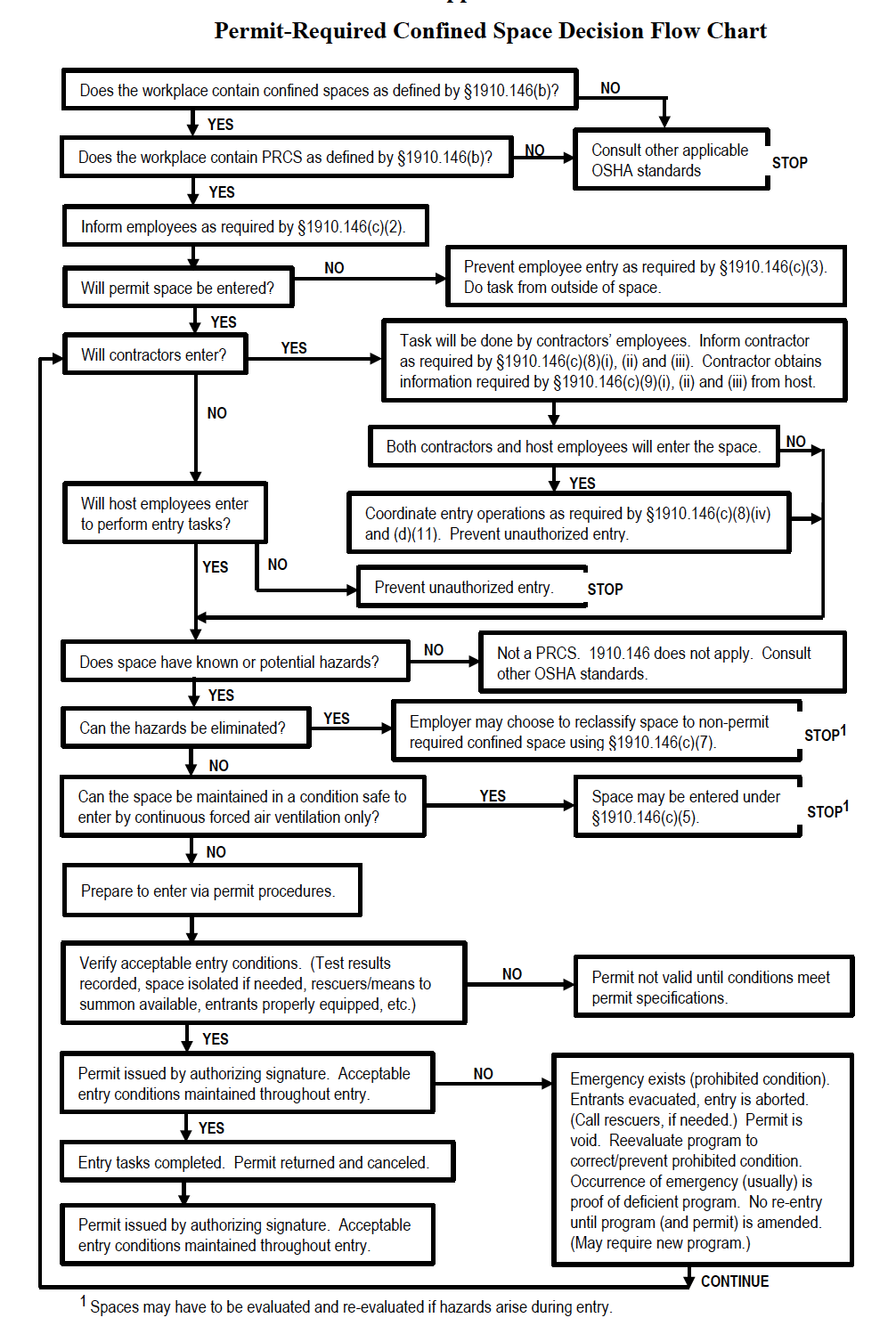
One of the questions that we all seem to get about Confined Spaces is the “service bays” at vehicle repair shops like your quick oil change shops where you position your vehicle over an open pit. Under the floor, there is a room where the technician enters via a set of stairs in order to gain access to the undercarriage of your vehicle. This is easier and safe than lifting the vehicle. These spaces have had some serious accidents in recent years when employees used a solvent for cleaning. These spaces are not Confined Spaces, nor are they Permit-Required Confined Spaces; however, this does not mean that we can not generate a hazardous atmosphere within the space. In this Fatal OSHA Case, a worker was using a solvent to clean the walls of this service pit. This practice should be prohibited in any area that does not provide the MINIMUM ventilation rates as stated on 1910.106(e)(3)(v)(a).
But as with any flammable liquid work, the space/area AND the quantities permitted to be STORED and USED in the area must be controlled. The use of a solvent to clean a large surface area, walls of the pit in this case, in an area that will ACCUMULATE the vapors, under the floor in this case, WITHOUT “adequate ventilation” is about as high-risk as one can get with using flammable liquids to clean. PLEASE understand this same incident could have happened in a basement office! It does not need to be a “service pit” to accumulate the flammable vapors, which are almost always heavier than air. To put the cherry on top of this risk, these vapors require very little energy to ignite. Static electricity is MORE THAN capable of igniting these vapors – such that the static is so weak we would not even feel it. This means the Minimum Ignition Energy for almost all of these solvent vapors is LESS THAN 1 millijoule (mJ) – we do not even feel static until it is around 10-15 mJ!!!! Our movement through air can generate 1 mJ.
So this worker was in a below-level area, using a solvent that had a flash point lower than the temperature in the pit, spreading this solvent across a large surface area (i.e. liberating a lot of vapors to the atmosphere), without adequate ventilation and he died of burns. Sad and tragic event and I am not sure why the only citation issued was regarding the lack of ventilation.
But these events should be learning events for the rest of us! If your facility uses flammable liquids, CONTROL the overall inventory on-site, CONTROL the inventory on each building, each floor, and each fire area! Make sure these areas are PROPERLY DESIGNED for flammable liquids. My guess is that this pit was NOT designed for flammable liquids and such it was not designed as a Class I, Div 2 Hazardous Location (my guess based on my time spent in pits like these). The OSHA case file does not identify the probable ignition source, but in most cases, these pits are expected to have oils and greases in them, and such they would not be a HAZLOC in terms of the electrical wiring for electrical equipment such as lighting.
A lesson to be learned… these pits are NOT normally a Confined Space since they are designed for employee occupancy with lighting and such and are provided stairs for access. Of course, replace the stairs with a ladder and take away the lighting and the electrical outlets and then we would have to RE-THINK our assessment. But in this case, the pit was designed for continuous employee occupancy and did not have a restricted means of entry/exit and yet we still killed a worker who was using a flammable liquid in the space.