
2018 UPDATE: OSHA Inspection Results
|
Violation Summary
|
|||
|---|---|---|---|
| Serious | Other | Total | |
| Initial Violations | 10 | 10 | |
| Current Violations | 4 | 3 | 7 |
| Initial Penalty | $62,101 | $62,101 | |
| Current Penalty | $25,200 | $12,600 | $37,800 |
| Violation Items | |||||||
|---|---|---|---|---|---|---|---|
| Type | Standard | Issuance | Abate | Curr$ | Init$ | Contest | LastEvent |
| Serious | 5A0001 | 07/09/2014 | 03/20/2015 | $6,300 | $6,300 | 07/15/2014 | F – Formal Settlement |
| Serious | 5A0001 | 07/09/2014 | 03/20/2015 | $6,300 | $6,300 | 07/15/2014 | F – Formal Settlement |
| Serious | 5A0001 | 07/09/2014 | 03/20/2015 | $6,300 | $6,300 | 07/15/2014 | F – Formal Settlement |
| Serious | 5A0001 | 07/09/2014 | 11/20/2014 | $0 | $4,501 | 07/15/2014 | F – Formal Settlement |
| Other | 19100023 A05 | 07/09/2014 | 03/20/2015 | $2,700 | $2,700 | 07/15/2014 | F – Formal Settlement |
| Other | 19100111 B03 II | 07/09/2014 | 03/20/2015 | $3,600 | $3,600 | 07/15/2014 | F – Formal Settlement |
| Other | 19100111 B10 IV | 07/09/2014 | 03/20/2015 | $6,300 | $6,300 | 07/15/2014 | F – Formal Settlement |
| Other | 19100134 E01 | 07/09/2014 | 03/20/2015 | $0 | $3,600 | 07/15/2014 | F – Formal Settlement |
| Serious | 19100120 Q01 | 07/09/2014 | 02/29/2016 | $6,300 | $6,300 | 07/15/2014 | F – Formal Settlement |
| Serious | 19100120 Q06 II | 07/09/2014 | 02/29/2016 | $0 | $6,300 | 07/15/2014 | F – Formal Settlement |
| Serious | 19100120 Q03 IV | 07/09/2014 | 08/25/2014 | $0 | $6,300 | 07/15/2014 | F – Formal Settlement |
| Serious | 19100305 G01 IV | 07/09/2014 | $0 | $3,600 | 07/15/2014 | F – Formal Settlement | |
12/31/14 UPDATE: PHMSA Report
PART I – REPORT TYPE
1. Incident Id: I-2014040138
2. This is to report: Hazardous Material Incident
PART II – GENERAL INCIDENT INFORMATION
3. Date of Incident: 03/20/2014
4. Time of Incident (use 24-hour time): 18:15
5. Enter National Response Center Report Number (if applicable): 1077277
6. If you submitted a report to another Federal DOT agency, enter the agency and report number:
7. Location of Incident:
City: TECUMSEH
County: JOHNSON
State: NE
Zip Code: (if known): 68450
Street Address/Mile Marker/Yard Name/Airport/Body of Water/River Mile:
8. Mode of Transportation: FMCSA-HIGHWAY
9. Transportation Phase: UNLOADING
10. Carrier/Reporter:
Name: GREENWOOD FARMERS COOPERATIVE
Street: 304 S 3RD ST
City: ELMWOOD
State: NE
Zip Code: 68349-6114
Federal DOT Id Number: 772286 Hazmat Registration Number: 053113550038V
11. Shipper/Offeror:
Name: GREENWOOD FARMERS COOPERATIVE
Street: 304 S 3RD ST
City: ELMWOOD
State: NE
Zip Code: 68349-6114
Waybill/Shipping Paper: Hazmat Registration Number: 053113550038V
12. Origin (if different from shipper address)
City: HOAG
State: NE
Zip Code: 68310
13. Destination:
City: TECUMSEH
State: NE
Zip Code: 68450
Form DOT F 5800.1 (01-2004) Reproduction of this form is permitted.
14. Proper Shipping Name of Hazardous Material: AMMONIA ANHYDROUS
15. Technical/Trade Name:
16. Hazardous Class/Division: 2.3 POISONOUS GAS
17. Identification Number: UN1005 (E.g. UN2764, NA 2020)
18. Packing Group: (if applicable) II
19. Quantity Released: (Include Measurement Units) 8.355 Gas – Cubic Foot
20. Was the material shipped as a hazardous waste? NO
If yes, provide the EPA Manifest Number:
21. Is this a Toxic by Inhalation (TIH) material? NO
If yes, provide the Hazard Zone:
22. Was the material shipped under an Exemption, Approval, or Competent Authority Certificate? NO
If yes, provide the Exemption, Approval, or CA number:
23. Was this an undeclared hazardous materials shipment? NO
PART III – PACKAGING INFORMATION
24. Check Packaging Type (check only one – if more than one, list type of packaging, copy Part III, and complete for each type: IBC
25. See instructions and enter the appropriate failure codes found at the end of the instructions. Be sure to enter the codes from the list that corresponds to the particular packaging type checked above. Enter the number of codes as appropriate to describe the incident.
Enter the most important failure point in line 1. If there are more than two failure points, provide in this format in part VI.
What Failed: –
How Failed: –
Causes of Failure: –
26a. Provide the packaging identification markings, if available.
Identification Markings: UN 31HA1/Y/1007/USA/+A2503
26b. For Non-bulk, IBC, or non-specification packaging, if identification markings are incomplete or unavailable, see instructions and complete the following:
Single Package or Outer Packaging: Single Package or Inner Packaging (if any):
Packaging Type: Packaging Type:
Material of Construction: Material of Construction:
Head Type (Drums only):
27. Describe the package capacity and the quantity:
Single Package or Outer Packaging: Single Package or Inner Packaging (if any):
Package Capacity: Package Capacity:
Amount in Package: Amount in Package:
Number in Shipment: Number in Shipment:
Number Failed: Number Failed:
28. Provide packaging construction and test information, as appropriate:
Manufacturer: Manufacture Date: null
Serial Number: Last Test Date: null
Material of Construction: (if Tank Car, CTMV, Portable Tank, or Cylinder)
Design Pressure: (if Tank Car, CTMV, Portable Tank)
Shell Thickness: (if Tank Car, CTMV, Portable Tank)
Head Thickness: (if Tank Car, CTMV)
Service Pressure: (if Cylinder)
If valve or device failed:
Type:
Model:
Manufacturer:
29. If the packaging is for Radioactive Materials, complete the following:
Packaging Category:
Packaging Certification:
Certification Number:
Nuclide(s) Present: Transport Index:
Activity:
Critical Safety Index:
PART IV – CONSEQUENCES
30. Result of Incident (check all that apply): – Spillage: NO – Fire: NO – Explosion: YES – Vapor (Gas) Dispersion: NO – Environmental Damage: NO – No Release: NO
31. Emergency Response: The following entities responded to the incident: (Check all that apply)
Fire/EMS Report #: YES
Police Report #: YES
In-house cleanup: NO
Other Cleanup: NO
32. Damages: Was the total damage cost more than $500? NO
If yes, enter the following information: (If no, go to question 33.)
Material Loss: $ 0
Carrier Damage: $ 0
Property Damage: $ 0
Response Cost: $ 0
Remediation/Cleanup Cost: $ 0
(See damage definitions in the instructions)
33a. Did the hazardous material cause or contribute to a human fatality? YES, If yes, enter the number of fatalities resulting from the hazardous material:
Employees: 1
Responders: 0
General Public: 0
33b. Were there human fatalities that did not result from the hazardous material? NO, If yes, how many? 0
34. Did the hazardous material cause or contribute to personal Injury? YES, If yes, enter the number of injuries resulting from the hazardous material:
Hospitalized (Admitted Only):
Employees: 0
Responders: 0
General Public: 0
Non-Hospitalized:
(e.g.: On site first aid or Emergency Room observation and release)
Employees: 1
Responders: 1
General Public: 1
35. Did the hazardous material cause or contribute to an evacuation? NO
If yes, provide the following information:
Total number of general public evacuated: 0
Total number of employees evacuated: 0
Total evacuated: 0
Duration of the evacuation: 0
36. Was a major transportation artery or facility closed? NO, If yes, how many? 0
37. Was the material involved in a crash or derailment? NO, If yes, provide the following information:
Estimated speed (mph): 0
Weather conditions:
Vehicle overturned? NO
Vehicle left roadway/track? NO
PART V – AIR INCIDENT INFORMATION (please refer to S 175.31 to report a discrepancy for air shipments)
38. Was the shipment on a passenger aircraft? If yes, was it tendered as cargo, or as passenger baggage?
39. Where did the incident occur (if unknown, check the appropriate box for the location where the incident was discovered)?
40. What phase(s) had the shipment already undergone prior to the incident? (Check all that apply)
– Shipment had not been transported – Transported by air (first flight)
– Transport by air (subsequent flights) – Initial transport by highway to cargo facility
– Transfer at sort center/cargo facility
PART VI – DESCRIPTION OF EVENTS & PACKAGE FAILURE
– Describe the sequence of events that led to the incident and the actions taken at the time it was discovered. Describe the package failure, including the size and location of holes, cracks, etc. Photographs and diagrams should be submitted if needed for clarification. Estimate the duration of the release, if possible. Describe what was done to mitigate the effects of the release. Continue on additional sheets if necessary.
Describe:
AROUND 6:00 PM A LOAD OF ANHYDROUS AMMONIA ARRIVED IN TECUMSEH TO FILL THE BULK PLANT. AROUND 6:15 PM AN IBCA SHUTTLE FILLED WITH 200 GALLONS OF WATER BURST. THE IBCA WAS BEING USED AS A STATIONARY BLEED OFF TANK TO REMOVE PRESSURE FROM THE BULKHEAD USED TO TRANSFER ANHYDROUS AMMONIA FROM THE TRANSPORT TO THE BULK FACILITY. THE AMMONIA WAS TRANSFERRED INTO THE IBCA THROUGH THE BOTTOM OF THE TANK VIA 3/8′ HOSE. IT WAS LEARNED THROUGH INTERVIEWS THAT THE BLEEDER VALVE ON THE BULK PLANT THAT RAN TO THE IBCA WAS LEFT ON DURING THE TRANSFER. UNDER NORMAL FILLING PROCEDURE THIS VALVE IS TO BE LEFT OFF. THE PUMPING OF ANHYDROUS DIRECTLY INTO THE IBCA CAUSED THE CONTAINER TO BECOME PRESSURIZED AND THEN BURST. AROUND 6:20 PM ALL VALVES ON THE TRANSPORT AND BULK FACILITY WERE TURNED OFF STOPPING ANY FURTHER RELEASE. THE FOLLOWING DAY IT WAS DISCOVERED THAT THE LID HAD BEEN SECURED TO THE TOP OF THE IBCA WHICH LIMITED THE CONTAINERS ABILITY TO VENT.
PART VII – RECOMMENDATIONS/ACTIONS TAKEN TO PREVENT RECURRENCE
– Where you are able to do so, suggest or describe changes (such as additional training, use of better packaging, or improved operating procedures) to help prevent recurrence.
Provide recommendations for improvement to hazardous materials transportation beyond the control of your individual company. Continue on additional sheets if necessary.
Describe:
ANY IBCA’S USED GOING FORWARD WILL HAVE HOLES DRILLED IN THE TOPS TO VENT ANY PRESSURE THAT BUILDS UP IN THESE CONTAINERS WORKPLACE PROCEDURE WILL BE MODIFIED TO INCLUDE THE LOCATION OF THE BLEEDER VALVE TO ENSURE IT GETS TURNED OFF DURING THE FILLING PROCESS.ONCE PROCEDURES ARE UPDATED EMPLOYEES WILL BE TRAINED ON THE UPDATE.
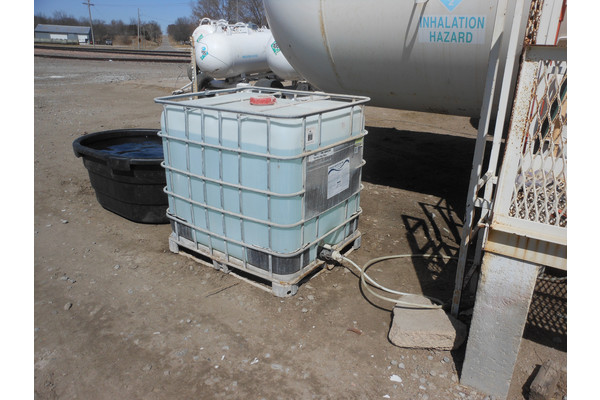
08/08/14 UPDATE – w/ Scene Photos from NE Fire Marshal Report. Now this incident makes COMPLETE sense and we can now understand how this incident was first called an “explosion”. Technically, this incident was an explosion, just not one with an ignition. A VERY COMMON practice for unloading ammonia is to bleed the unloading hoses to a water bath. Often times this “water bath” is a crude/simple arrangement and more often than not a DOT “tote” is used as the “bath”. A hose is attached to the tote, or in many cases merely lowered down into the water via an open top. This hose allows the ammonia left in the unloading system to be “scrubbed” by the water in the tote before disconnecting the hoses. There are TONS of issues when this “set up” does not meet any type of RAGAGEP or have any solid “design basis” and as this incident shows us, this entire water bath, which is often times not considered part of the PSM/RMP covered process, can fail and result in horrific outcomes for the workers and off-site.
Nebraska State Fire Marshal’s Office report states the accident resulted due to the following causes:
- The bleed-off valve on the liquid valve at the load-in bulkhead was accidentally left in the open position when the liquid and vapor hoses from the semi-transport were connected. (HUMAN FACTORS)
- When the primary liquid valves were opened and the transport pump was started, high-pressure liquid anhydrous ammonia was allowed to enter the plastic bleed-off water tank through the open bleed-off valve.
- This high-pressure liquid anhydrous ammonia vaporized within the plastic water container, which led to an over-pressurization and eventually an explosive rupture of the container.
- This type of plastic container is not designed to be capable of holding pressure as a pressure vessel.
- It should be noted also that there is NO regulatory requirement that the bleed-off water tank be a pressure vessel or that the tank be vented.
- Once the container was destroyed, the liquid anhydrous ammonia was free to vaporize and escape to the atmosphere, creating a vapor cloud.
- This anhydrous ammonia release continued until an employee was able to close the bleed-off valve.
CLICK HERE (pdf) for the scrubbed Report (names removed) from the NE Fire Marshal’s office.
CLICK HERE (pdf) for the scrubbed Accident Photos (not all the photos from the original report)
A common procedure at facilities unloading anhydrous ammonia is to vent hoses with ammonia liquid or vapor into a plastic bleed-off water tank to absorb ammonia into the water.
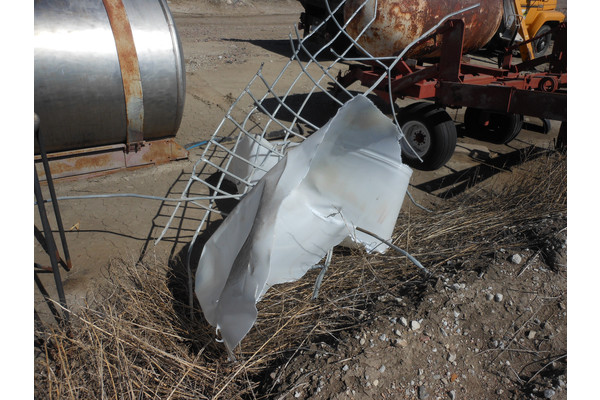
Below is the twisted metal cage and ruptured plastic atmospheric container damaged by expanding vapor within the bleed-off water tank from the fatality in Tecumseh, NE.
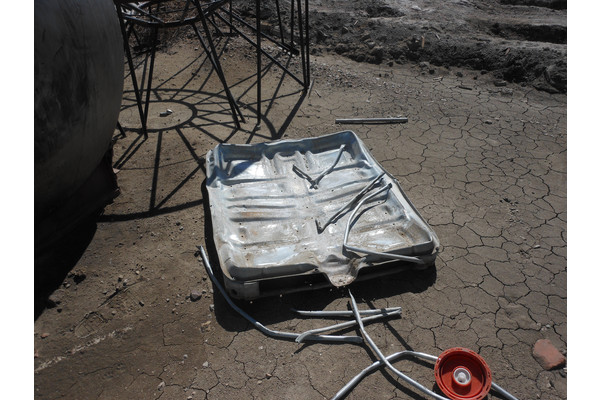
Base of the bleed-off water tank in Tecumseh, NE, following the over-pressurization tank rupture.
07/16/2014 UPDATE -After the death in March of a truck driver, OSHA has cited the grain handling facility for 12 serious safety violations. The driver was overcome by anhydrous ammonia vapors while transferring the liquid from a semi-truck to bulk storage tanks on March 20. He later died at the hospital from complications related to the ammonia inhalation. Three other workers, a second employee walked into the cloud, employee of BNSF Railway who was performing maintenance on the adjacent railroad tracks, and a deputy sheriff were injured. OSHA proposed penalties of $62,101. According to OSHA’s account of the accident, a 250-gallon tank ruptured, releasing anhydrous ammonia into the atmosphere and exposing the 63-year-old driver, who had worked at the facility for more than 10 years, to an ammonia vapor cloud. Several were violations of OSHA’s Storage and Handling of Anhydrous Ammonia Standards, such as failing to provide an ammonia control system; to provide employees with chemically impervious clothing; to inspect and maintain ammonia equipment and piping to prevent potential leaks and system failure; and to develop and train workers in an emergency response plan. The company was also cited for storing the chemical in tanks within 100 feet of a mainline railroad track. Other violations involved respiratory protection standards.
https://www.osha.gov/pls/oshaweb/owadisp.show_document?p_table=NEWS_RELEASES&p_id=26367
Those who read my Weekly Incident Alerts saw two (2) Anhydrous Ammonia fatalities last week:
#1 at a fertilizer facility and
#2 at an Ice Plant outside of the USA.
BOTH of these fatalities were from OVEREXPOSURE to NH3 caused by a Loss of Primary Containment (LOPC). The incident outside the USA was confirmed by the area coroner and I have been asking around about the incident within the USA. The USA incident was first reported as an “explosion” so I began asking if this were a NH3 ignition event or a catastrophic failure of a pressure vessel. It turns out there was not really an explosion at all; but something did happen that caused a pressure wave, rattling windows of nearby homes and businesses, who then reported the incident as an “explosion”. I contacted the Johnson Country Attorney as she was quoted in many of the news publications and a DOT PHMSA contact for insights as to what really happened. Both were kind enough to respond and this is what they said:
(emphasis added by me)
Mr. Haywood,
An investigator from our Central Region office was looking into this incident. The incident happened during the off-loading of a cargo tank into a fixed storage tank, and was caused by human error. There was NO ignition or explosion, and there were NO issues with the cargo tank. The incident is currently under investigation by OSHA and EPA.
Hope this is of some help.
Regards,
XXXXXXXXXXX
Acting Director, Southwest Region
Hazardous Materials Safety, Field Operations
Pipeline and Hazardous Materials Safety Administration
U.S. Department of Transportation
8701 S. Gessner Road, Suite 900
Houston, TX 77074
713-272-2811
I do NOT believe that there was an ignition or flames, nor did the employee die from burns. Rather, it was a rapid release of ammonia which was under pressure. It was released with enough force to shake the windows of another business several hundred feet away, and after hearing the “boom,” that business owner called 911. The employee who died, died over 4.5 hours later, and I believe it was as a result of inhaling anhydrous ammonia.
XXXXXXXX Smith
Johnson County Attorney
The fertilizer season is among us and thus tons of NH3 will be handled on a daily basis for the next several months. Although we do not have ALL the facts of this UNLOADING ACCIDENT, we should still remind our employees of the hazards associated with handling Anhydrous Ammonia and the INCREASED hazards they face while LAODING or UNLOADING via TEMPORARY CONNECTIONS.
One thing to consider is the DOT/PHMSA Data regarding these Loading/Unloading accident involving hazardous materials, especially NH3. SAFTENG members can CLICK HERE to see this data from my 2013 analysis.
OSH ACT of 1970 Section (5)(a)(1): The employer did not furnish employment and a place of employment which were free from recognized hazards that were causing or likely to cause death or serious physical harm to employees in that employees were exposed to severe burns, lacerations, and pulmonary edema from anhydrous ammonia not properly controlled by the ammonia storage and transfer system.
The ammonia control system was not designed to prevent anhydrous ammonia from entering or leaving the process at an unintended time, rate, or path.
A bleeder valve was left open during transport truck anhydrous ammonia delivery, causing a large amount of ammonia to enter and violently rupture an aluminum caged plastic IBC tote filled with water. The IBC tote rupture released ammonia and the delivery driver suffered fatal injuries and other workers, including a facility employee, a responding deputy sheriff, and a railroad worker required treatment for ammonia exposure.
AMONG OTHER METHODS, FEASIBLE AND ACCEPTABLE METHODS TO CORRECT THIS HAZARD ARE:
1) Properly design storage and transfer system controls that prevent anhydrous ammonia from entering or leaving the process at an unintended time, rate or path per NFPA 400 (2013) Hazardous Materials Code – 6.1.4.2.2 as adopted by Nebraska State Fire Marshal per NAC 477.281.
2) Design and install system controls that prevent ammonia from entering the water container during the truck transport unloading operation such as installing a “deadman” type bleeder valve.
3) Design and install a water container to capture remaining ammonia, after the completion of the ammonia transfer operation, that does not allow the accumulation of pressure, such as an open top tank.
4) Develop detailed site specific standard operating procedures, regarding the safe handling of anhydrous ammonia during all procedures, including the proper position of all system valves.
5) Ensure all employees that engage in the handling of anhydrous ammonia are thoroughly trained and retrained periodically on each location’s standard operating procedures for the safe handling of anhydrous ammonia.
OSH ACT of 1970 Section (5)(a)(1): The employer did not furnish employment and a place of employment which were free from recognized hazards that were causing or likely to cause death or serious physical harm to employees in that employees were exposed to skin/body injuries including severe burns, frostbite or death from liquid and/or vapor anhydrous ammonia while responding to a release without wearing chemical impervious clothing.
Employees responding to an ammonia release on or about March 20, 2014, did not wear chemical impervious clothing while shutting ammonia valves and turning off equipment at the accident site. Protective slicker(s) and/or protective pant(s) and jacket(s) that are impervious to ammonia were not available on site at the facility.
AMONG OTHER METHODS, FEASIBLE AND ACCEPTABLE METHODS TO CORRECT THIS HAZARD ARE:
1) Provide protective slicker(s) and/or protective pant(s) and jacket(s), all impervious to ammonia at permanent ammonia storage locations per ANSI K61.1 (1999)/CGA G-2.1 (1999) – 3.4.1.4 as adopted by Nebraska State Fire Marshal as Title 153, NAC Chapter 14.
2) Provide an adequate number and sizes of slickers and/or pants and jackets for potential employee exposure to ammonia at permanent ammonia storage locations.
3) Develop inspection protocols to ensure ammonia protective clothing remains available and in good condition at permanent ammonia storage locations.
4) Train employees on the location of impervious clothing at permanent ammonia storage facilities and the appropriate procedures to use the protective clothing.
OSH ACT of 1970 Section (5)(a)(1): The employer did not furnish employment and a place of employment which were free from recognized hazards that were causing or likely to cause death or serious physical harm to employees in that employees are exposed severe burns, tissue damage, or pulmonary edema from gas and/or liquid anhydrous ammonia from the potential failure of the ammonia piping system and its components.
The ammonia piping system, components, and appurtenances had extensive peeled paint and external corrosion. Internal seals for the ammonia pump for filling nurse tank leaked during the inspection.
AMONG OTHER METHODS, FEASIBLE AND ACCEPTABLE METHODS TO CORRECT THIS HAZARD ARE:
1) Properly maintain equipment including ammonia piping systems and system pumps/compressors in an operable condition per NFPA 400 (2013) Hazardous Materials Code – 6.1.16.1 as adopted by Nebraska State Fire Marshal per NAC 477.281.
2) Remove external corrosion and properly paint/coat ammonia piping and system components.
3) Develop inspection protocols to examine for corrosion and paint failure of the ammonia piping system to decrease the likelihood of accidental release.
4) Inspect and maintain ammonia system pump(s)/compressor(s) as required by the manufacturer.
5) Train employees to properly inspect and document external ammonia piping system and paint failure.
6) Develop and implement regular maintenance schedules for ammonia piping systems, components, appurtenances, and storage vessels.
OSH ACT of 1970 Section (5)(a)(1): The employer did not furnish employment and a place of employment which were free from recognized hazards that were causing or likely to cause death or serious physical harm to employees in that employees are exposed to crushing injuries, struck-by injuries, severe burns, tissue damage, or pulmonary edema from potential train derailment, flying debris, sparks, and gas and/or liquid anhydrous ammonia from release.
Four permanent anhydrous ammonia storage tanks, ranging in capacity from 12,000 to 15,000 gallons, are each located closer than 100 feet to a Class 4 (per 49 CFR 213.9) mainline of a railroad. Trucks transporting approximately 40,000 pounds of anhydrous ammonia also unload in the area between tank #4 (north end closest to tracks) and the railroad mainline.
AMONG OTHER METHODS, FEASIBLE AND ACCEPTABLE METHODS TO CORRECT THIS HAZARD ARE:
1) Relocate anhydrous ammonia storage tanks to a minimum 100 feet of separation between the tanks and the mainline of the adjacent railroad per ANSI K61.1 (1999)/CGA G-2.1 (1999) – Table 3 as adopted by Nebraska State Fire Marshal as Title 153, NAC Chapter 14.
2) Contact railroad about potential relocation of the adjacent mainline to a minimum separation distance of 100 feet between the anhydrous ammonia storage tanks and the railroad mainline.
3) Protect transport drivers, other workers, and tanker trucks during anhydrous ammonia transfer operations between the railroad tracks and ammonia storage tank #4.