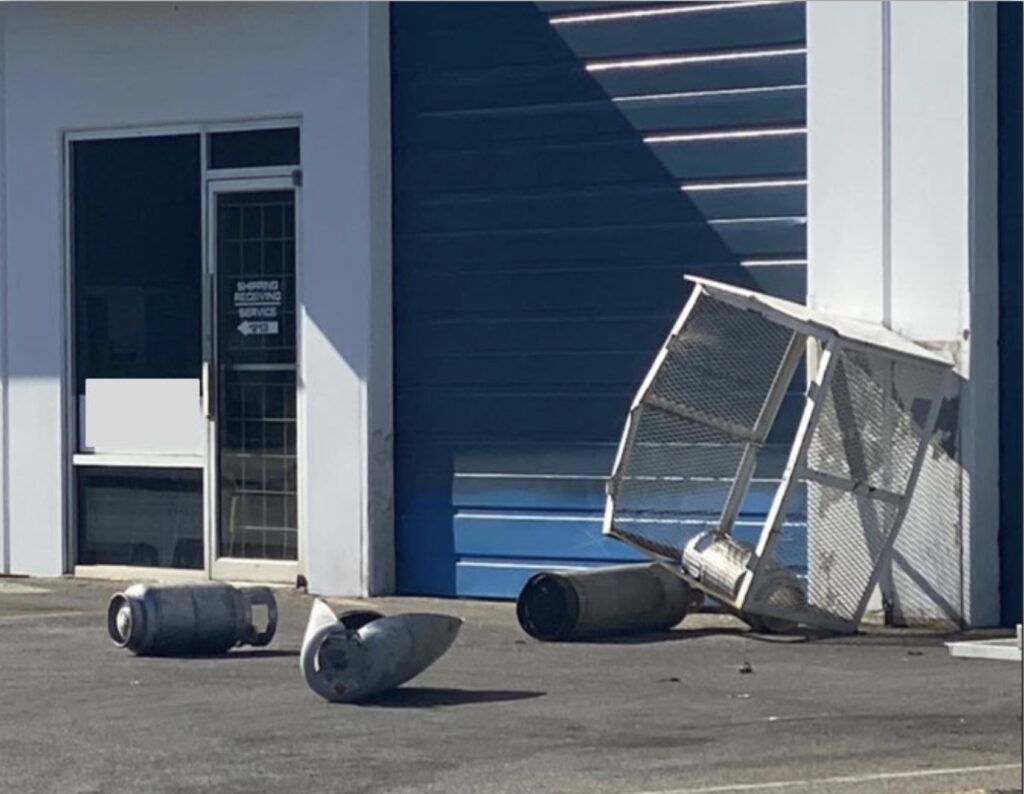
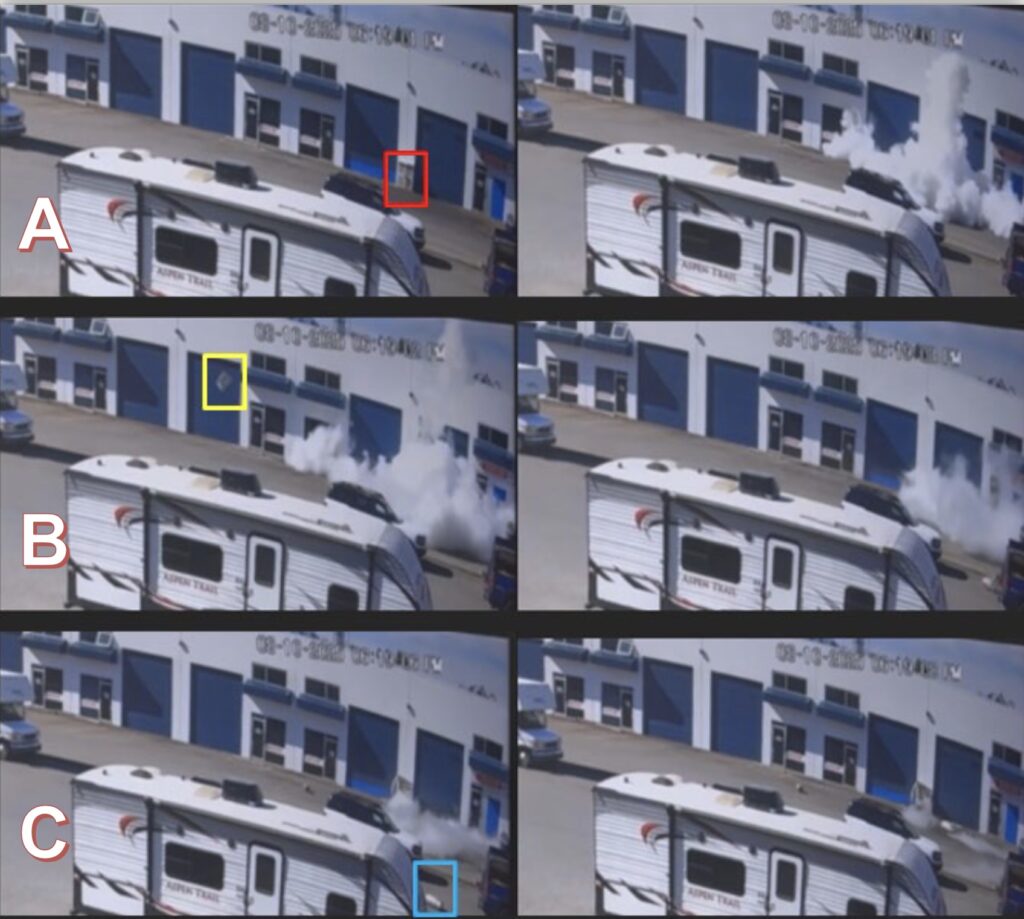
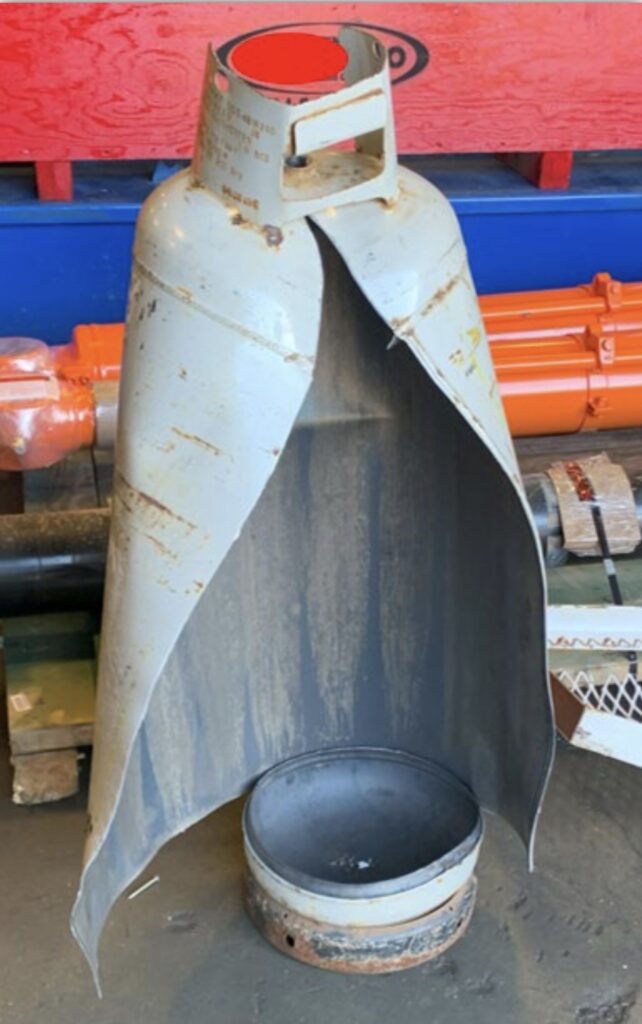
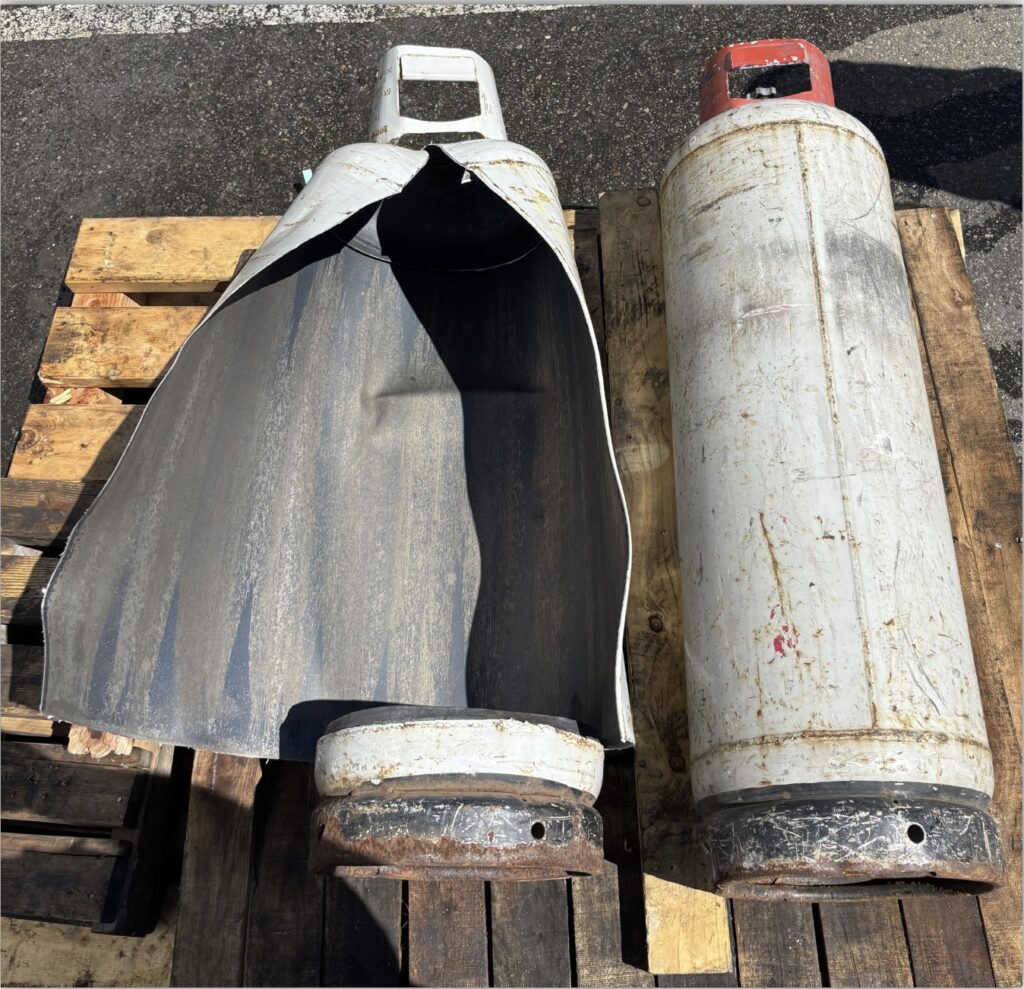
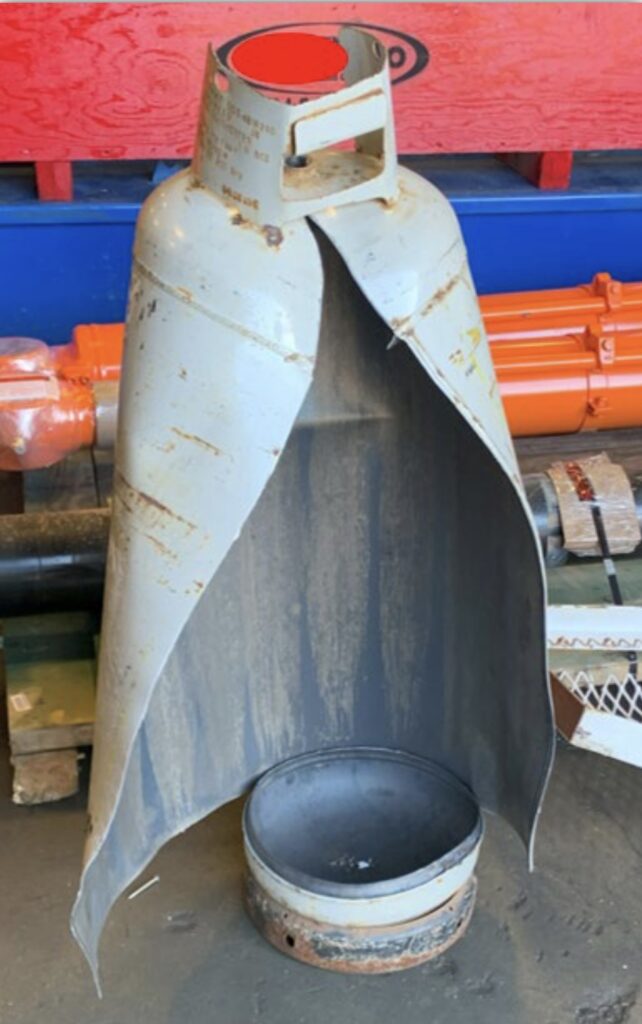
An error in “requalification” of the 60-pound cylinder and an “overfilling event” led to the spectacular catastrophic failure of the 60-pound cylinder. The 60-pound propane cylinder split open instantly, releasing all of its contents. The force of the explosion ripped the metal cylinder cage door off its hinges, dented and deformed other propane cylinders in the cabinet, and propelled multiple cylinders across a parking lot. Seven (7) propane cylinders were stored in a metal cylinder storage cabinet outside of a commercial business in a business park. One full 60-pound propane cylinder in the cabinet suffered a catastrophic pressure boundary failure and split open instantly, releasing all the propane contained inside.
Propane is stored as a liquid under pressure in tanks or cylinders and is typically used by appliances as a gas. Cylinders are always filled to a maximum level of 80% liquid, leaving space to allow for liquid expansion. Pressure is equalized between the liquid and gas phases and rises with increasing temperature.
During use, gas is withdrawn from a cylinder, reducing the pressure, and the liquid boils and vaporizes until the pressure within the cylinder equalizes. Liquid propane expands to 270 times its volume when it converts from liquid to gas. Pressure relief valves on propane cylinders are safety devices designed to protect the cylinder from over-pressurization. They are typically located in the gas space near the top of the cylinders and remain sealed under normal conditions, keeping the propane safely contained. If the internal pressure exceeds the set pressure, often due to overfilling or heat exposure, the valve automatically opens to release gas, reducing the pressure to a safe level. Once the pressure drops back below this threshold, the valve’s spring closes it and stops the release. For standard propane cylinders, this valve is usually set to open at around 375 psi (25.8 bar).
Since 2008, Canadian regulations have required all refillable propane cylinders with capacities of 4 to 40 pounds to be equipped with a valve featuring an Overfill Prevention Device (OPD) to enhance safety. An OPD is a special valve mechanism that automatically stops filling the cylinder when it reaches about 80% capacity, preventing overfilling. These valves are identified by their triangular-shaped handwheel and the letters “OPD” stamped on the valve itself. This safety feature
helps protect against the risk of propane release due to overfilled tanks. Propane cylinders over 40 pounds are NOT required to have an OPD safety device.
In Canada, portable propane cylinders, regulated by Transport Canada, must not be filled unless they are recertified every 10 years from the date of manufacture. This process involves a visual inspection for damage, corrosion, and leaks, and includes replacing the pressure relief valve. Only certified facilities are authorized to perform this requalification, and once complete, the cylinder is stamped with a new date indicating its extended usability. In contrast, propane tanks, which are larger, stationary vessels, are built to ASME standards and do not require recertification in the same way. These tanks are considered permanent installations and are subject to different inspection protocols, such as periodic checks by qualified professionals, but they are not governed by the 10-year expiry rule that applies to cylinders.
Persons who fill and recertify cylinders in BC must complete training modules from third-party providers recognized and approved by the authority having jurisdiction (Technical Safety BC).
Failure scenario(s)
The 60-pound propane cylinder was originally manufactured in September 2005. The cylinder was designed and manufactured to meet the TC-4BWM specification and other requirements from the CSA B-339 standard.
The cylinder was in regular service until it exceeded its 10-year certification period from the date of manufacture. The cylinder was recertified on April 17, 2019, at a facility registered with Transport Canada by an employee holding a training certification from the Canadian Propane Association’s Propane Training Institute (PTI) for “Cylinder inspection and re-qualification of propane cylinders”. During the recertification, the original cylinder service valve, which included an appropriately sized relief valve and a fixed liquid-level gauge dip tube, was replaced with an incorrect service valve lacking a relief valve or a fixed liquid-level gauge.
The installation of the service valve rendered the cylinder unprotected from excessive pressure that could damage it. The cylinder was returned to service and remained in service for over 6 years without overpressure protection. Visual inspections of the cylinder during each fill and transport never identified the missing required relief valve. Although the company’s procedure for recertifying cylinders did not specifically address the correct selection of valves for the cylinders being recertified, it did require pre-requisite training and competencies from the approved third-party training modules, including the 100-04 Cylinder Inspection and Re-Qualification, which does cover the correct selection of service valves.
In Summer 2025, the cylinder was overfilled at a commercial propane bulk plant and cylinder filling facility. 60-pound cylinders are uncommon in the company’s region and are infrequently filled at the facility. All employees filling cylinders at the facility had the required recognized certifications for transferring propane into cylinders and had been trained in the company’s safety procedure for filling propane cylinders by weight. The cylinder was filled by weight using scales at the propane supplier’s cylinder-filling dock. The cylinder filling scales all utilize Fisher N201 automatic cylinder filling valves, which stop the flow of propane into a cylinder when the scale beam rises, when it reaches the scale’s set weight, and contacts a microswitch, triggering the valve. During filling of the cylinder, it is likely that either an incorrect scale setting or a non-functioning automatic cylinder fill valve resulted in the propane cylinder being overfilled to likely above 95% full. The overfilled cylinder was stored on the dock in a storage area with other filled cylinders until it was loaded onto a cylinder delivery truck, transported, and delivered to the client’s location on July 31, 2025, ten (10) days before the incident. The cylinder was placed inside a locked metal cylinder storage cabinet with six (6) other propane cylinders outdoors in front of the client’s facility.
At the client’s facility, there were two (2) other 60-pound propane cylinders connected for use inside the building, but there had not yet been a need to replace them, so the overfilled cylinder remained in the outdoor storage cabinet until the incident. On August 10th, the day of the incident, it was a Sunday, and the client’s business, along with several neighboring businesses in the commercial business park, was not open. This reduced the number of people, mobile equipment, and vehicles that would have typically been in the area of the cylinder storage cabinet during the week when the businesses were open. The ambient outdoor temperatures in the area had steadily increased over the past 5 days, rising from a high of 21°C (70°F) to 30°C (86°F) on the day of the incident.
Although the cylinder had not had a pressure relief valve for over 6 years of service, proper filling would have prevented its internal pressure from exceeding the required relief valve set pressure of 375 psi during typical storage and use. When the cylinder was overfilled, the temperature rise reached a point where the tank became “liquid full,” and the thermal expansion of the liquid inside quickly spiked the internal pressure beyond the cylinder’s burst pressure (Chart 1). The pressure likely exceeded the manufacturer’s required test pressure without bursting, reaching up to 1500 psi (four times the service pressure). The cylinder split open, and the propane within it rapidly converted from liquid to vapor, causing a BLEVE explosion that blew the door off the cylinder cabinet and damaged and scattered the other propane cylinders from the cabinet across the parking lot.
Facts and evidence
Statements
Propane customer
- They use the 60-pound propane cylinders for handheld torches for their business process.
- Two 60-pound cylinders are typically stored indoors, attached to the torches, and two full cylinders are typically stored in a locked cylinder cabinet outdoors for replacements.
- The incident happened on a Sunday when they weren’t open, and there were no employees around.
- The only damage was to the cylinder cage and cylinders inside. There was no damage to the building or surrounding vehicles.
Propane supplier
- They have documented safe working procedures, including:
o Safe filling of propane cylinders by weight.
o Recertification of propane cylinders.
o Handling of an overfilled cylinder. - The employee who recertified the cylinder was experienced, trained, and qualified to do so when they installed the new valve in the cylinder in 2019.
- 60-pound cylinders are uncommon, and only approximately 12 are infrequently filled at the filling location where the cylinder was filled.
- When cylinders are filled at the location, they are placed on a scale, and the scale is manually set to tip at the weight of the empty cylinder plus the weight of the fill nozzle and 42% of the water capacity stamped on the cylinder’s collar which is the weight of the liquid propane when the container is 80% full.
- The scales all utilize automatic cylinder filling shutoff valves that stop the flow of propane into the cylinder when activated.
- When cylinders come in empty, they are typically filled and stored full on the cylinder filling dock or transport truck until they are delivered to the next customer.
Documents
- The invoices for the cylinder delivery show the last time full 60-pound cylinders were delivered was July 31, 2025, ten days before the incident.
- The catalog for the Sherwood 3250AD service valve identifies that the valve is only to be used when a separate pressure relief device is provided.
The propane pump attendant 100-01 training manual
- Before filling any cylinder, the cylinder must receive a pre-fill visual examination or inspection.
- If a cylinder is overfilled, the excess propane liquid must be removed before the cylinder is returned to the customer.
The cylinder inspection and re-qualification 100-04 training manual
- The relief valve discharge pressure for a cylinder is 375psig, it will be stamped on the body of the valve.
- The relief valve must be replaced with a correctly pressure rated valve.
- When a cylinder valve is replaced, you must ensure the replacement valve meets the requirements of the CSA B149.2 and the CSA B340.
- When replacing a valve with a dip tube, make sure the fixed liquid level gauge is correct for the application, and the dip tube is the exact length required.
Surveillance Video
- Video from a neighboring unit captured the cylinder explosion and showed a rapid release of liquid propane.
- The propane was observed to dissipate without igniting.
- The cylinder cabinet was blown open, and the cylinders inside were scattered across the parking lot.
Site observations
- The propane filling plant has six scales used for filling cylinders including 60- pound cylinders.
- The scales are equipped with Fisher N201 valves to automatically stop the filling of the cylinders when the scale beam tips up at its set weight.
- Two signs were observed on the cylinder fill dock with scales and guidance for filling cylinders both by weight and by volume.
Causes and contributing factors
The rise in temperature caused the pressure inside the overfilled propane cylinder to rise rapidly. The incorrect service valve without the required pressure relief safety device allowed the pressure to continue to increase beyond the burst pressure of the cylinder, causing the explosion. Redundant checks and balances were ineffective at identifying that the propane cylinder was at risk of explosion.
Contributing factors to the incident include:
- An incorrect service valve being selected and installed in the cylinder during requalification by a qualified employee.
- The incorrect valve in the cylinder not being identified during typical filling and transport during the six years of operation following the cylinder requalification.
- The overfilling of the cylinder did not provide enough vapor space in the cylinder for liquid expansion during a rise in temperature.