While moving a mattress, employees accidentally bumped a stove knob, turning on the gas, which was left on overnight. This allowed gas to accumulate inside the camper. When the supervisor entered the unit, fresh air mixed with the propane, creating a flammable concentration. Once the power for lighting was restored, the ignition occurred, resulting in an explosion that caused major injuries to three (3) workers and major structural damage. Three (3) employees approached and smelled a gas odor. One entered to investigate, and the others stayed just outside the camper.
INVESTIGATION CONCLUSIONS
Site, system, and components
Camper Unit
The incident happened inside a Northern Lites Model 9-6 Sportsman Plus Camper. It was manufactured in April of 2022, in British Columbia. The camper is a small living quarters designed to be loaded onto a pickup truck and often referred to as a recreational vehicle or “RV”. Campers require a truck with a cargo-bed to be transported and have manual or hydraulic legs that hold its structure high enough for loading and storage. Campers can be used for recreational camping or commercial applications like first-aid stations or security shelters etc., and can include different amenities like a kitchen facility, bathroom, dining and a sleeping area, along with essential systems for water, sewage, and electricity.
The camper involved in the incident contained a Suburban Elite series stove as part of the kitchen amenities. Stoves in many RVs and Campers, as well as homes can have forward facing gas control knobs. The major difference in the home vs. RV stoves would be the small space being a notably higher risk for rubbing items against the forward-facing knobs inadvertently by humans and pets which is captured in many safety articles and warnings.
Unlike other gas appliances, these stoves don’t have positive flame verification. For example, furnaces, boilers and fireplaces have a sensor (typically a flame rod) that must continuously verify the presence of a flame to allow gas through the gas valve for continued operation. Gas stoves, especially in RV’s typically don’t have this feature.
When a camper or other recreational vehicle that’s been used for commercial rentals in British Columbia is ready for a new owner, if it has propane, it will be examined by a certified RV Technician.
Propane and Tank Information
Propane is used in many applications like heating spaces, fueling stoves, barbeques, fireplaces and more. Propane occurs naturally as a gas. However, at high pressure or low temperatures, it becomes a liquid. As a liquid, propane is 270 times more compact than as a gas, and it is transported and stored in its liquid state in pressurized containers. Propane becomes a gas again when a valve is opened to release it from its pressurized container, and it is then burned as a gas.
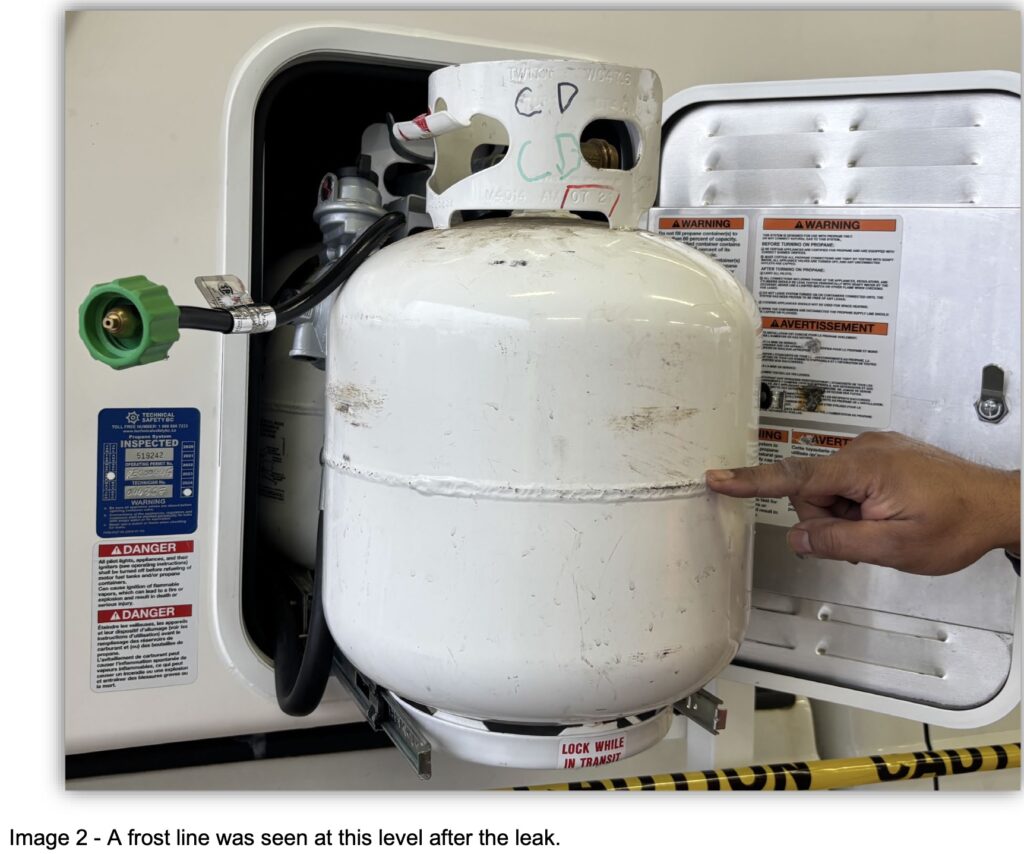
Should a rapid emptying of a propane tank happen, an intense evaporation chilling effect and gas expansion will occur. The escaping liquid propane will pull heat from the surrounding environment and frost, and condensation may occur (Image 2). Propane in its concentrated form can mix with oxygen which results in a flammable range (the flammable range of propane in air is approximately 2.1% to 9.5% by volume).
Propane is given a distinct odor by adding mercaptans that typically have a powerful, foul odor resembling rotten cabbage or eggs. Propane tanks should be kept in a manner to avoid damage in an upright position.
The 12-Volt Battery
12-Volt batteries are used to house the energy needed to power many things including in applications for RVs and campers when they are not plugged into to a 120V power source. Potentially, if the RV is plugged into the 120V system all appliances requiring 120V can be used in the camper unit similar to a home. A 12V inverter can power other appliances requiring that amount of energy. Battery disconnect switch (Image 6) can turn off the power supply for the unit when power is not required.
Gas Stove
The gas valve knobs are positioned facing forward, creating a potential hazard during activities conducted in the confined space surrounding the stove. Tasks such as mattress replacement (Image 5) may result in inadvertent contact with the knobs. Even minor pressure combined with rotational movement can unintentionally engage the valve, releasing propane when the stove is not in use, but propane is left on.
Gas Alarm Information
Propane Gas Alarm – MTI Industries Safe-T-Alert Model 30-442-P
- Limitations: Alarm will not function without power.
o Detects propane only at the sensor location; gas may be present elsewhere.
o If you smell gas, immediately contact your propane supplier or fire department. - Warnings: Connect only to wiring that cannot be turned off by a wall switch or ground fault protector.
- Installation: Power supply: 12V DC on a properly fused circuit.
o Use UL® approved connectors.
o Disconnect power until installation is complete.
Failure scenario(s)
The incident occurred during the decommissioning of a single truck camper from a commercial rental fleet in preparation for private sale. The camper, equipped with propane appliances, had passed a pre-sale safety inspection by a certified RV Technician the previous day. It was parked under a wash bay with stabilizing jacks deployed and tied down, and a pickup truck was positioned underneath for added
safety.
On the evening prior to the incident, employees were replacing a mattress inside the camper. Due to the confined space, the mattress being removed had to be maneuvered past the stove, which featured forward-facing gas valve knobs. During this process, one knob was accidentally depressed into an “ON” position. Although an employee noticed it was on and turned it off at that point, the team was
under time pressure and did not confirm whether the knob had been reactivated to the same “ON” position while they were maneuvering in the new mattress.
The main battery was turned off despite the instructions posted for employees. (Image 4). The master switch (key like device) (Image 6), and one propane tank remained open. With the battery for power to the camper turned off, the gas detector alarm inside the camper had no power supply and when disconnected could not provide an alert for the propane leaking from the stove. Current RV safety standards do not require backup power for gas detectors.
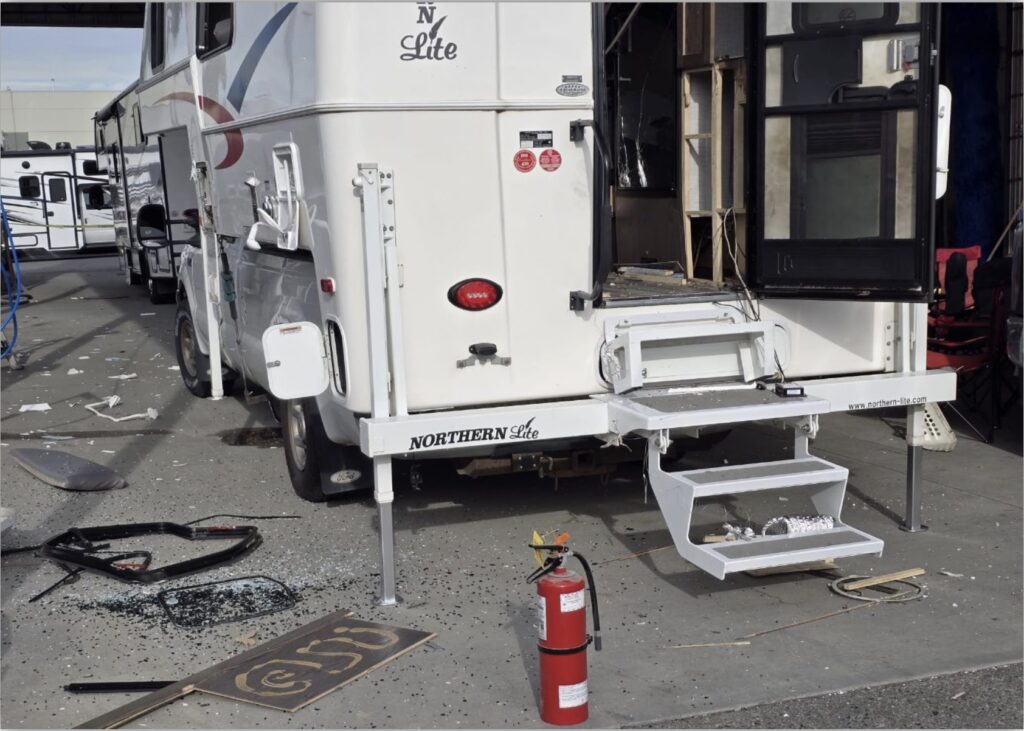
Overnight, propane was left on and able to accumulate inside the camper through a valve that was left in an open position, likely when a mattress was replaced the night before. The following morning, three different employees arrived to finish some cleaning inside and before entering detected a strong gas odor. Two employees hesitated to enter and waited just outside the main rear entry door near the steps, (Image 1) but the supervisor fully entered the unit. Opening the main door allowed fresh air to mix with the propane, bringing the concentration within its flammable range (approximately 2.1%–9.5% by volume).
The stove’s gas valve knob was observed in the on position and turned off, and windows were being opened for ventilation. During this process, the master switch was re-engaged to restore power for lighting (Image 6). This likely introduced an ignition source. The gas ignited, causing an explosion and damage (Image 7, Image 8, and Image 9).
Two employees outside the unit were thrown back by the blast—one employee was thrown approximately 15 feet, sustaining multiple injuries—and both employees inside and the employee further from the door sustained injuries.
Calculations of the estimated amount of propane within the unit:
- Propane Lower Explosive Limit (LEL): The LEL for propane is approximately 2.1% by volume in air.
- Camper Interior Volume: The Northern Lite 9-6 Sportsman Plus has an interior height of 6 feet 4 inches (which is approximately 6.33 feet). The floor length is 9 feet 2 inches (about 9.17 feet), and the exterior width is 8 feet 2 inches (about 8.17 feet). Plus, the sleeping area, which is approximately 8.17 feet wide by 6.66 feet long and 3.5 feet of headroom.
- There are 170 cubic feet of propane within one 20lb propane cylinder; therefore, this would be sufficient to create an environment between the LEL and UEL. It should also be noted that the witness stated that there was a frostline midway through the propane tank; therefore, at some point, it is
probable that the propane level was above the UEL. Therefore, between the leakage within the trailer and the door opening, it would have brought it within the two levels.
Statements:
Workers on Site:
- The two propane tanks that fueled the camper were hooked up, with one bottle open, leading up to the incident (Image 4).
- It was half full after the incident. There was frost halfway down the bottle, indicating a consistent, outflow or leak leading up to the incident (Image 2).
- It was recorded as full the day before.
Worker near stairs:
- Was outside. Close to the door, early in the morning.
- Has worked there for 15 years with no incidents, but has smelled propane before, but can’t recall specific incidents.
- The crew cleaned on Wednesday afternoon. Thursday morning, I asked the supervisor to go inspect the unit before management comes in.
- Another worker moved a mattress on Wednesday night and put the mattress all the way into its place.
- The stove is very easy to turn on by bumping into it or passing a person in the small space.
- The propane smell was strong, and they were familiar with what propane smells like.
- They were concerned because of the health and safety training and warnings they have gotten from their supervisors over the years regarding that if they smell propane, they need to leave the area.
- This smell was very strong, so they did not want to go in but the supervisor did go inside.
- Was by the stairs, and the supervisor was inside.
- It’s possible the supervisor turned on the lights.
- Boom, then the air forced them 16 feet or 20 feet. Another coworker stayed outside as well.
- In the past, the knobs have been moved when two people are inside sometimes. Sometimes our bodies touch the knobs.
- The mattress that had been moved was heavy, large, and queen-size. The replacement mattress was the same.
Site Observations
- Where the fuel tanks are there is a copper tube with a brass nut.
- None were loose.
- No leaks found in between components.
- The propane tank was a standard 20lb, white tank.
RV Tech Statement:
October 29th RV Technician completed an LP gas certification and leak tests on camper No.223-128. All RV dealers are required by the Motor Vehicle Sales Authority of British Columbia (VSA) to ensure that vehicles equipped with a propane system are safe before being sold.
All systems were closed before turning off the main exterior gas shut-off valves.
October 29th cleaning and maintenance.
Other Investigation Reports
- When the cleaners opened the main door to enter the camper, fresh air was introduced into the enclosed space, allowing the propane concentration to return to within its flammable range (the flammable range of propane in air is approximately 2.1% to 9.5% by volume).
- Employee 2 was outside the camper, stating they turned on the master power switch to the unit while Employee 1 was still inside the camper for power to the lighting.
- The area of origin was determined to be the interior of the camper.
- Shared updates on injured workers.
Causes and contributing factors
The cause of the incident was an inadvertent release of propane for an extended period that went unnoticed and eventually ignited.
Contributing factors:
- The stove knob was likely inadvertently turned on the night before when moving a mattress, resulting in the release of propane.
- Despite the written posted instructions, the staff did not check that the stove was off before leaving.
- A stove design that places the knobs in a high-traffic area and allows for easy depression and inadvertent activation.
- Wiring of the propane gas alarm through the battery disconnect, with no battery backup, which deactivated the propane gas alarm when the master switch was turned off.
- The decision by staff to enter the camper after smelling a strong smell of propane, despite being trained not to do so.