
Workers were weatherproofing the outer layer of a large ammonia storage tank when contractor-operated equipment struck a bleed pipe, causing an unplanned release of ammonia. Two (2) workers were exposed to ammonia, one worker suffering fatal injury and the other worker suffering minor injuries.
NOTE: Another case of an EEBA not working because it was NOT on the person, but in the JLG lift basket.
Background information
The facility is located in Alberta and is part of the Agricultural Chemical Manufacturing Industry. The company employs 165 workers across its locations, with 96 companies in its corporate family. The facility contracted Aluma Systems to weatherproof two 30-metric-ton anhydrous ammonia storage tanks.
The company was contracted by the host facility to conduct weatherproofing of two anhydrous ammonia tanks at the work site. Access to the work area required the rental and operation of an aerial work platform (AWP). The contractor directly employed the weatherproofing crew and the area supervisor.
Painter 1
Painter 1 (deceased worker) was a journeyman laborer/painter. Between the hiring date and the date of the incident, painter 1 worked as a foreman painter, was laid off, and was then rehired. Painter 1 worked primarily at the Plains Midstream Empress (Plains) plant and had experience with AWPs, such as the JLG involved in the incident.
Painter 2
Painter 2 (injured worker) had been employed as a painter for approximately two years. Painter 2 had worked with Painter 1 at the Plains plant and had experience working in AWPs. Painters 1 and 2 worked as a team on the South tank for the weatherproofing project.
Painter 3
Painter 3 started at the beginning of the weatherproofing project on November 16, 2015. Painter 3 had worked for another company at gas plants since approximately 1999 and had previously worked at the plant for approximately two years. Painter 3 worked on the North tank with the foreman.
Foreman
The foreman was, at all relevant times, an employee of the contractor assigned the duties of immediate
worker supervision at the work site. The foreman was an experienced journeyman scaffolder and had five years’ experience working under the contract company’s guidelines.
Area supervisor
The area supervisor and another worker had completed the weatherproofing on the north tank in approximately 2010. The area supervisor’s role was described as securing and looking after work, engaging workers, and ensuring they were in compliance with company codes and practices.
Anhydrous ammonia storage tanks
The Anhydrous ammonia storage tanks (tanks) were 30 metric ton anhydrous ammonia (ammonia) storage tanks. There were two tanks in a bermed area approximately 211 meters (m) by 102 m; one tank was on the north end of the bermed area, and the other was on the south end.
The incident occurred on the south tank (Figure 1). The tanks were approximately 50.2 m in diameter and 21 m tall. The ammonia was stored at approximately -33.33°C (-28°F). The tanks had pipe infrastructure on their west sides. The area rarely had vehicle traffic. A vehicle entry/hot work permit was required if vehicles were in the bermed area. As part of the preventive maintenance program, the insulation on the tanks was inspected and weatherproofed every 5 years. The workers involved in the incident were conducting the weatherproofing operation.
Sample valve and pipe
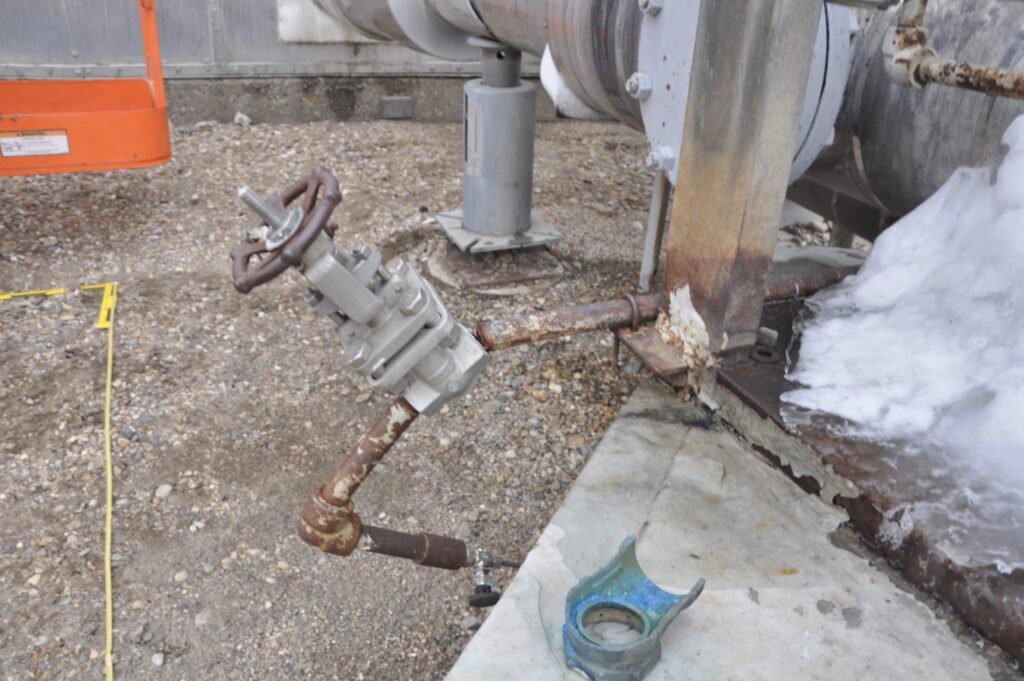
The pipe was a 200 mm (8″) nominal diameter, schedule 80, seamless carbon steel pipe attached to a Ladish gate valve and a Whitey ball valve assembly used primarily for sampling product. The pipe broke on the upstream side of the valve at the threads (Figure 2).
Figure 2. The broken pipe and valve are looking towards the tank.
JLG 800 AJ articulating boom lift
The JLG 800 AJ articulating boom lift (JLG) was a rough terrain articulating boom lift (Figure 3). It could extend vertically to 24.38 m and horizontally to 15.45 m. The unit was 3 m tall and 11.13 m long. The contractor had rented the equipment, including training for all workers required
to operate the equipment at the work site.
Post-incident review of the equipment affirmed it was in good working order at the time of the
injury event.
Emergency Escape Packs
Scott ELSA 5 emergency escape respirators were designed for ease of use and allowed users a method to escape from toxic environments. The incident AWP was equipped with an escape pack (Figure 4).
Post-incident examination affirms the equipment was in good working order.
Figure 4. Painter 1’s escape pack in the AWP basket.
Sequence of events
The contractor conducted a variety of work at the site and was awarded the weatherproofing project on October 5, 2015. The project involved inspecting the insulation of tanks, backing out screws on metal panels, applying silicone, and putting the screws back in. Project personnel consisted of two crews of two workers, each using an AWP to access the screws. The crew on the south tank (incident tank) was painters 1 and 2. The north tank crew consisted of the foreman and painter 3.
On November 16, 2015, the AWP rental company trained all four workers, including painter 1, in operating the JLGs before the equipment was used at the work site. Work commenced on or about November 17, 2015. The project was expected to be finished by the end of December, giving crews approximately six weeks to complete work.
On December 7, 2015, crews arrived at the plant between 7:50 and 8:00 a.m. Painters 1 and 2 started work (the crew). They commenced work on a second level of paneling, approximately 3 m off the ground. Painter 1, operating the JLG, approached the area with the AWP boom retracted to get as close as possible to the work area. The crew completed work on one section, painter 1 moved the equipment forward, and a tire struck an unseen sampling valve (Figure 2). As the crew started to work, painter 2 noticed a gas cloud and alerted painter 1. In response, painter 1 attempted to maneuver the AWP away from the cloud as painter 2 donned a protective respirator.
As the crew backed out of the area, the cloud thickened and workers were sprayed with liquid ammonia. Painter 2 jumped, at which time they realized the platform was at or near ground level. Painter 2 then attempted to re-enter the AWP basket to assist painter 1. All attempts to reach painter 1 were not successful. Painter 2 received second-degree chemical burns to both wrists and their left elbow. Painter 1 succumbed to injuries consistent with exposure to a toxic gas.
Completion
A review for enforcement action was completed on May 12, 2017, and it was determined that the file would be referred to Alberta Justice for review. The entire file was sent to Alberta Justice on June 2, 2017. Charges were laid on November 30, 2017. Charges were stayed on June 24, 2019, because information reviewed indicated there was no reasonable prospect of conviction.
This investigation was closed on May 22, 2020.