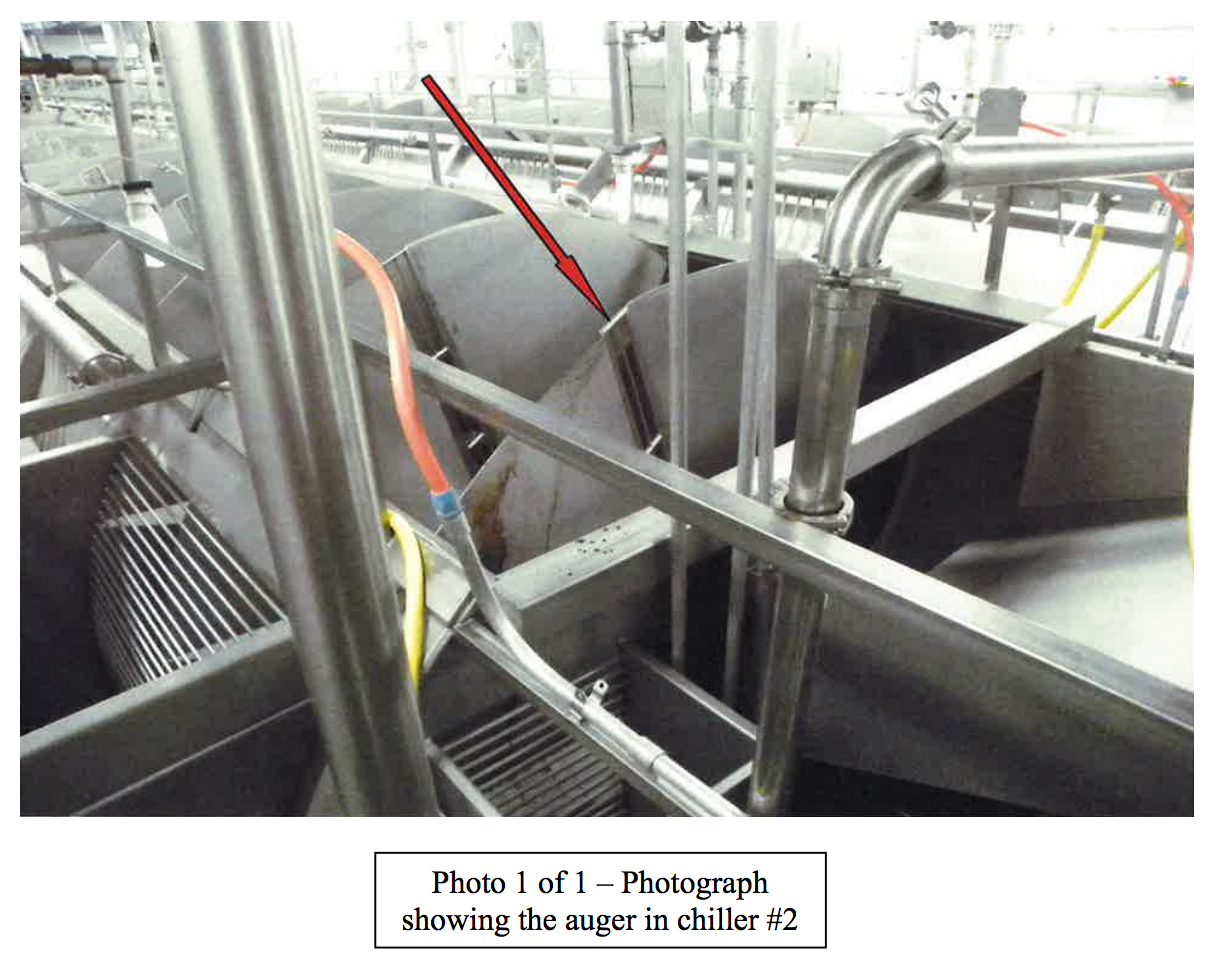
A 38-year-old male was fatality injured when his arm, and upper body was pulled into an operating auger as he leaned over the catwalk railing to clean, and sanitize a poultry processing chiller tank. The victim, along with other employees, were cleaning, and sanitizing the reverse flow, cold water chillers in a poultry processing plant. The victim was told to stay on the central catwalk, and left alone to spray down the tank interior of Chiller #2 with hot water, and sanitizing solution while the auger was in operation. During the cleaning process, a nearby employee heard a noise, and saw the victim’s legs extending from beneath the guard rail positioned approximately 15 inches above the top of the tank. The emergency pull cable was activated immediately. The victim was fatality injured by blunt force trauma to the body. There were no witnesses to the actual incident, but it remains a possibility the employee moved from the central catwalk, to the outer catwalk of Chiller #2 reaching in with his arm, and body to clean the interior of the tank, and was caught by the auger blade, pulling the employee into the tank from the catwalk. This was his sixth day of employment.
29 CFR 1910.147(c)(4)(i)
Procedures were not developed, documented, and utilized for the control of potentially hazardous energy when employees were engaged in activities covered by lock-out/tag-out. In that Stellar Management Group Inc dba QSI employees were cleaning and sanitizing Morris & Associates Quick Chill 3000 Model MAT-10WHS-85HF reverse flow chillers while the equipment was operating in the following instances:
- The auger found in Chiller #1 (chiller on east side) was allowed to continue to operate while employees sprayed down the interior of the tank. Part of this process required that hot water and detergent be sprayed on the surfaces of the tank interior to aid in cleaning. The employee spraying the tank interior worked from the catwalk located between the two chillers. The process in place at the time of the accident (with the augers running) exposed employees to coming in contact with the auger blades (containing vents for water flow) and to pinch points hazards where the auger blades run in close proximity to the tank wall while reaching over and under the top rails located above the sides of the tank. The serial number of the equipment was IW016652-0313.
- The auger found in Chiller #2 (chiller on west side) was allowed to continue to operate while employees sprayed down the interior of the tank. Part of this process required that hot water and detergent be sprayed on the surfaces of the tank interior to aid in cleaning. The employee spraying the tank interior worked from the catwalk located between the two chillers. The process in place at the time of the accident (with the augers running) exposed employees to coming in contact with the auger blades (containing vents for water flow) and to pinch points hazards where the auger blades run in close proximity to the tank wall. The serial number for the equipment was 5467-0313.
IN THE ALTERNATIVE: 29 CFR 1910.212(a)(1): One or more methods of machine guarding were not provided to protect the operator and other employees in the machine area from hazards such as those created by point of operation, ingoing nip points, rotating parts flying chips, and sparks. In that employees working from the catwalks adjacent to the chillers were able to reach over or under the top rail of the guards above the sides of Morris & Associates Quik Chill 3000 reverse flow chillers Model MAT-10WHS-85HF allowing access to the blades of the augers contained within the chiller tanks while the augers continued to rotate in the following instances:
- The auger found in Chiller #1 (chiller on east side) was allowed to continue to operate while employees sprayed down the interior of the tank. Part of this process required that hot water and detergent be sprayed on the surfaces of the tank interior to aid in cleaning. The spraying operation was done from the catwalk located between the two chillers or from the catwalk along the east side of the chiller. The top rail was approximately 42 inches above the surface of the catwalks from which employees worked. The top rail was approximately fifteen inches above the body of the chiller tank. An emergency pull cable was placed at a point approximately eight inches above the top rail. The auger blade contained vents running from near the center of the auger to a point near the outer edges of the blades to allow water to pass through the blades. Employees would reach over the guard rails while spraying the interior of the tank closest to the central platform from which the employee was working. The serial number of the equipment was IW016652-0313.
- The auger found in Chiller #2 (chiller on west side) was allowed to continue to operate while employees sprayed down the interior of the tank. Part of this process required that hot water and detergent be sprayed on the surfaces of the tank interior to aid in cleaning. The spraying operation was done from the catwalk located between the two chillers or from the catwalk along the west side of the chiller. The top rail was approximately 42 inches above the surface of the catwalks from which employees worked. The top rail was approximately fifteen inches above the body of the chiller tank. An emergency pull cable was placed at a point approximately eight inches above the top rail. The auger blade contained vents running from near the center of the auger to a point near the outer edges of the blades to allow water to pass through the blades. An employee could get caught in the vents or by the rotation of the auger blades. Employees would reach over the guard rails while spraying the interior of the tank closest to the central platform from which the employee was working. The serial number of the equipment was 5467-0313.
29 CFR 1910.147(c)(7)(i)(A)
Each authorized employee was not trained in the recognition of applicable hazardous energy sources, the type and magnitude of the energy available in the workplace, and the methods and means necessary for energy isolation and control. In that an employee was allowed to perform a maintenance and service activity (cleaning and sanitizing) on Morris & Associates Quik Chill 3000 reverse flow cold water chillers while the equipment was operational. The employee had not been provided complete lock-out training prior to being allowed to work on the equipment. The employee had not been provided lock-out equipment. The employee’s supervisor was with the employee while he performed part of the cleaning process on Chiller #2 on the day of the accident.