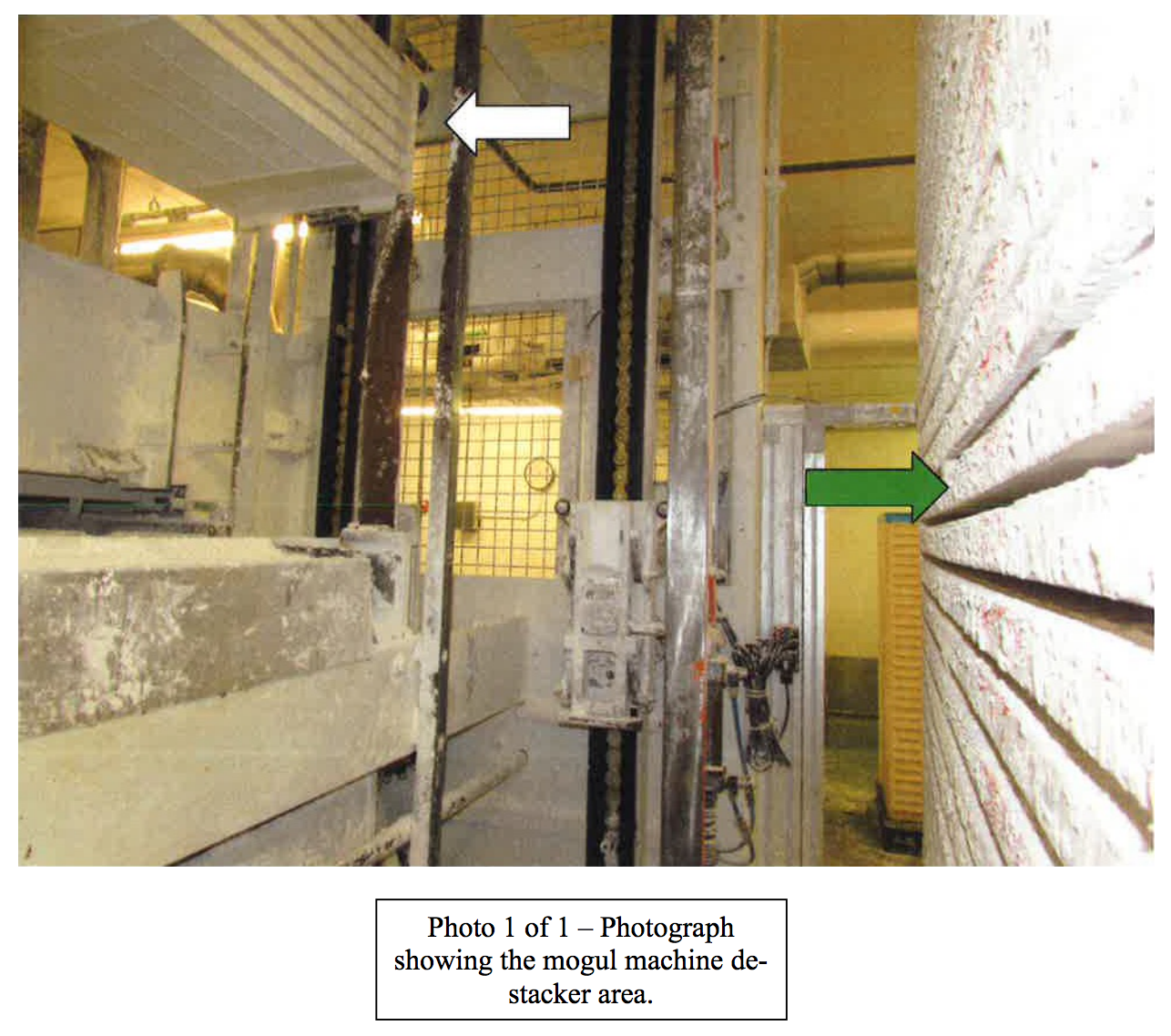
A 54-year-old male employee was fatality injured while cleaning the de-stacker area of the mogul machine in the gummies department when he was crushed between a tray of product, and the frame of the de-stacker mechanism of the mogul machine. The mogul machine would become obstructed during the day with falling and shifting gummy trays, and starch. The track that moved the trays would get covered with these materials and would need to be cleaned with a pneumatic air wand. The victim performed the company lockout/tagout procedure for the mogul machine, and locked out the vertical movement of the de-stacker. As the victim entered the machine for cleaning, he inadvertently struck a positional sensor inside of the track system, and advanced the candy trays into the machine. The victim was standing directly adjacent to the metal frame of the de-stacker mechanism when a stack of trays began to advance into the machine, crushing him between a tray of product and the frame of the de-stacker.
The first responders and company mechanics attended to the victim while working to reverse the tray track mechanisms to free him from the machine. During the investigation, it was determined that the company program addressed how to lockout the electrical energy source for both the vertical movement of the de-stacker section of the mogul, and the lateral movement of the track system that fed the de-stacker section of the mogul, but did not specify that both must be done to safely remove all hazardous energy sources before maintaining or servicing that area of the machine.
The supervisors that were responsible for monitoring the lockout/tagout procedures did not understand the necessity to isolate the energy sources for both sections of the machine. The training for the service and maintenance of the mogul machine was from operator to operator, with no follow up or discovery by the employer to verify the effectiveness of the training. The lockout/tagout point for the lateral control was located on the opposite side of the room, on the other side of the machine, approximately 80 feet away. The victim died from blunt force injuries due to compression by machinery such as multiple fractures, a rupture of pleura, hemathorax, contusions of the intestines, and abrasions on the face.
Citation 1 Item 1
29 CFR 1910.147(c)(4)(i)
Procedures were not developed, documented, and utilized for the control of potentially hazardous energy when employees were engaged in activities covered by this section. In that the employer did not ensure that lockout tagout procedures for intermittent cleaning of the mogul machine were followed, which resulted in an employee receiving fatal injuries.
Citation 1 Item 2
29 CFR 1910.147(c)(6)(i)(C)
Where lockout was used for energy control, the periodic inspection did not include a review, between the inspector and each authorized employee, of that employee’s responsibilities under the energy control procedure being inspected. In that an inspection of the procedures being used and a discussion with the authorized employees was not done.
Citation 1 Item 3
29 CFR 1910.147(c)(4)(ii)(B)
The energy control procedures did not clearly and specifically outline the steps for shutting down, isolating, blocking, and securing machines or equipment to control hazardous energy. In that the employer did not develop and maintain written machine-specific lockout tagout procedures for the heat exchanger in the Life Savers Gummies kitchen.
Citation 1 Item 4
29 CFR 1910.147(c)(5)(ii)(D)
Lockout devices and tagout devices did not indicate the identity of the employee applying the device(s). In that, at the time of the fatality, a lockout tagout lock was applied by the employee to the de-stacker controls of the mogul machine with no means to identify that the lock was placed by him. Also during the comprehensive inspection, lockout tagout locks were discovered being used throughout the facility with no means to identify the individuals who applied the locks.
Citation 1 Item 5a
29 CFR 1910.147(d)(1)
The authorized employee did not have knowledge of the type and magnitude of the energy, the hazards of the energy to be controlled, and the method or means to control the energy before the authorized or affected employee turned off equipment. In that employees did not understand the hazards associated with both the de-stacker and the track section of the mogul machine during intermittent cleaning procedures which resulted in an employee receiving fatal injuries.
Citation 1 Item 5b
29 CFR 1910.147(d)(2)
The machine or equipment was not turned off or shut down using the procedures established for the machine or equipment. In that the track system was only put in manual mode when employees entered the mogul machine for intermittent cleaning procedures which resulted in an employee receiving fatal injuries.
Citation 1 Item 5c
29 CFR 1910. 147(d)(3)
All energy isolating devices that are needed to control the energy to the machine or equipment was not physically located and operated in such a manner as to isolate the machine or equipment from the energy sources. In that the track system of the mogul machine was not isolated from energy sources before employees entered the machine for intermittent cleaning procedures which resulted in an employee receiving fatal injuries.
Citation 1 Item 5d
29 CFR 1910.147(d)(4)(i)
Lockout or tagout devices were not affixed to each energy isolating device by authorized employees. In that lockout tagout locks were not applied on the track system of the mogul machine before employees entered the machine for intermittent cleaning procedures which resulted in an employee receiving fatal injuries.
Citation 1 Item 5e
29 CFR 1910.147(d)(6)
Prior to starting work on machines or equipment that had been locked out or tagged out, the authorized employee did not verify that isolation and de-energization of the machine or equipment had been accomplished. In that de-energization of the mogul machine, both de-stacker and track system, was not verified before employees entered the machine for intermittent cleaning procedures which resulted in an employee receiving fatal injuries.
Citation 1 Item 6
29 CFR 1910. 303(b)(1)(viii)
Electric equipment was not free from recognized hazards that are likely to cause death or serious physical harm to employees. Safety of equipment was not determined using the following considerations: Other factors that contribute to the practical safeguarding of persons using or likely to come in contact with the equipment. In that a plastic sleeve mounted to the inside of the cover plate door for a 220 volt panel box in the boiler room was discovered to contain water.
Citation 2 Item 1
29 CFR 1910.157(d)(2)
Portable fire extinguishers for use on Class A fires were not distributed so that the travel distance for employees to any extinguisher was 75 feet or less. In that for the following two instances, the employer had not provided portable fire extinguishers within a travel distance of 75 feet: a. in the cooling/curing room and b. in the room directly above the cooling/curing room.
Photo 1 of 1 – Photograph showing the mogul machine destacker area.