HIGHLY TOXIC -
A material which produces a lethal dose or lethal concentration that falls within any of the following categories:A chemical that has a median lethal dose (LD50) of 50 milligrams or less per kilogram of body weight when administered orally to albino rats weighing between 200 and 300 grams each.

A chemical that has a median lethal dose (LD50) of 200 milligrams or less per kilogram of body weight when administered by continuous contact for 24 hours (or less if death occurs within 24 hours) with the bare skin of albino rabbits weighing between 2 and 3 kilograms each.

A chemical that has a median lethal concentration (LC50) in air of 200 parts per million by volume or less of gas or vapor, or 2 milligrams per liter or less of mist, fume or dust, when administered by continuous inhalation for one hour (or less if death occurs within 1 hour) to albino rats weighing between 200 and 300 grams each.
The definition is derived from 1910.1200. These materials are considered dangerous to humans when inhaled, absorbed or injected through the skin or ingested orally. Highly toxic materials present a health hazard and are subsequently listed as Group H-4 in Section 203.6.6. Examples of highly toxic materials include gases such as arsine, fluorine and hydrogen cyanide, liquid acrylic acid and calcium cyanide in solid form.
Mixtures of these materials with ordinary materials, such as water, might not warrant a highly toxic classification. While this system is basically simple in application, any hazard evaluation that is required for the precise categorization of this type of material is to be performed by experienced, technically competent persons.
This definition, as does the definition of “Toxic,” gives very specific criteria in the form of lethal doses and lethal concentrations as administered to albino rats and albino rabbits. The lethal dosages are related to the ingestion and skin contact with materials, generally liquids and solids. The lethal concentrations are related to vapors, dusts, gases or mists as inhaled by albino rats. Inhalation can occur from either a gas, vapor or mist that is generated from highly toxic or toxic
liquids.
In some cases, a liquid may be considered highly toxic or toxic if ingested or if skin contact occurs, but vapors are not an inhalation hazard according to the criteria. These definitions give criteria to help determine what materials are regulated by Chapters 50 and 60 and whether a building may warrant a Group H-4 occupancy classification.
Often, materials are listed as toxic or highly toxic on an SDS but may not necessarily meet these criteria. Instead, the terminology
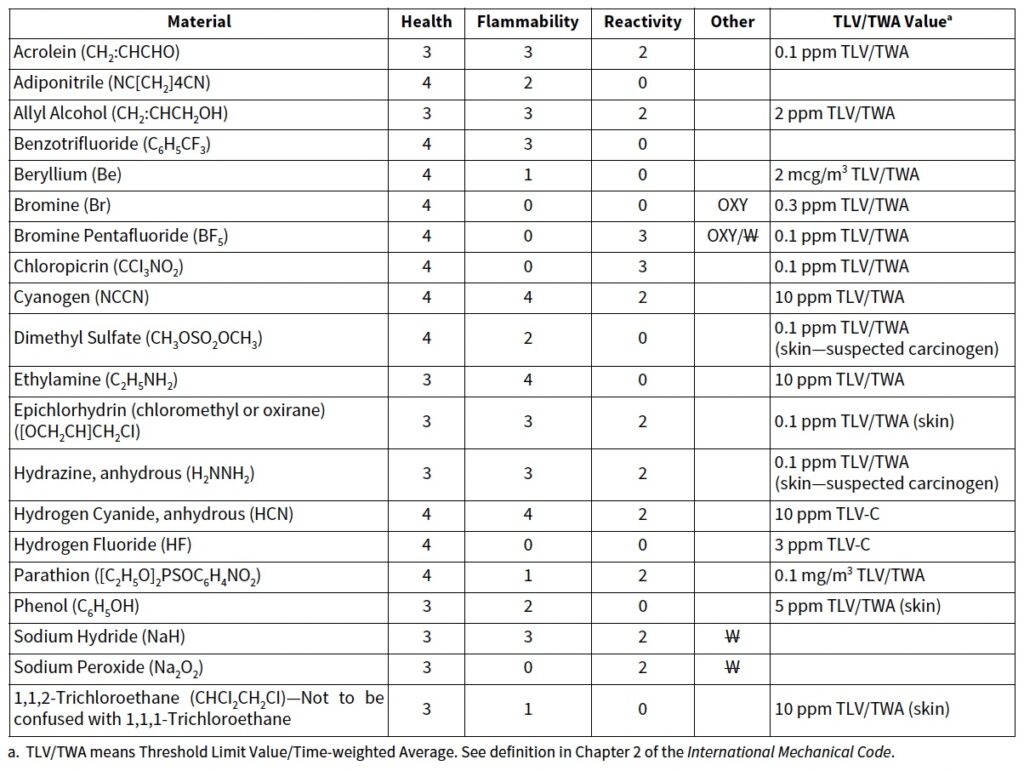
may be used to describe irritant characteristics of the material. For a list of common highly toxic materials, see Commentary Figure 202-H3