
Over the past decade, we have received dozens of requests from both current and new clients seeking to move to 19% Aqua Ammonia, so the process is NO LONGER RMP-covered. (NOTE: OSHA only covers 44% or higher Aqua Ammonia; EPA begins its coverage at 20%). This is taking the “inherently safe” approach to process safety. Call it “substitution” in the hierarchy of controls. But with this shift comes some challenges that many fail to consider in their initial attempt to exit PSM/RMP, and in this article, I will explain some of these challenges.
Part of why so many businesses are looking to exit PSM/RMP is the constant demand for activities related to the covered process(es), and many think that if they exit PSM/RMP, there will no longer be these regulatory demands. There is some truth to this; however, the demands NEVER fall to “zero” when we have a hazardous material on site, and yes, 19% Aqua Ammonia is a regulated hazardous material that may still require the facility to manage its presence accordingly.
We have discussed the physical properties of hazardous chemicals extensively on this site, and if you have ever attended an SAFTENG training course on HAZCOM, Chemical Safety, or Emergency Response, you know how seriously I take these properties. And here’s why…
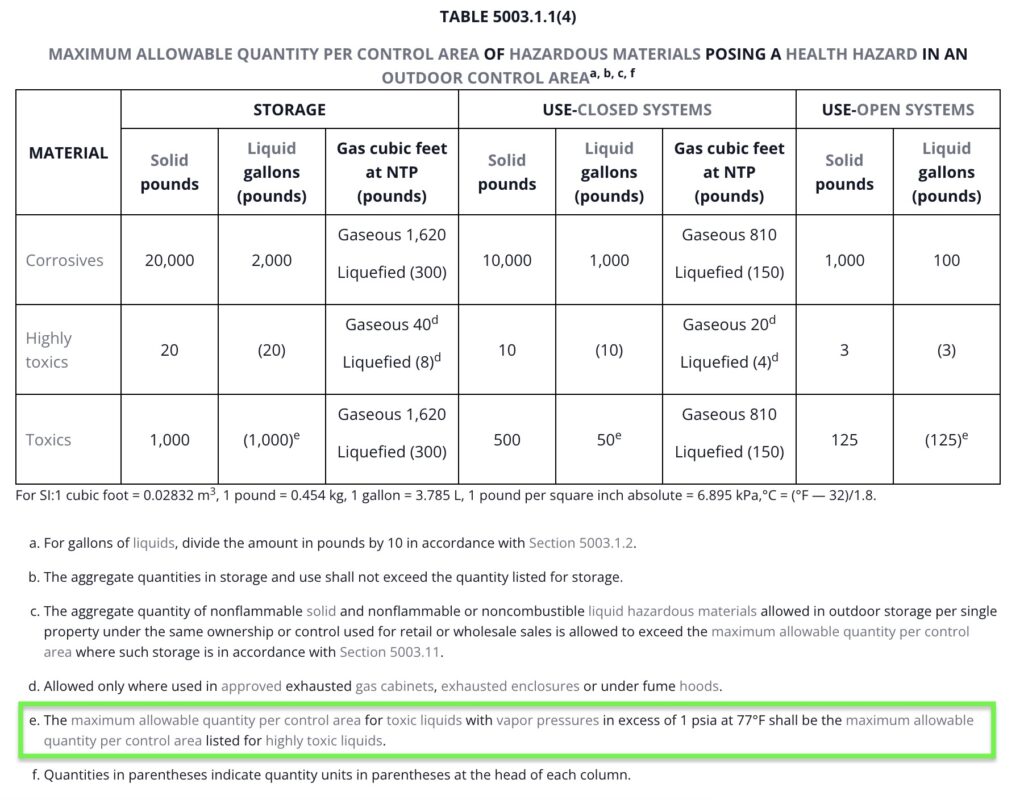
19% Auqa Ammonia has a Vapor Pressure (@ 77F) of 264 mm Hg. This is critical to know, as the IFC and most states’ fire codes will require a “toxic liquid,” such as aqueous ammonia, to be managed as a “Highly Toxic Liquid” when the solution has a VP of 1 mm Hg at 77F. Pay close attention to Footnote “e” for TABLE 5003.1.1(4) MAXIMUM ALLOWABLE QUANTITY PER CONTROL AREA OF HAZARDOUS MATERIALS POSING A HEALTH HAZARD IN AN OUTDOOR CONTROL AREA
1 psia (pounds per square inch absolute) = 52 mm Hg.
19% Auqa Ammonia has a Vapor Pressure (@ 77F) of 264 mm Hg
Thus, the code requires us to manage this 19% Auqa Ammonia as a “Highly Toxic” liquid, which, as shown above in Table 5003.1.1(4), has a Maximum Allowable Quantity (MAQ) for OUTSIDE STORAGE of 20 pounds. When we exceed the MAQ, we are required to manage the area(s) as a High Hazard Area, designated as an H-4 Occupancy.
H-4 areas require specialized construction. Key requirements include 1) fire-rated separation, 2) automatic sprinklers, 3) ventilation, 4) liquid-tight floors, and 5) emergency alarms, designed to mitigate health risks from materials.