
The United Nations issued its 8th Revision to the Globally Harmonized System of Classification and Labelling of Chemicals (GHS) late last year and in this 8th revision we have some very good guidance on Combustible Dust (COM DUST). For the record, OSHA is considering adopting the 7th Revision; we currently are using the 3rd revision in our 1910.1200 compliance. So this is not so much about OSHA compliance, but more about another resource to educate and manage combustible dust hazards for those who feel NFPA 654 is too intrusive and demanding. ANNEX 11 GUIDANCE ON OTHER HAZARDS NOT RESULTING IN CLASSIFICATION is where we turn to find our COM DUST program. ANNEX 11 provides guidance on the factors that contribute to a dust explosion hazard and on hazard identification and the need for risk assessment, prevention, mitigation, and communication. The standard/ANNEX applies to…
any solid substance or mixture, which is combustible, may pose a dust explosion risk when in the form of fine particles in an oxidizing atmosphere such as air.
A risk assessment may be needed for many substances, mixtures, or solid materials, not just those classified as flammable solids in accordance with Chapter 2.7. In addition, dust may be formed (intentionally or unintentionally) during transfer or movement, or in a facility during handling or mechanical processing (e.g., milling, grinding) of substances/mixtures/solid materials (e.g., agricultural commodities, wood products, pharmaceuticals, dyes, coal, metals, plastics). Thus, the possibility of the formation of small particles and their potential accumulation should also be assessed. Where a dust explosion risk is identified, effective preventive and protective measures should be implemented as required by national legislation, regulations, or standards.
This guidance identifies when combustible dust may be present and thus when the risk of a dust explosion should be considered. The guidance:
- Gives a flow chart specifying the key steps to identify possible combustible dust;
- Identifies the factors contributing to a dust explosion;
- Sets out principles of hazard and risk management; and
- Indicates where expert knowledge is required
One key item I noticed in this GHS Annex is that they use 500 μm for their particle size and OSHA’s Combustible Dust National Emphasis Program (CPL-03-008) uses 425 μm.
The flow chart, Figure A11.2.1: Flow chart for decision on combustible dust, and the explanation provided for each gate in the flow chart is actually easy to follow and will be very useful in getting end users to assess their COM DUST hazards.
Another item that caught my eye is what they consider “Potential sources of ignition”. The standard includes all the traditional ignition sources, but there are a few surprises that I am researching. Here is their list:
(a) Hot surfaces;
(b) Flames and hot gases;
(c) Mechanically generated sparks;
(d) Electric apparatus;
(e) Stray electric currents and cathodic corrosion protection;
(f) Lightning;
(g) Static electricity;
(h) Radiofrequency electromagnetic waves (104 Hz – 3×10¹² Hz) ;
(i) Electromagnetic waves (3×10¹¹ Hz – 3×10¹⁵ Hz);
(j) Ionizing radiation;
(k) Ultrasonics;
(l) Adiabatic compression and shock waves;
(m) Exothermic reactions, including self-ignition of dust, smoldering/glowing particles or dust, and thermite reactions (e.g., between aluminum and rusty steel).
Lastly, the revision provides us with a nice concise table for PREVENTION and MITIGATION options for our COM DUST…
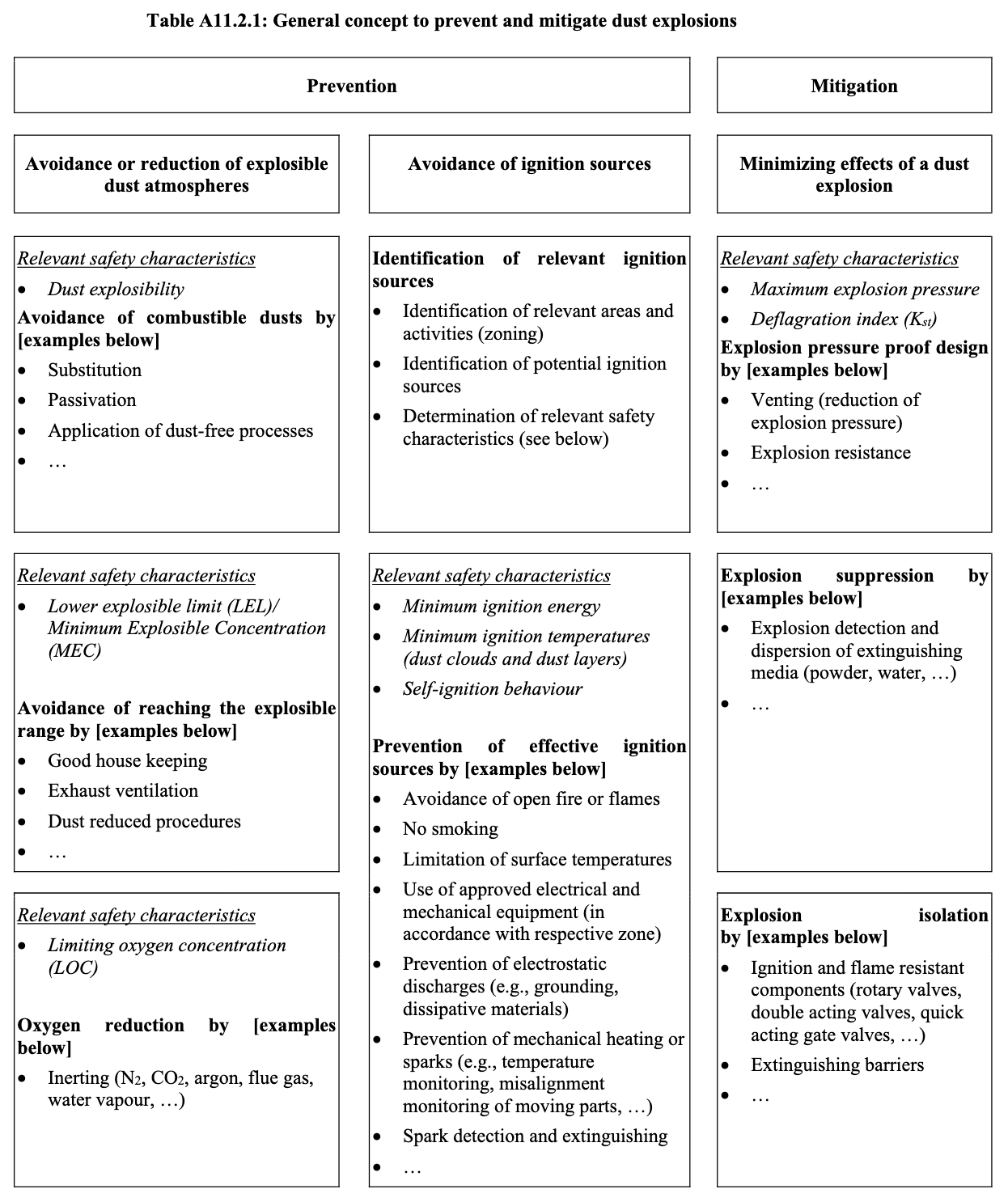
So as we can see, this ANNEX is full of some useful information and if you have been hitting a brick wall with your management on your COM DUST hazards, this may be a means to get your foot in the door. This is now OFFICIALLY part fo the GHS Standard and if OSHA continues to update our Haz Com standard (1910.1200), it will be only a matter of time until this Annex becomes part of our compliance requirements. I like it as it will finally bring some structure to OSHA’s COM DUST battles and allow employers to fully understand their MINIMUM OBLIGATIONS related to the COM DUST hazards in their workplace(s). But to be a realist, who knows when OSHA will even get us up to Revision 7 of the GHS, much less Rev 8. But check it out, you may find it makes for a nice internal COM DUST hazard assessment program that can be helpful in getting some recognition of the COM DUST hazard(s) in your workplace.
FREE ACCESS to: