
Incident overview
The bolted flanged connection on the suction of a reciprocating compressor failed causing an uncontrolled release of ammonia into the machinery room. The ammonia
detection system worked as designed activating the ventilation system and alarming the appropriate parties. The leak was isolated and no injuries resulted.
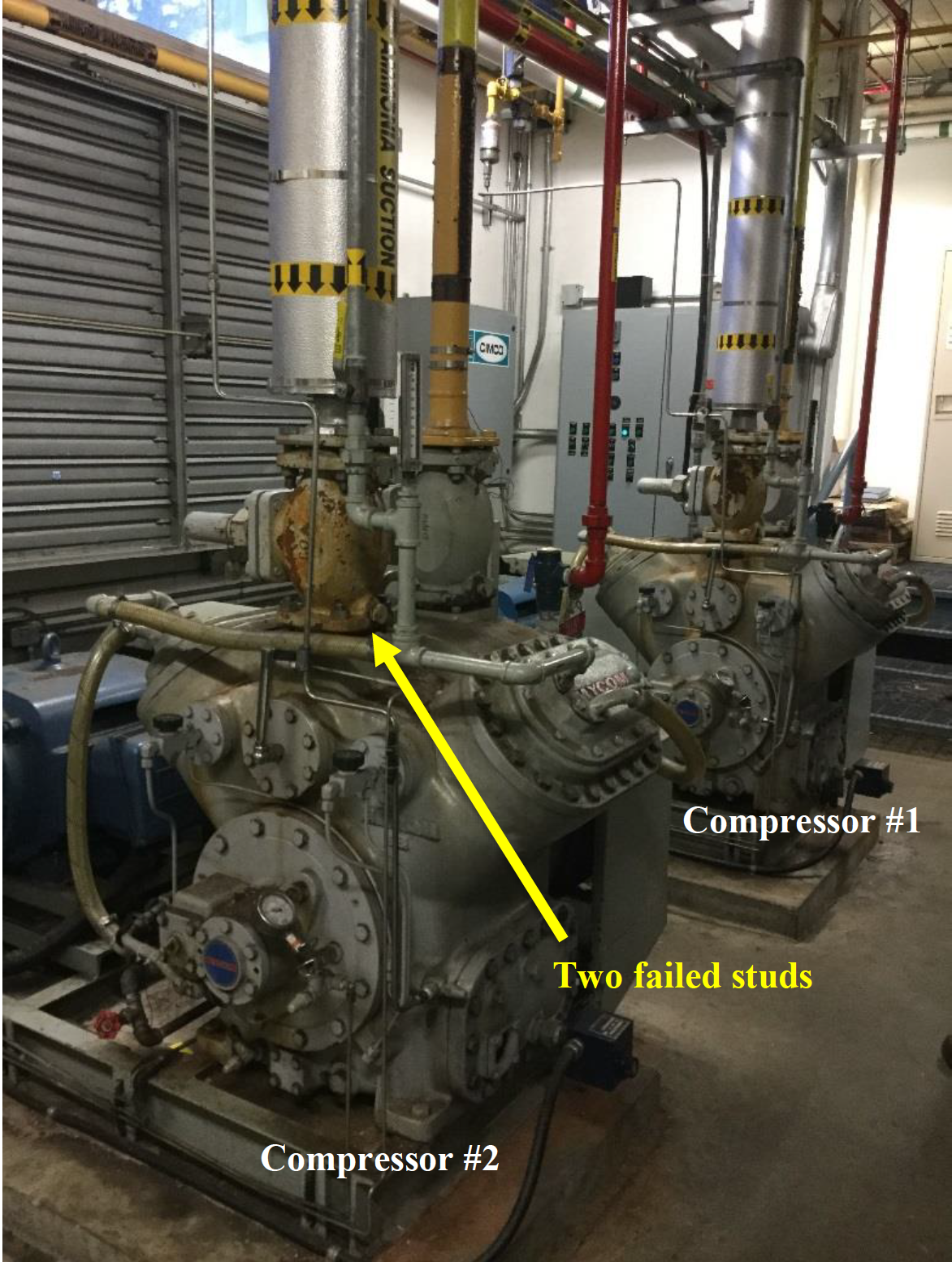
Site, system and components
The flange connected an ammonia suction valve to the compressor using nuts fastened onto studs passing through the flange, (Figure 2). The stud fasteners are subject to vibration from the compressor to which it is mounted, causing a cyclic loading condition on the studs. Threaded studs are susceptible to fatigue failure under cyclic loading.
To assure a safe lifecycle of ammonia refrigeration equipment in cyclic loading service at ice rink facilities the following must be taken into account:
- design of the system must ensure that the stress is below the threshold of the fatigue limit for the stud fastener or;
- the equipment must be designed for a fixed number of cycles, inspected throughout the lifecycle and studs replaced prior to failure.
The nuts at compressor connections must be torqued to manufacturer recommendations during initial installation and at maintenance intervals specified by the manufacturer. Periodic testing for leaks is required to ensure early detection of damaged studs.

Failure scenario(s)
On the morning of November 24, 2018 at 5:45 am the ammonia detection system triggered a low level alarm and a strong smell of ammonia was noted by the plant staff. This alarm triggers at 25 ppm with blue warning lights and activates the exhaust fan in the machinery room. The refrigeration mechanic arrived on site at approximately 6:30 am and noticed that the two ammonia sensors in the machinery room were indicating a level between 10 to 15 ppm. Later it was determined that the level in the machinery room reached 46 ppm.
The refrigeration mechanic attempted to tighten the studs on the flange connection. With very little force applied, stud #1 broke off (Figure 2). Two days later, stud #2
broke off when attempting to tighten it. The refrigeration contractor later replaced all four studs/nuts and the gasket located between the flange and compressor.

Facts and evidence
The leak was determined to be at the ammonia suction flanged connection of compressor #2 between the service valve and the compressor. Soap solution and litmus paper were used to find the leak. Compressor #2 was shut down and isolated using the suction and discharge service valves. The ammonia levels in the machinery
room dropped rapidly.
Reciprocating compressor #2 was in operation for 16 years. The gasket and studs/nuts at the failed connection are believed to be original. No evidence could be found to show that the nuts were properly torqued at the time of original installation. The suction piping above compressors #1 and #2 is supported in the vertical direction with no support provided in the horizontal direction at this location. Neither of the compressors appeared to exhibit excessive vibrations at the time of the incident investigation. Compressor #1 was completely rebuilt in August 2016 and compressor #2 was completely rebuilt in June 2018. Approximately 15 lbs of ammonia was released during the incident. The plant does not have a vibration analysis program in place and there have been no obvious signs of excessive vibration noted by the plant personnel.
Most of the fracture face of stud #1 (Figure 4) and approximately half of the fracture face of stud #2 (Figure 3) was discolored. The discoloration is likely a corrosion
product that developed on the metal surface of the partially fractured studs as a result of being exposed to a corrosive environment prior to final failure. Both fracture
surfaces indicate a slow progressing damage mechanism. Both fracture surfaces indicate the initiation points at the root of the threads. No necking was noted at the
location of both fractures, which would be present if the studs failed due to sudden stress overload. Analysis of stud #1 and #2 fracture surfaces found indications of
fatigue cracking followed by sudden overload failure. Stud #2 showed two separate initiation points with discoloration in each area. This suggests reverse bending fatigue failure as the failure mode. Stud #1 showed a single area of initiation indicating unidirectional bending fatigue. The fatigue cracking likely initiated during long term
cyclic loading. No visual indication of cracking was found on the two remaining studs at the failed connection.
Cyclic loading throughout the 16-year life likely caused fatigue cracking to slowly propagate through the thickness of the two studs that failed. The weakened studs
allowed the gasket to lose its seal causing the ammonia release. The final fracture occurred when the studs were tightened at the time of the release.

Causes and contributing factors
Cause:
Stress concentration at the suction valve to compressor connection along with cyclic loading likely caused a fatigue failure of two of the studs.
Contributing Factors
Lack of support in the horizontal direction of the suction piping above the compressors may have increased the amplitude of the cyclic loading.
Early detection of the leak may have been possible if the required regular testing for leaks was carried out.
