
At an Ethylene unit in the Czech Republic (2015), when swapping over cooling water supply lines during a flowmeter calibration, the operator made a simple mistake. While intending to open valve #3 on the spare supply line, he closed the identical valve #2 instead, shutting off all cooling water to the Light Ends columns.
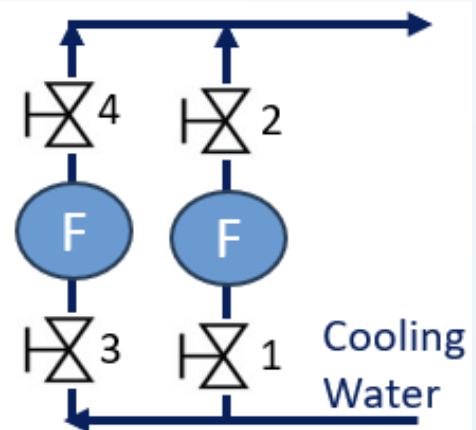
A rapid chain of events ensued. The propylene column was over-pressured, causing the PSVs to lift; one of which chattered, loosening the inlet flange bolts and releasing high-pressure propylene.
The resulting jet fire impacted other PSVs, which then failed, causing a small explosion that was sufficient to extinguish the nearby boilers.
Steam supply to the cracker was lost, resulting in a crash shutdown and a split in one of the furnace tubes.
The resulting fire caused extensive damage to four (4) furnaces.
Critical valve operation errors can be eliminated with physical interlocking systems like “trapped key” system.
SAFTENG Comment: We can also use a “Car Seal Program” as an added layer of administrative control when a single deviation of a valve can lead to serious consequences. Car Seal is not only a tool in Pressure Relief System Designs, but can also be used in process controls. Had this cooling water valve been Car Sealed OPEN, the operator would have had to seek permission to remove the car seal before closing the valve. It is only an ADMINISTRATIVE CONTROL, whereas the “Trapped Key” system is considered an “Engineering Control”, but the Car Seal process can add an INDEPENDENT LAYER of protection to these “human error” scenarios.
Source: https://www.epsc.be/l/library/download/urn:uuid:c3dc6cab-c25a-4dc2-8565-6ed10dc05403/25.06+epsc+learning+sheet+-+petrochemical+fire+_+en.pdf?utm_source=mailing&utm_medium=email&utm_campaign=learning-sheet-july-2025