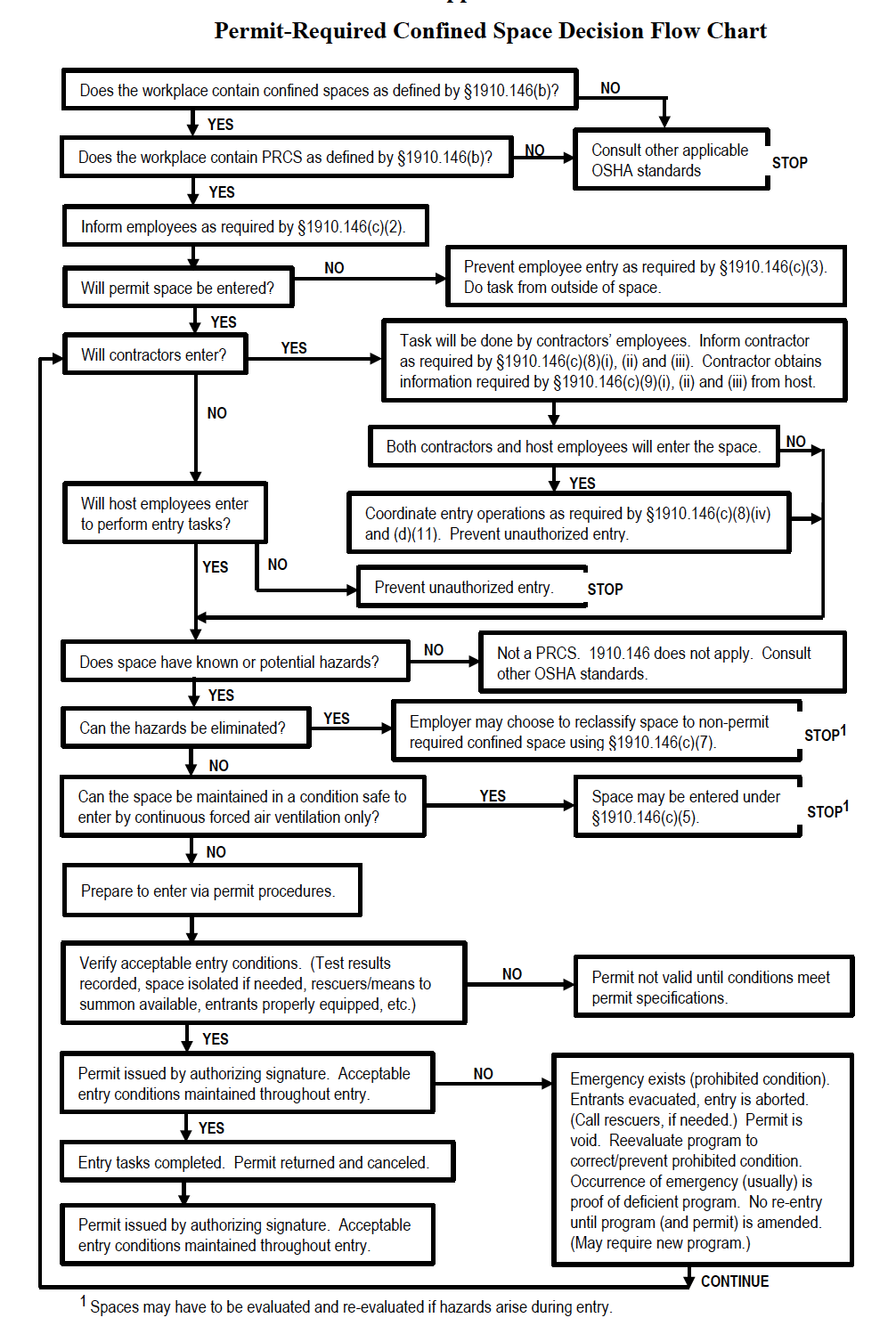
As it usually goes, the vast majority of challenges and questions I have received thus far from yesterday’s ASSP2019! Presentation centered around the most controversial characteristic of 1910.146…
4. Contains any other recognized serious safety or health hazard
I could have spent half a day talking about this single characteristic, but I had only 35 minutes. Seems some safety professionals were offended by my position on what constitutes a “recognized serious safety or health hazard“. This phrase is a point of contention within our profession, so I take no offense at the questions and challenges, but I thought it was worth following up on some of the feedback and inquiries about where I got my training in PRCSs and where those OSHA references “you claimed” exist. So let’s jump right into this, shall we…
Item #1 – “You said that doing Asbestos work inside a CS would not make it a PRCS, even if the workers exceeded the Asbestos PEL… that flies directly in contrast to the definition of a hazardous atmosphere”.
He/She went on to tell me how cavalier I was about atmospheric hazards and how I missed an opportunity to further the industry efforts in confined spaces.
So I most certainly said all of that, and I stand by my statements. What he/she forgot to mention about this characteristic is the “NOTE” to that part of the OSHA definition of a HAZ ATM and that “NOTE” makes it clear that OSHA only considers a HAZ ATM that would be such that would have an ACUTE RESPONSE such as death, incapacitation, impairment of the ability to perform self-rescue due to the exposure to the HAZ ATM.
(4) Atmospheric concentration of any substance for which a dose or a permissible exposure limit is published in Subpart G, Occupational Health and Environmental Control, or in Subpart Z, Toxic and Hazardous Substances, of this Part and which could result in employee exposure in excess of its dose or permissible exposure limit
NOTE: An atmospheric concentration of any substance that is NOT capable of causing death, incapacitation, impairment of the ability to self-rescue, injury, or acute illness due to its health effects is not covered by this provision. (Emphasis by me)
What I also said is that OSHA expects us to MANAGE/CONTROL the asbestos hazard(s), but that it is not a hazard for which we would use 1910.146. Asbestos is a CHRONIC RESPONSE hazard and does NOT, even as serious as the hazard is, make a CS a PRCS.
Item #2 – A gentleman shared one of his OSHA inspection experiences with us, and to summarize, they had “reclassified a PRCS to a non-PRCS” and then needed to do some stick welding inside the reclassified space. They put the PRCS classification back on the space and did the work under the protection of a full-blown permit entry. I commend this safety effort and the awareness of those involved. He stated that as the OSHA CSHO passed by the space, a discussion ensued, and the CSHO stated that had they not done the stick welding under an entry permit, he would/have cited them. Not because of the welding fumes creating a HAZ ATM, but because the “electrical hazard” met his criteria for “Contains any other recognized serious safety or health hazard” element.
This discussion yesterday stemmed from my statements regarding OSHA’s position on welding inside a reclassified PRCS. In the early days of the standard, OSHA stated that no work could take place inside a reclassified PRCS that had the potential to generate a HAZ ATM, specifically mentioning “welding,” but not specifying the types of welding. Since then, they have made it clear that their concern is leaking acetylene or oxygen valve/hose on a cutting rig, NOT stick welding. I was quite shocked that a CSHO would claim that the mere presence of “electrical” welding constituted a “recognized serious safety or health hazard“. I am in NO WAY suggesting that stick welding is not a serious hazard that MUST be managed/controlled, but this is NOT what OSHA had in mind when they wrote the PRCS standard and included “Contains any other recognized serious safety or health hazard”.
In fact, way back in 1997, OSHA issued an LOI – Introduction of electrical welding equipment into a non-permit confined space, stating that the mere presence of electrical welding equipment would NOT make a CS a PRCS. Here is OSHA’s position:
With regard to your question whether the introduction of electrical welding equipment into a non-permit confined space automatically leads to a reclassification of the space to a PRCS, please be advised that as long as the protective measures of Subpart Q — Welding, Cutting and Brazing, prevent a hazard from developing, the use of electrical welding equipment would NOT cause a confined space to be classified as PRCS. (emphasis by me) The protective measures of other standards would be applicable to the work in this space, specifically the following paragraphs of Subpart Q. [1910.252(a)(4)(i), 1910.252(b)(4)(i) to 1910.252(b)(4)(vii), 1910.252(c)(4), 1910.252(c)(9), and 1910.252(c)(10)] must be followed.
Let’s look at this another way… How much electricity must be present before we (as a safety profession) could unanimously agree that we have a “recognized serious safety or health hazard”? Stick welders are dealing with large voltages, certainly enough to kill a worker. But I can make the argument that a 110V extension cord can kill just as quickly and effectively as a stick welder. Does using an extension cord in a PRCS prevent me from reclassifying this space? The vast majority of reclassifications I was directly involved in involved internal vessel inspections, which often took days/weeks. During these inspections, lighting was a critical need, so we would set up some serious light towers and run power from outside the space via heavy-duty electrical cords. Many of these entries were examined by OSHA and VPP Teams, and we were never once challenged on the electrical aspect, making the space ineligible for reclassification.
Let me say this… let’s say we have a CS that has been classified as PRCS due to open switchgear within the space. The CS walls actually served as a guard/shield from the open switchgear for those outside the space; however, entrants would be exposed to the hazards of the uncovered switchgear. Would this open, permanently installed, electrical switchgear need to be ISOLATED, LOTO’ed to a ZES, and verifications of the absence of voltage in order to “reclassify” this space? ABSOLUTELY it would, but that would not prohibit me from using sound electrical safety-related work practices within the space, such as providing electricity for tools and lighting… or stick welding.
Item #3 – Fall hazards into and within a CS make it a PRCS
This one seemed to really tick off a number of attendees, as they are all adamant that OSHA has told them that a fall hazard into or within the space makes the CS a PRCS. I am not doubting their stories of how a CSHO stated this “fact” to them, as they are certainly passionate about fall hazards, as we all should be. But I stand by my position that OSHA has officially stated in their 1999 Regional Memo “Interpretation of 29 CFR 1910.146 and its applicability to fall hazards into pits” that a fall into or within a space is not the type of hazard that would make a CS a PRCS. AGAIN, WE MUST MANAGE/CONTROL the FALL HAZARD, but we do that with OTHER OSHA STANDARDS such as the new General Industry Walking and Working Surface Standards. Here is what OSHA said about falls and PRCSs…
Specifically, your question is, “Whether a fall from 21 feet into a pit constitutes a serious hazard under the standard, therefore requiring a permit program to enter the space?” This question was further refined by telephone conversation with Mr. Duncan with the State of Indiana to mean:
“Would a pit, which meets the definition as a confined space, also meet the definition of a permit-required confined space, if the only hazard is a potential fall from 21 feet while descending on a ladder within the pit?”
Specific fall protection requirements were not included in the PRCS standard. Fall protection and ladder safety requirements are addressed in Walking — Working Surfaces, 29 CFR 1910, Subpart D and the General Duty Clause of the Occupational Safety and Health Act. Therefore, if the described potential fall hazard is the exclusive hazard within this pit, a permit program would NOT be required. (Emphasis by me)
For example, I have a 12-foot-deep, 6-foot-by-6-foot pit in my facility. The pit has a vertical bucket elevator, motors, and combustible dust accumulations.
The pit is classified as a PRCS due to the mechanical hazards posed by the bucket elevator and potential atmospheric hazards. We have guardrails (with tow boards) around the pit, with a swing gate at the ladderway opening to prevent falls into the pit, as required by the Walking and Working Surfaces standard(s). If OSHA walked by this pit and there was a “fall hazard,” they would NOT cite us under 1910.146 for the fall hazard(s); they would cite us under the Walking and Working Surfaces standard. If they walked by and we had done our “reclassification” properly, were working inside the pit, AND the railings had been removed for some stupid reason, OSHA would again not take issue with our reclassification; instead, they would cite us for the exposure to a fall hazard. SO let’s be clear here… a fall into a CS does NOT make the CS a PRCS. We MUST control/manage the fall hazard, but it is not up for consideration in our evaluation of the application of 1910.146 or 1926.1201-.1213.
Now, let’s examine a fall within a PRCS. In this example, I will use a power plant boiler with scaffolding installed, and elevated work is being performed on it. The boiler is without a doubt a PRCS, but one that could be reclassified to a NON-PRCS. But what made the boiler a PRCS? The operational hazards present when the boiler is functioning. We shut it down and ELIMINATED all those hazards, so the boiler is VOID of all PRCS hazards. But the scope of work in this reclassified space will involve “elevated work” in building the scaffolding and then working from it over the next six (6) weeks. Does this fall hazard prevent me from “reclassifying” this boiler to a non-PRCS? ABSOLUTELY NOT! Do I have to manage the fall hazards? ABSOLUTELY I DO, just like I would outside of the space.
One attendee actually stated in his e-mail, “If I have a fall hazard, I have to make the space a PRCS, so if someone falls, I have rescue available.” I am sorry, this is not even in the realm of rational thinking! You have to have rescue available for any elevated work; it is specifically called out in 1926.502(d)(20). So the fact that the fall occurred inside an industrial boiler has ZERO to do with whether the space is a PRCS or not.
But this is what many have pointed to as the “gotcha” moment. It is from OSHA’s FAQ and now in the OSHA Instruction CPL 2.100, Application of the Permit-Required Confined Spaces (PRCS) Standard, 29 CFR 1910.146. In this document, OSHA states the following…
10. The definition of permit-required confined space contains the phrase “any other recognized serious safety and health hazard” as one of its hazard characteristics which would result in a confined space being classified as a permit space. The “Types of Hazards” listing in the Confined Space Hazards section of OSHA’s Confined Space Entry Course No. 226 identifies hazards. Does the mere presence of a non-specified hazards such as physical hazards (e.g. grinding, agitators, steam, mulching, falling/tripping, other moving parts); corrosive chemical hazards; biological hazards; and other hazards (i.e. electrical, rodents, snakes, spiders, poor visibility, wind, weather, or insecure footing), which do not pose an immediate danger to life or health or impairment of an employee’s ability to escape from the space constitute a hazard which would invoke this characteristic?
When a hazard in a confined space is immediately dangerous to life or health, the “permit space” classification is triggered. The list referenced above is ONLY illustrative of the general range of confined space hazards which could, but not necessarily always, constitute a hazard which would present an immediate danger to life or health, such that “permit space” protection would be required. The determination of whether the resulting exposure to a hazard in a confined space will impair the employee’s ability to perform self-rescue is the aspect that must be addressed by the employer. (emphasis by me)
In order for “serious safety and health hazard” to be recognized as being an impairment to escape, its severity potential for resulting physical harm to an employee must be considered.
Now, I am not going to argue with how that answer was worded by OSHA, but I will debate the logic and massive expansion of what most safety professionals call an IDLH environment. Most of us use this term as intended by OSHA and NIOSH. OSHA has defined the phrase in three (3) of their standards: 1910.134, 1910.146, and 1926.1202, and there is a slight difference in the respiratory protection definition and the PRCS definition.
Immediately dangerous to life or health (IDLH) means an atmosphere that poses an immediate threat to life, would cause irreversible adverse health effects, or would impair an individual’s ability to escape from a dangerous atmosphere. (1910.134)
Immediately dangerous to life or health (IDLH) means any condition that poses an immediate or delayed threat to life or that would cause irreversible adverse health effects or that would interfere with an individual’s ability to escape unaided from a permit space. (1910.146)
Immediately dangerous to life or health (IDLH) means any condition that would interfere with an individual’s ability to escape unaided from a permit space and that poses a threat to life or that would cause irreversible adverse health effects. (1926.1202)
But I would argue and have before an A.D. that saying a slip/trip/fall within a space would negate an employer’s ability to reclassify the space, essentially means (c)(7) is a waste of ink and paper. Not sure how many spaces you have been in that had well-designed walking/working surfaces, but for me, the number is ZERO out of maybe 1,000+ spaces I have been in over my 30 years in CS/PRCS. Extension cords, compressed air lines, breathing airlines, water from pressure washing, water from basic cleaning, water left over from the triple rinse/flush, etc., etc. Then we have the bolts/screws that protrude into the space, posing a slip/trip hazard. We would go to extremes and treat permanent trip hazards inherent to the space itself, like the “inwardly converging walls that slope to a smaller cross-section”. When we wanted to reclassify a space that had this configuration hazard, the entries done to build the “false floor” were done as Permitted-Entries, and once we had a flat floor (e.g., ELIMINATED the configuration hazard of inwardly converging walls that slope to a smaller cross-section), then we would reclassify the space for the rest of the shutdown/turnaround. So I guess we would do the same for the bolts/screws that penetrate the space and pose a trip hazard; but wait, if we are going to do this for the trip hazard, why wouldn’t we do it for the head hazards? I mean, bang your head into a 1″ diameter bolt and see what can happen? Hardhats? Sorry, those are designed for top impact – NOT side impact. So I guess we could certify a PPE Hazard Assessment and determine that Bump Caps would work, revise our site PPE program (via a MOC, of course), revise our site PPE training module, and then implement the practice. But wait… PPE does NOT ELIMINATE the hazard of the 1″ bolt knocking you out. So we are back to square one. Something tells me that OSHA did not include this silliness in their CS/PRCS standards because these are not the hazards that have killed thousands of workers. When we look at the definition in BOTH standards, we see the SAME criteria:
1) HAZ ATM
2) Engulfment
3) Configuration
4) Other serious hazards, such as agitators, augers, sweep arms, fan blades – physical type hazards that pose a significant risk to entrants.
The standard was intended to force employers to rise to the level of the risks posed by entering these spaces. The hazards are specific to PRCS hazards, not hazards that we find OUTSIDE of these spaces. So when we try and look to OSHA’s PRCS standard to control every hazard and potential hazard within a space we may be asking too much of OSHA and their VERY SPECIFIC 1910.146 – Permit-Required Confined Spaces standard.
It was a great time this year. We had 261 attendees to our session, and 73 came up to discuss their concerns and questions for an additional 40 minutes (until we ran out of the room). Please don’t hesitate to keep this discussion going. All 5,000+ SAFTENG articles I have written/posted over my 25-year career are FREE till July 2019. I have hundreds of articles on the topic of PRCSs.