
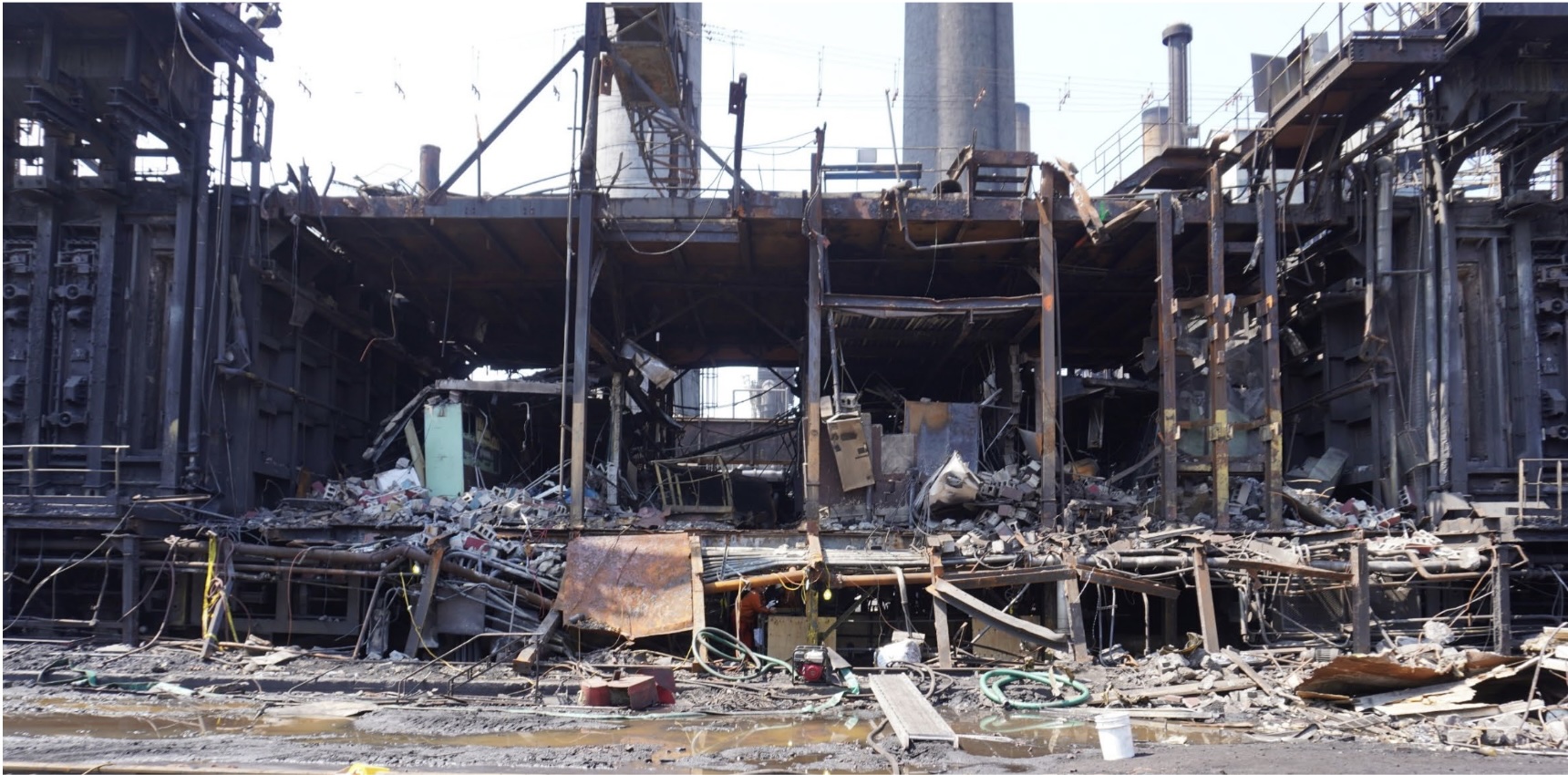
Today, the U.S. Chemical Safety and Hazard Investigation Board (CSB) released its final report on the fatal August 11, 2025, explosion at the Coke Works facility in Clairton, Pennsylvania. The incident occurred when toxic flammable coke oven gas was released and exploded — fatally injuring two people, injuring 11 others, five of them seriously, and causing an estimated $52.5 million in property damage.
The facility was built in 1901 and is the largest coke manufacturing facility in the Western Hemisphere. The facility processes coke inside “coke ovens,” which are connected by common walls and operated as one unit, called a “coke battery.” The facility currently operates six coke batteries, with a total of 455 ovens.
The August 11, 2025 fatal explosion occurred during a maintenance operation in which facility employees and contractors were attempting to fully close and reopen a double disc gate isolation valve in the piping that supplied coke oven gas to one of the coke oven batteries, called Battery 13.
The CSB found that the facility maintained an operating procedure for “exercising” Battery 13’s cast iron double gate isolation valve, as well as other valves at the facility. Exercising a valve included closing it and then reopening it, to ensure that the valve could successfully operate through its full range. The facility employees told the CSB that they occasionally had difficulty fully closing a valve when exercising it due to the coke oven residue that accumulated in the valve seat over time.
The CSB also found that the facility had a practice of injecting steam or high-pressure water into a valve’s cleanout port when the valve would not close fully, in an attempt to remove residue. However, the company’s exercising procedure did not mention the use of water, and the company had no formal procedure for washing valves with water. Nevertheless, despite the lack of a formal procedure for using water, employees had utilized pressurized water to clean valves on an ad hoc basis for at least three years prior to the incident.
On the day of the incident, a facility supervisor decided to exercise the Battery 13 isolation valve, to confirm that the valve operated correctly. The supervisor arranged for contractors, a company that provides industrial cleaning services, to use a pump truck to apply pressurized water to the valve. While applying pressurized water to the valve’s seats, the workers closed or nearly fully closed the valve’s double gates, which created an enclosed space between the two gates. The pressurized water filled this space inside the valve and caused the pressure inside the valve to increase beyond the valve’s ability to contain it. The valve then failed catastrophically, releasing toxic flammable coke oven gas into the surrounding area. Within minutes, the released gas ignited and exploded.
The failed valve was made from cast iron and was over 70 years old. The valve was originally manufactured in 1953 and had been refurbished in 2013. Cast iron is widely recognized as a brittle material, and numerous safety publications either prohibit or warn against using cast iron equipment in certain hazardous applications, including for flammable substances like coke oven gas.
The explosion occurred in an area located between Batteries 13 and 14 called the “transfer area,” where there were multiple buildings routinely occupied by employees. The buildings were located less than 20 feet directly above the coke oven gas piping that was the source of the release. None of those buildings were designed or constructed to withstand an explosion, and all of them were catastrophically damaged.
At the time of the explosion, the two fatally injured workers were each in or near separate control rooms directly above the coke oven gas piping, and two of the five seriously injured workers were inside a break room, also directly above the coke oven gas piping. One of the fatally injured employees was propelled by the force of the explosion and was found underneath rubble by emergency responders on the ground level adjacent to the coke batteries. The other fatally injured worker was buried in debris and was found by a search and rescue team roughly nine hours after the explosion.
Both of the workers in the break room at the time of the explosion were seriously injured by debris from the room’s walls and ceiling. One of them suffered burns, broken ribs, broken vertebrae, and a broken tibia, The other suffered explosion shrapnel to his face, burns, and broken bones in his spine, ankle, lower legs, knees, and hands. One of these two workers freed himself from the rubble, crawled out of the debris, and found help. The other was trapped under debris and was unable to free himself. Emergency responders located him, alive, roughly four hours after the explosion.
Nine other people outside of those buildings were also injured, three of them seriously.
https://www.csb.gov/assets/1/6/us_steel_clairton_investigation_report_publication_copy.pdfhttps://www.csb.gov/assets/1/6/us_steel_clairton_investigation_report_publication_copy.pdf