
The US Chemical Safety Board’s (CSB) most recent Safety Bulletin: Key Lessons from the ExxonMobil Baton Rouge Refinery Isobutane Release and Fire was once again a great piece of work by the agency. But as with most incidents, other underlying issues may have contributed (or not) to the incident. In this bulletin, I could not help but notice a poor practice, as shown in one of the bulletin photos…
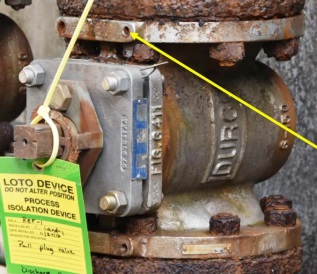
So I take issue with how the “tag” has been applied to the valve stem. The facility is complying with the “tagout” provision called “tag-plus” by removing the valve handle as their “plus” item; however, how the tag is placed causes me concern:
1) merely sliding the nylon cable tie over the stem like the authorized employee did is not substantial enough to prevent inadvertent or accidental removal. (emphasis by me)
1910.147(c)(5)(ii)(C)(2) Tagout devices. Tagout devices, including their means of attachment, shall be substantial enough to prevent inadvertent or accidental removal. Tagout device attachment means shall be of a non-reusable type, attachable by hand, self-locking, and non-releasable with a minimum unlocking strength of no less than 50 pounds and having the general design and basic characteristics of being at least equivalent to a one-piece, all-environment-tolerant nylon cable tie.
2) that “tag” appears to be made of “card stock,” and I would question its ability to have a strength of no less than 50 pounds. For me, for a tagout to meet full compliance, the entire attachment means must have a minimum unlocking strength of no less than 50 pounds, not just the nylon cable tie. In other words, the connection to the tag MUST be able to withstand 50 pounds. My standard for tagout is we should be able to lift a 50# block by grabbing the tag and using the tag and nylon cable tie to lift the 50# block.
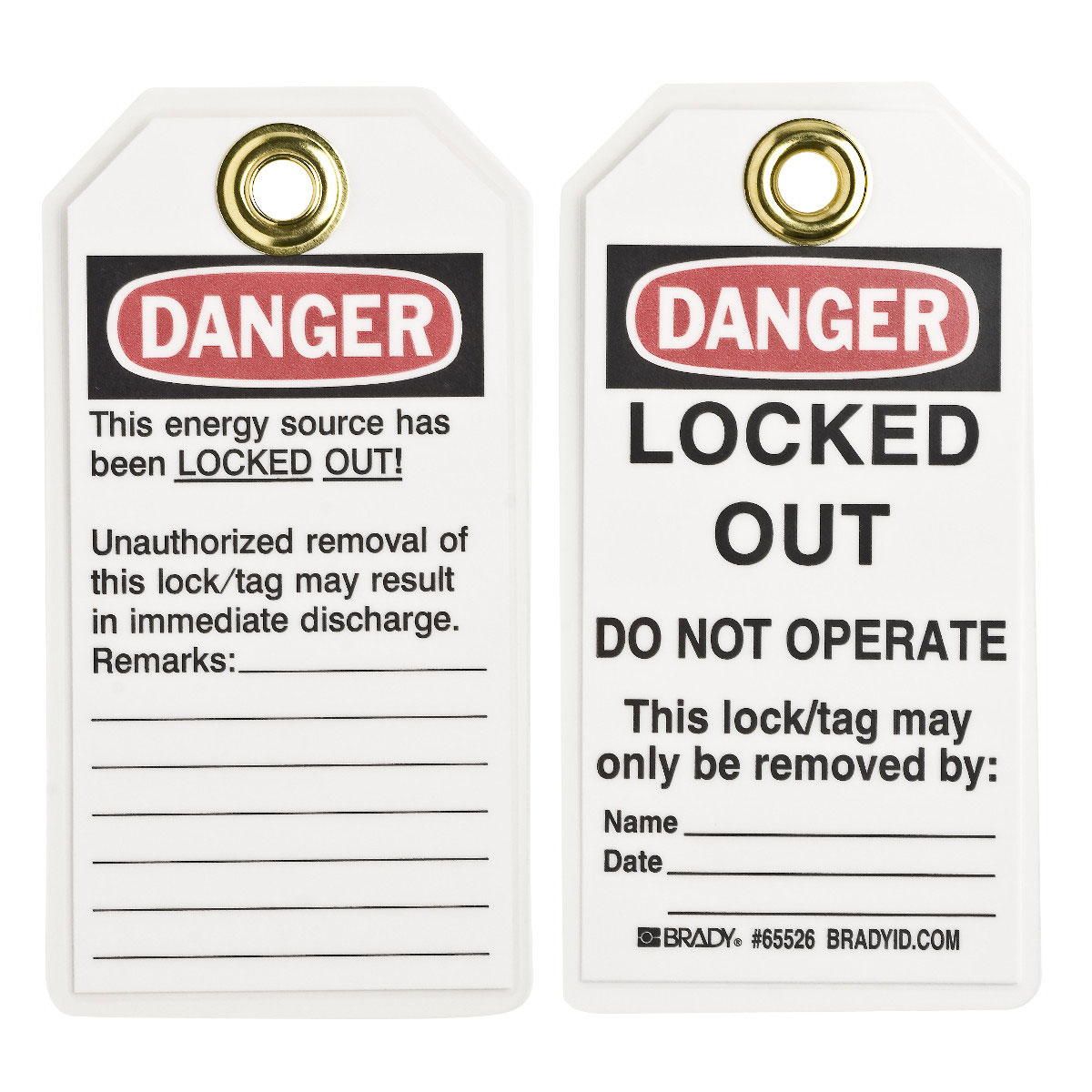
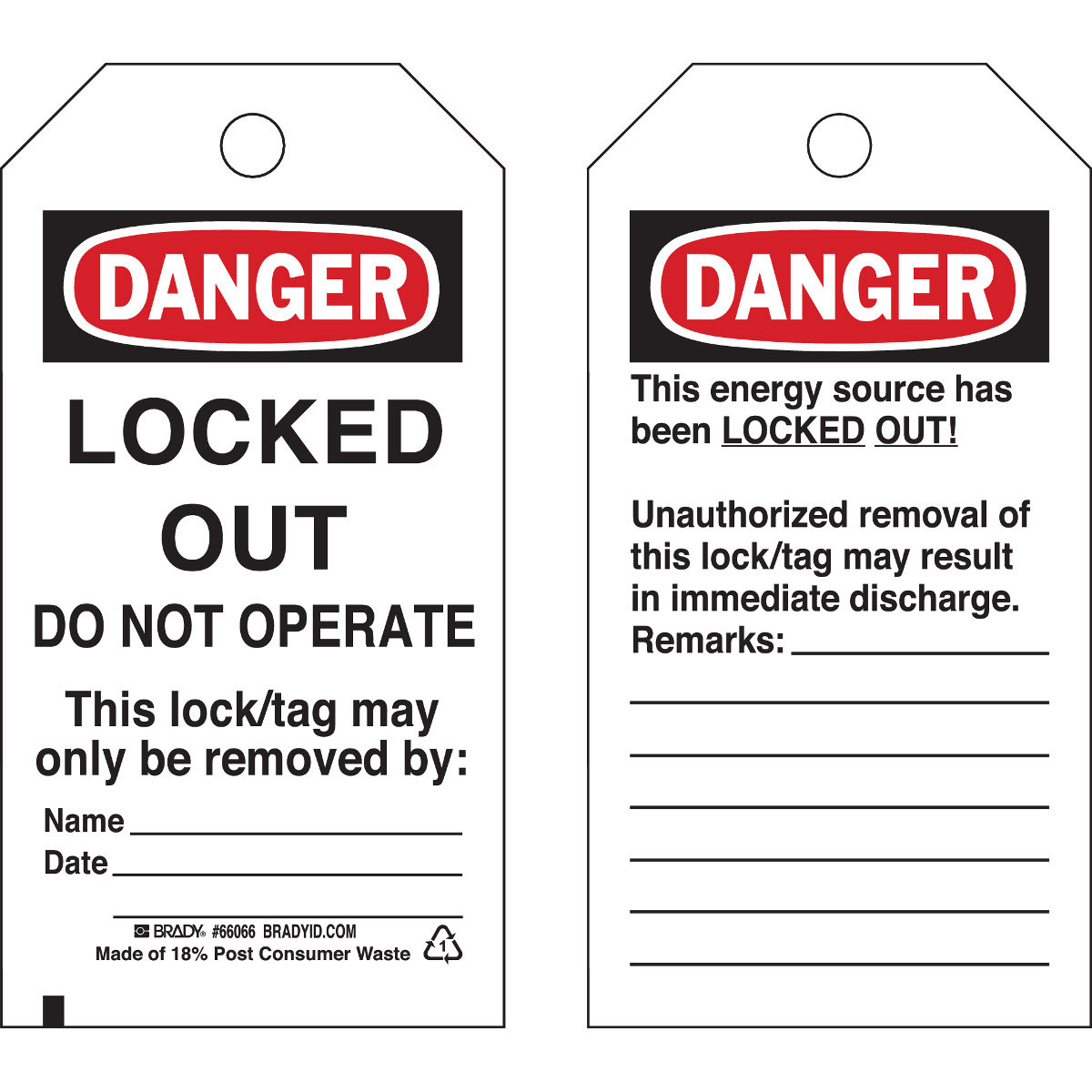
I was raised that there is a significant difference between the two tags shown below:
 |
 |
Source: Brady
Notice the difference in the tags above? The wording, colors, information, etc., are the same, yet there is one significant difference: CONSTRUCTION!
The tag on the left has an insert around the hole where we will run the nylon cable. This insert provides a lot of strength to the tag connection means and, as you can imagine, will allow the tag and its attachment mean to withstand 50# of force. The tag on the right, well, the nylon cable tie will cut into the tag and tear the tag well before we reach 50 #s.
Will OSHA agree with my position? Not sure if they get that picky, but the “INTENT” of the tagout requirements is to ensure that the tag will remain in place and that weather conditions (e.g., wind, rain, and ice, etc.) or something hitting the tag or nylon cable tie would not knock the tag off the energy isolation device. As shown in the CSB Alert, I would seriously question the means used to attach the tagout tag.
3) does the facility’s Tagout Tag comply with BOTH of the following:
-
1910.147(c)(5)(iii) Tagout devices shall warn against hazardous conditions if the machine or equipment is energized and shall include a legend such as the following: Do Not Start. Do Not Open. Do Not Close. Do Not Energize. Do Not Operate.
- 1910.145, Specifications for accident prevention signs and tags?
This is again an item that OSHA may never touch with a 10′ pole, but technically speaking, the tag itself, as shown in the CSB photo, may not comply. I am not worried so much about the wording, as I believe anyone who comes across this “tagout” would understand the purpose of the tag. The tag uses the heading “LOTO Device” and then uses the phrase “DO NOT ALTER POSITION,” and for me, this meets the intent of 1910.147(c)(5)(iii).
I take issue with the tag’s design because it does NOT comply with 1910.145, Specifications for accident prevention signs and tags. Here is what OSHA had to say about tag-out tags meeting 1910.145 in their LOTO Preamble: (emphasis by me)
In paragraph (c)(5)(iii), OSHA states that the legend (major message) on tagout devices must warn against hazardous conditions if the equipment is re-energized. Five examples of major message are provided in paragraph (c)(5)(iii): Do Not Start, Do Not Open, Do Not Close, Do Not Energize, and Do Not Operate. OSHA recognizes, however, that these messages may not be sufficient to cover all conditions involving hazardous energy control. For that reason, the above-stated legends are only examples of what must be stated. The use of graphics, pictographs or other symbols to convey the message which the tag represents serves the same purpose as the written message and therefore would be acceptable to OSHA. Additionally, the use of danger tags would have to meet the requirements of 1910.145.
So why does the tag NOT comply with 1910.145? I have highlighted the items of concern below:
1910.145(f) Accident prevention tags –
1910.145(f)(1) Scope and application.
1910.145(f)(1)(i) This paragraph (f) applies to all accident prevention tags used to identify hazardous conditions and provide a message to employees with respect to hazardous conditions as set forth in paragraph (f)(3) of this section, or to meet the specific tagging requirements of other OSHA standards.
…
1910.145(f)(2) Definitions.
“Major message” means that portion of a tag’s inscription that is more specific than the signal word and that indicates the specific hazardous condition or the instruction to be communicated to the employee. Examples include: “High Voltage,” “Close Clearance,” “Do Not Start,” or “Do Not Use” or a corresponding pictograph used with a written text or alone.
“Pictograph” means a pictorial representation used to identify a hazardous condition or to convey a safety instruction.
“Signal word” means that portion of a tag’s inscription that contains the word or words that are intended to capture the employee’s immediate attention.
“Tag” means a device usually made of card, paper, pasteboard, plastic or other material used to identify a hazardous condition.
…
1910.145(f)(4) General tag criteria. All required tags shall meet the following criteria:
1910.145(f)(4)(i) Tags shall contain a signal word AND a major message.
1910.145(f)(4)(i)(A) The signal word shall be either “Danger,” “Caution,” or “Biological Hazard,” “BIOHAZARD,” or the biological hazard symbol.
1910.145(f)(4)(i)(B) The major message shall indicate the specific hazardous condition or the instruction to be communicated to the employee.
1910.145(f)(4)(ii) The signal word shall be readable at a minimum distance of five feet (1.52 m) or such greater distance as warranted by the hazard.
1910.145(f)(4)(iii) The tag’s major message shall be presented in either pictographs, written text or both.
1910.145(f)(4)(iv) The signal word and the major message shall be understandable to all employees who may be exposed to the identified hazard.
1910.145(f)(4)(v) All employees shall be informed as to the meaning of the various tags used throughout the workplace and what special precautions are necessary.
1910.145(f)(4)(vi) Tags shall be affixed as close as safely possible to their respective hazards by a positive means such as string, wire, or adhesive that prevents their loss or unintentional removal.
1910.145(f)(5) Danger tags. Danger tags shall be used in major hazard situations where an immediate hazard presents a threat of death or serious injury to employees. Danger tags shall be used only in these situations.
1910.145(f)(6) Caution tags. Caution tags shall be used in minor hazard situations where a non-immediate or potential hazard or unsafe practice presents a lesser threat of employee injury. Caution tags shall be used only in these situations.
1910.145(f)(7) Warning tags. Warning tags may be used to represent a hazard level between “Caution” and “Danger,” instead of the required “Caution” tag, provided that they have a signal word of “Warning,” an appropriate major message, and otherwise meet the general tag criteria of paragraph (f)(4) of this section.
As I said, some of these items may slide right past an OSHA inspector, but I could not just let the photo go unchecked. As for me, attention to detail when LOTO is in play means a lot. We would have indeed written audit findings against this “tagout” had we come across this, and I am betting my house the facility would have pushed back against these findings, but that is how we get better and grow as safety professionals… a good challenge only makes us better!