
UPFRONT DISCLAIMER: I am not suggesting you throw out any of your LOTO devices or change your practices. This is NOT advice, merely an attempt to demonstrate how some companies go above and beyond OSHA minimums.
In my days working in the chemical industries, I had the pleasure of working with some of the finest plant managers, engineers, and safety professionals. And in those years, I learned safety – NOT as OSHA defined it – but how the company defined it. I worked in plants and at companies that had suffered tragic losses long before the publication of OSHA’s PSM and EPA’s RMP standards. Two of these companies, mainly driven by the two plant managers I worked for, strictly prohibited using what most of us would call a “clamshell” lockout device (as shown below).
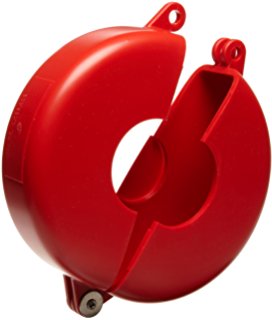
Yeah, I know, another crazy Haywood safety rule! But this was not my rule; this was an actual company prohibition, and if we look at OSHA’s definition of a “Lockout device,” we can see how some engineers would conclude that there are questions about using this type of device. Here is OSHA’s definition of a Lockout Device:
Lockout device. A device that utilizes a positive means such as a lock, either key or combination type, to hold an energy isolating device in the safe position and prevent the energizing of a machine or equipment. Included are blank flanges and bolted slip blinds.
The part that I have highlighted above is what drove the decision that, even now readily available in the marketplace or used in industries around the world, a “clamshell” does not in any way “hold an energy isolating device in the safe position.” It is merely a tamper barrier, much like a “tagout” would be. We were required to use a chain, cable, shark leader, etc., around the valve body and its handle to ensure the valve could not be opened (or closed if it were a bleed on a double block and bleed arrangement).
It was until I went to work at a plastic plant that I saw these devices in use, and when I questioned their use, they had a car ready to drive me back to the airport and send my ass back to Nebraska! But a few of them began to think independently and saw what I had been taught, and we attempted to rid the plant of these devices until corporate got involved and deemed them “LOTO Safe.”
This brings me to today and the ammonia refrigeration industries and their use of valves with no handles. Years ago, these valves used to be used when the valve was NOT “safety-critical,” and it would rarely be needed, such as break-down maintenance tasks. Used in those narrow design basis, I have no problems, but I felt these handle-less valves were becoming more and more popular. It was used in a broader application AND without any engineering or process safety rationale. Late last year, I was asked to assist a client with their PSSR on a new refrigeration process, and as we got onto the roof, I quickly noticed that darn near every valve on the roof was without a handle, and the valve stems were “capped.” So I had to ask the following questions:
- Which valves are the ones that would be used to stop a leak on an evaporator in an occupied space?
- Which valves are called out in the Emergency Shutdown SOP?
As it turns out, the valves the operators happened to point out were all without handles. So I asked, is there a stash of valve handles in a box somewhere nearby that you could access to get the tool you need to close the valve. The answer was no, but they would use a wrench instead. So I asked, is it mandatory that all refrigeration techs carry a wrench that would fit/work on all valves that are without handles, and can you show me that in a written SOP?
The discussion then moved to “energy isolation” practices when utilizing these valves. The senior techs stated that in the refrigeration industry, it is an “acceptable practice” to use a pipe with a hole drilled through it. The pipe would be large enough to slide over the capped valve stem, and then the pipe would be locked into place by using a shark leader/cable run through the hole and a lock on the cable. This team intended to use stainless steel pipe for their “lockout device,” but using PVC pipe is a common practice.
Keep in mind the OSHA minimums for “lockout devices” is:
1910.147(c)(5)(ii) Lockout devices and tagout devices shall be singularly identified; shall be the only devices(s) used for controlling energy; shall not be used for other purposes; and shall meet the following requirements:
1910.147(c)(5)(ii)(A) Durable.
1910.147(c)(5)(ii)(A)(1) Lockout and tagout devices shall be capable of withstanding the environment to which they are exposed for the maximum period of time that exposure is expected.
1910.147(c)(5)(ii)(A)(2) Tagout devices shall be constructed and printed so that exposure to weather conditions or wet and damp locations will not cause the tag to deteriorate or the message on the tag to become illegible.
1910.147(c)(5)(ii)(A)(3) Tags shall not deteriorate when used in corrosive environments such as areas where acid and alkali chemicals are handled and stored.
1910.147(c)(5)(ii)(B) Standardized. Lockout and tagout devices shall be standardized within the facility in at least one of the following criteria: Color; shape; or size; and additionally, in the case of tagout devices, print and format shall be standardized.
1910.147(c)(5)(ii)(C) Substantial
1910.147(c)(5)(ii)(C)(1) Lockout devices. Lockout devices shall be substantial enough to prevent removal without the use of excessive force or unusual techniques, such as with the use of bolt cutters or other metal cutting tools.