
So this week we all got a chuckle when I posted this picture to my Social Media groups:
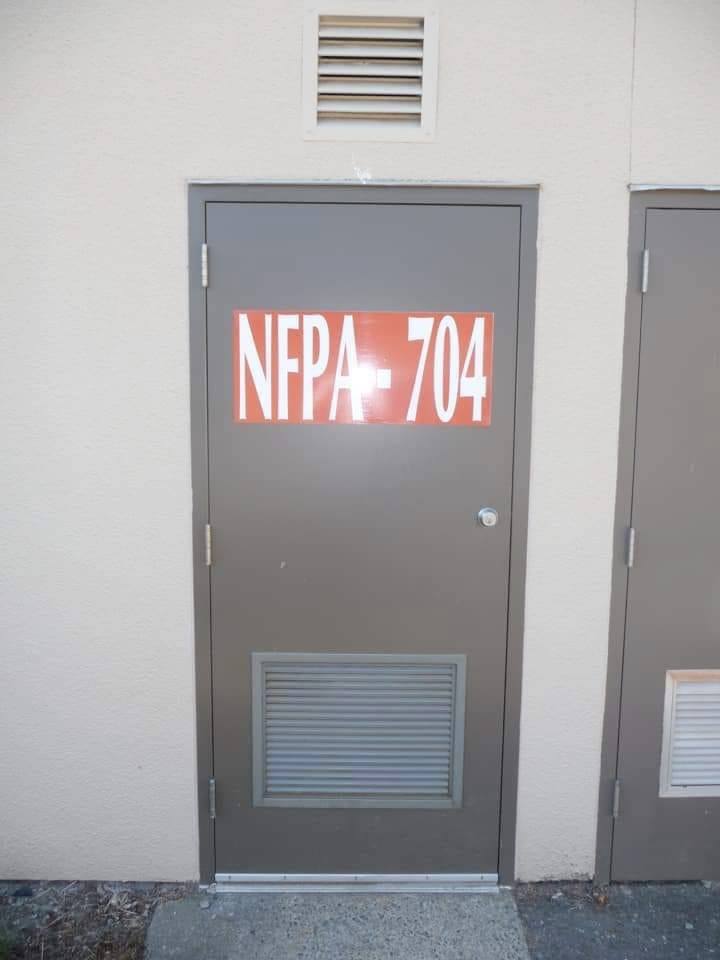
But in all seriousness, this is NO laughing matter! Well, we can at least surmise that EPA inspectors do not find the humor in it, as is evident in the nine (9) labeling issues they noted in this RMP inspection! From NFPA 704 Diamonds with differing degrees of hazards for the same chemical to faded labels such that the color-coding is no longer identifiable, to piping not being labeled per ASME A13.1, to the Ammonia storage tanks not being labeled per CGA 2.1-2014.
Respondent operates a “stationary source” and has submitted and registered an RMPlan. The respondent has developed an RMProgram accidental release prevention program for the stationary source. At its stationary source, Respondent manufactures explosives and has on-site for use, approximately 609,000 pounds of anhydrous ammonia, 2,730,000 pounds of nitric acid, and 100,000 pounds of oleum. At its stationary source, Respondent has six RMProgram level 3 covered processes, which store or otherwise use anhydrous ammonia, nitric acid, and oleum in amounts exceeding their applicable threshold of 10,000 pounds, 15,000 pounds, and 10,000 pounds, respectively. On May 8-9, 2017, the EPA conducted an onsite inspection of the RMProgram related records and equipment for the purpose of assessing Respondent’s compliance with the RMProgram requirements and the implemented recognized and generally accepted good engineering practices (RAGAGEP) for its covered processes at its stationary source. At the time of the inspection, Respondent had the following deficiencies:
- stated the rationale for selecting a nitric acid rail car located near the installation boundary for a worst case scenario was that it generated the largest toxic off-site impact. However, Respondent could not locate narrative documentation supporting this rationale.
- a walk-down comparison of piping and instrument diagrams (P&IDs) for select equipment at Building G-10 and Area A-1 (Ammonia unloading and storage) identified several inaccuracies.
- the inspection team requested copies of process safety system documentation for Building G-10 and was provided with a document package prepared by a contractor and dated July 27, 2007. This package recommended equipment modifications at Building G-10 in order to produce trichloro-trinitro-benzene (TC1NB). The inspection team reviewed this information and determined that the document identifies proposed equipment changes, but is unclear which recommendations at Building G-10 were subsequently implemented.
- the inspection team observed the following RAGAGEP discrepancies at the facility:
- Process lines at Building G-10 were not labeled in accordance with ASME A13.1- 2007 and ANSI/NEMA 2535.1-2006 such that contents and flow direction are identified, and color coded properly.
- The inspection team observed process lines lacking labels to identify line contents and direction of flow
- Process lines surrounding A-1 ammonia storage tanks T-42, T-43 and T-44 were not labeled in accordance with ASME A13.l-2007 and ANSI/NEMA 2535.1-2006 such that contents and flow direction are identified, and color-coded properly.
- The out-of-service hydrochloric acid (HCl) tank in Area A-1 had two National Fire Protection Association (NFPA) hazard diamonds: one on the tank, which was faded, and one on the surrounding containment. The information on these diamonds conflicted with each other and, therefore, did not meet the requirements of NFPA 704-2017, Section 4.1.1, which requires the markings (i.e., diamonds) to identify the hazards of a material.
- NFPA hazard diamond(s) were not clearly posted on A-1 ammonia storage tanks T-42, T-43, and T-44 per NFPA 704 such that they are clearly visible to emergency responders from the approaching access road.
- The A-1 ammonia storage tanks T-42, T-43, and T-44 were not labeled in accordance with ANSI G-2.1(2014).
- The inspection team reviewed the 2016 nitrotriazolone (NTO) Process Hazard Analysis (PHA). The PHA identified “Section 8, Line from Spent Acid Storage Tank to the process still, including diaphragm pump, Deviation 4. Misdirected flow of spent acid through caustic fill line to the Caustic Tank in Tank Farm” as a Risk Rank (RR) of 400. Per the PHA policy, any identified item with a RR greater than 200 requires further mitigation. Deviation 4 included Action Item 11, which stated, “Consider relocating spent acid line to the process still to the nozzle where the flow control valve is located.” The response to this recommendation was to “complete before startup.” However, the action item recommendation sheets did not document that the recommendation resolution was implemented. The inspection team verified the recommended control was implemented in the field and incorporated into the red-line drawing. Regardless, there was no documentation provided during the inspection stating the resolution of this action item
- The inspection team reviewed the Mechanical Integrity Policy and interviewed personnel involved in the inspection and mechanical integrity program. The provided inspection and mechanical integrity documentation did not provide references to which RAGAGEP were used for determination of inspection methods or frequency or otherwise indicate that the inspection and testing procedures follow RAGAGEP. The inspection team asked the personnel in an interview which RAGAGEP they adhere to for its inspection and testing procedures, and they were not able to provide an answer
Based on the EPA’s compliance monitoring investigation, the EPA alleges that Respondent violated the codified rules governing the Act’s Chemical Accident Prevention Provisions, because Respondent did not adequately implement provisions of 40 C.F .R. Part 68 when it:
(a) Failed to maintain records on the rationale for selecting worst case scenarios used in offsite consequence analyses as required by 40 CFR § 68.39(a);
(b) Failed to include certain complete P&IDs in the compilation of PSI as required by 40 CFR § 68.65( d)(l )(ii);
(c) Failed to include certain safety systems in the compilation of PSI as required by 40 CFR § 68.65(d)(l)(viii);
(d) Failed to document that equipment complies with recognized and generally accepted good engineering practices as required by 40 CFR § 68.65( d)(2);
(e) Failed to establish a system to promptly address the PHA team’s findings and recommendations; assure that the recommendations are resolved in a timely manner and that the resolution is documented; document what actions are to be taken; complete actions as soon as possible; develop a written schedule of when actions are to be completed; communicate the actions to operating, maintenance and other employees whose work assignments are in the process and who may be affected by the recommendations or actions as required by 40 CFR § 68.67(e); and
(f) Failed to follow RAGAGEP in its inspection and testing procedures and failed to be consistent with applicable manufacturers’ recommendations and good engineering practices in regards to the frequency of inspections and tests as required by 40 CFR §§ 68.73(d)(2) and 68.73(d)(3).
Respondent agrees to pay the civil penalty of EIGHTEEN THOUSAND SIX HUNDRED NINETY FOUR DOLLARS ($18,694)
Supplemental Environmental Project
Respondent shall undertake and complete the following Emergency Planning and Preparedness project within ninety (90) days of the effective date of this Consent Agreement and Final Order. Respondent shall expend no less than SIXTY-NINE THOUSAND NINE HUNDRED THIRTY-EIGHT DOLLARS ($69,938) for the purchase of:
- fifteen (15) TecGen SI-Level 3 Jackets
- fifteen (15) TecGen SI-Level 3 Pants
- one (1) CEPCO APX-TX3P Res-Q-Jack Apex Texas 3 Point Package
for the local Rescue Squad
- two (2) 1616 (1.5) ProVenger SG Fire Hose Nozzles
- three (3) Aluminum (1-1/2) x 15/16 Orifice Pistol Grip Smooth Bore Nozzles
- one (1) Bullard thermal camera
- eight (8) Globe Jacket Classix SE
- eight (8) Globe Pant Classic SE
- four (4) orange 1.75 50′ All American Hoses
- four (4) blue 1.75 50′ All American Hoses
- four (4) red 1.75 50′ All American Hoses
- ten (10) 2.25 500′ All American Hoses for the Carter’s Valley Volunteer Fire Department
- twenty-two (22) Nightstick Firefighter Flashlights
- one (1) Junkin Break-Away (Stokes/Rescue Basket)
- six (6) Globe Jacket Classix SE
- six (6) Globe Pant Classic SE
- two (2) Bullard thermal cameras
- eight (8) LED box lights
for the Volunteer Fire Department
CLICK HERE for the CAFO
