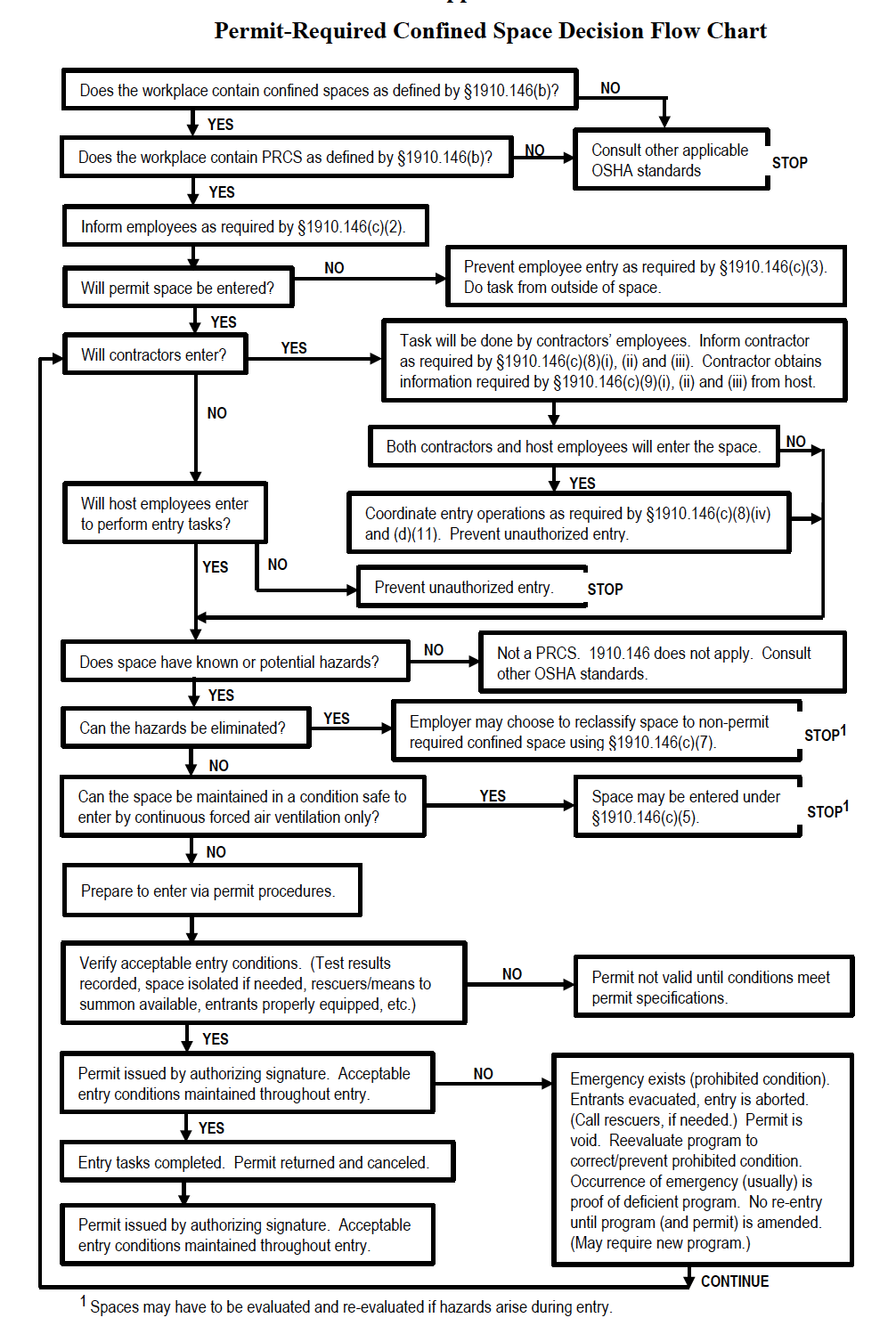
As our debate/discussion continues regarding falls within or into a Confined Space and if that fall hazard is one that makes the CS a PRCS and if a PRCS can be reclassified when there is a fall hazard present. I keep sharing OSHA language and it keeps being diced up and rephrased to meet personal agendas. Look, if anyone wants to manage the fall hazards via their entry permit system, I am in NO WAY saying you can not do it. What I am saying is that we need to stop laying claim that OSHA requires it. Granted, OSHA is the bottom of the proverbial safety barrel and as I have written many times, we MUST do better in safety than just meeting OSHA minimums. I have received countless e-mails and about 50% say a PRCS that contains a “fall hazard” can NOT be reclassified and surprisingly the other 50% danced around the idea that if the entrants were wearing personal fall arrest system (PFAS) that this would allow for the space to be reclassified. I still can not believe these arguments so many passionately defend, but to establish the fact that wearing a PFAS does NOT ELIMINATE the hazard, but merely controls the hazard. Thus if we treat a fall hazard as a “recognized serious safety and health hazard” that would prevent a PRCS from being reclassified to a non-PRCS; merely requiring the entrants (and/or attendants) to wear PFAS does NOT eliminate the hazard – which 1910.146(c)(7) requires ELIMINATION of the “hazards” which made the space a PRCS. Here is what OSHA had to say about “controlling” a hazard and “eliminating” a hazard as it relates to confined spaces…