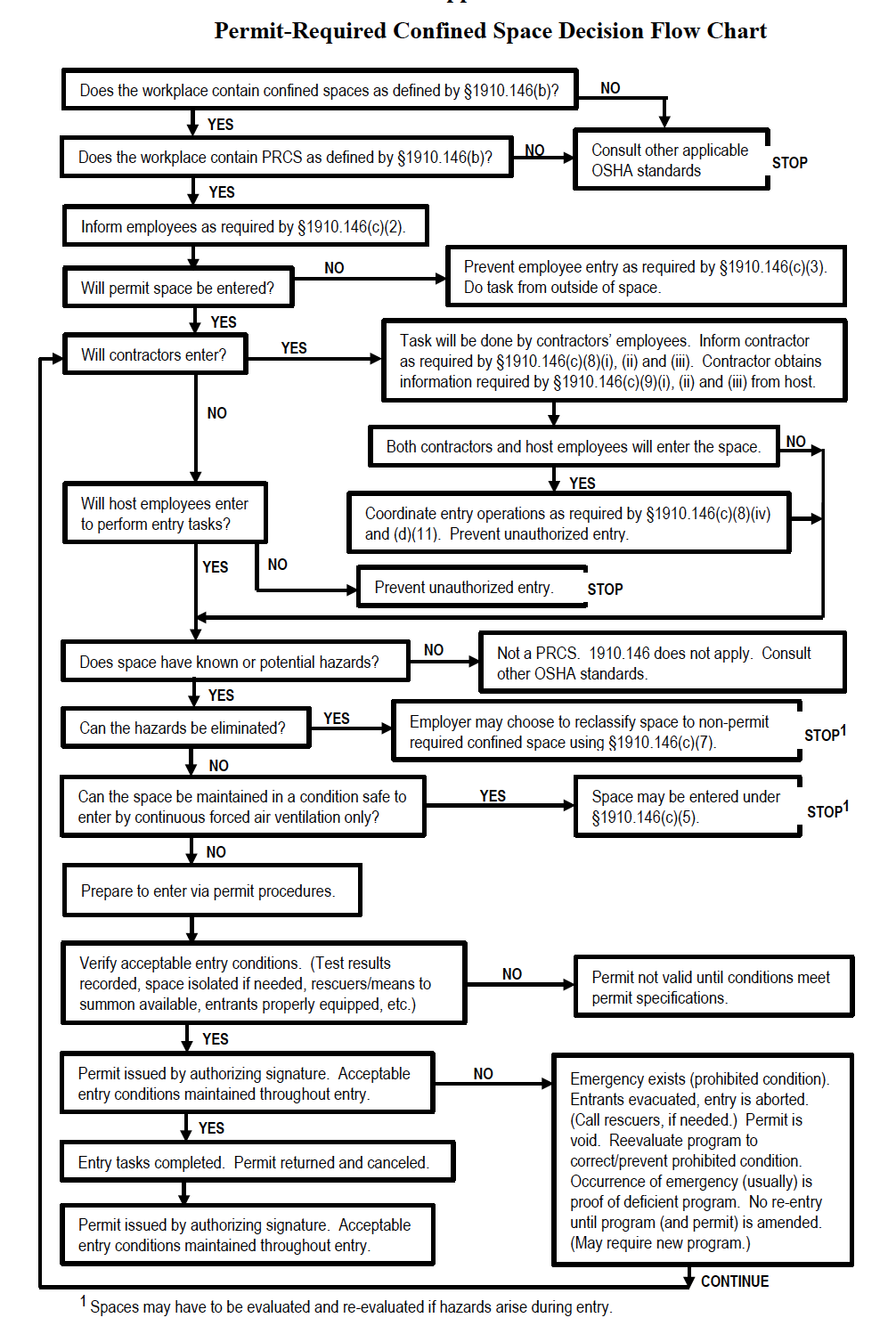
Evaluating a Confined Space

A space is a CONFINED SPACE when ALL THREE (3) of the following characteristics are true about the space:

  1. Is large enough and so configured that an employee can bodily enter and perform assigned work; AND
  2. It has limited or restricted means for entry or exit; AND
  3. It is not designed for continuous employee occupancy

Once you have determined the space is a CONFINED SPACE, the next step is to determine if your CONFINED SPACE has at least ONE (1) of the following hazards that would elevate it to the status of a PERMIT-REQUIRED CONFINED SPACE. Remember, ONLY ONE of the characteristics below need to be true for the CONFINED SPACE to become a PERMIT-REQUIRED CONFINED SPACE. These hazards are:

  1. Contains or has the potential to contain a hazardous atmosphere;
  2. Contains a material that has the potential for engulfing an entrant;
  3. Has an internal configuration such that an entrant could be trapped or asphyxiated by inwardly converging walls or by a floor which slopes downward and tapers to a smaller cross-section; or
  4. Contains any other recognized serious safety or health hazard.

To clarify a few other points:

  • the presence of asbestos is not a hazard recognized by the PRCS standard. Yes, it is a serious safety and health hazard, but asbestos does NOT pose an imminent/acute hazard that would impair an entrant from self-rescue and thus does not have to be considered in a PRCS evaluation. CPL-02-00-100 states:
Where employees are exposed to atmospheric or toxic hazards which do not present an immediate danger of death or disability that would render the employee unable to escape from the confined space e.g., air contaminants such as arsenic or asbestos) OSHA's health standards for those hazards apply rather than 1910.146, and employees must be appropriately protected in accordance with those health standards. The PRCS standard is intended to protect entrants against short-term, acute hazards (not exposures at or below the permissible exposure limits); other standards address a broader range of health and safety concerns.
  • breaking the plane of the space – “if an entry has not occurred until the head breaks the plane, then 97% of an entrant’s body would be in the space if he/she went feet first into the space, and a permit would not be needed since their head is still outside the space. OSHA changed it to any part of your body. As a personal preference, the hazardous atm’s care the heck out of me, so I treat those spaces that I can only get my head in as a PRCS, BUT THIS IS NOT REQUIRED BY REGULATORY LANGUAGE – just personal preference from experience. The other nightmare we see from time to time is they use the BIGGEST WORKER as a measuring stick a, and since the 6’8 350 worker cannot fit into the space, then it is not a CS,nd therefore it can not be a PRCS. This is just CRAZY and LAZY.
  • Too many people make the mistake, I am guilty of it too, by using the terms CONFINED SPACE and PERMIT-REQUIRED CONFINED SPACE interchangeably. These are entirely different spaces by definition – yes, they may physically be the same space, but the conditions within them are what distinguish them. If you read the comments from the NPRM there was quite a debate about how the standard would be laid out as many thought the current method is too complex and causes confusion. Go figure!!!!
Scroll to Top