
It appears we may be blending 1910.146(c)(5) and (c)(7) in our attempt to reclassify a PRCS to a non-permit status. We must follow (c)(7) in our reclassification efforts. It does sound as if our PRCS may be able to be reclassified; however, I am not familiar with the type of space or specific situation.
OSHA states in (c)(7) that a PRCS can be reclassified if it has NO known OR potential hazardous atm. It also says in the CPL and preamble that ALL other hazards MUST BE “ELIMINATED.” Using the term “eliminated” is key; as in (c)(5), OSHA allows the hazardous atm to be “controlled” using the force air ventilation. But when reclassifying a PRCS, ALL hazards MUST BE “ELIMINATED.”
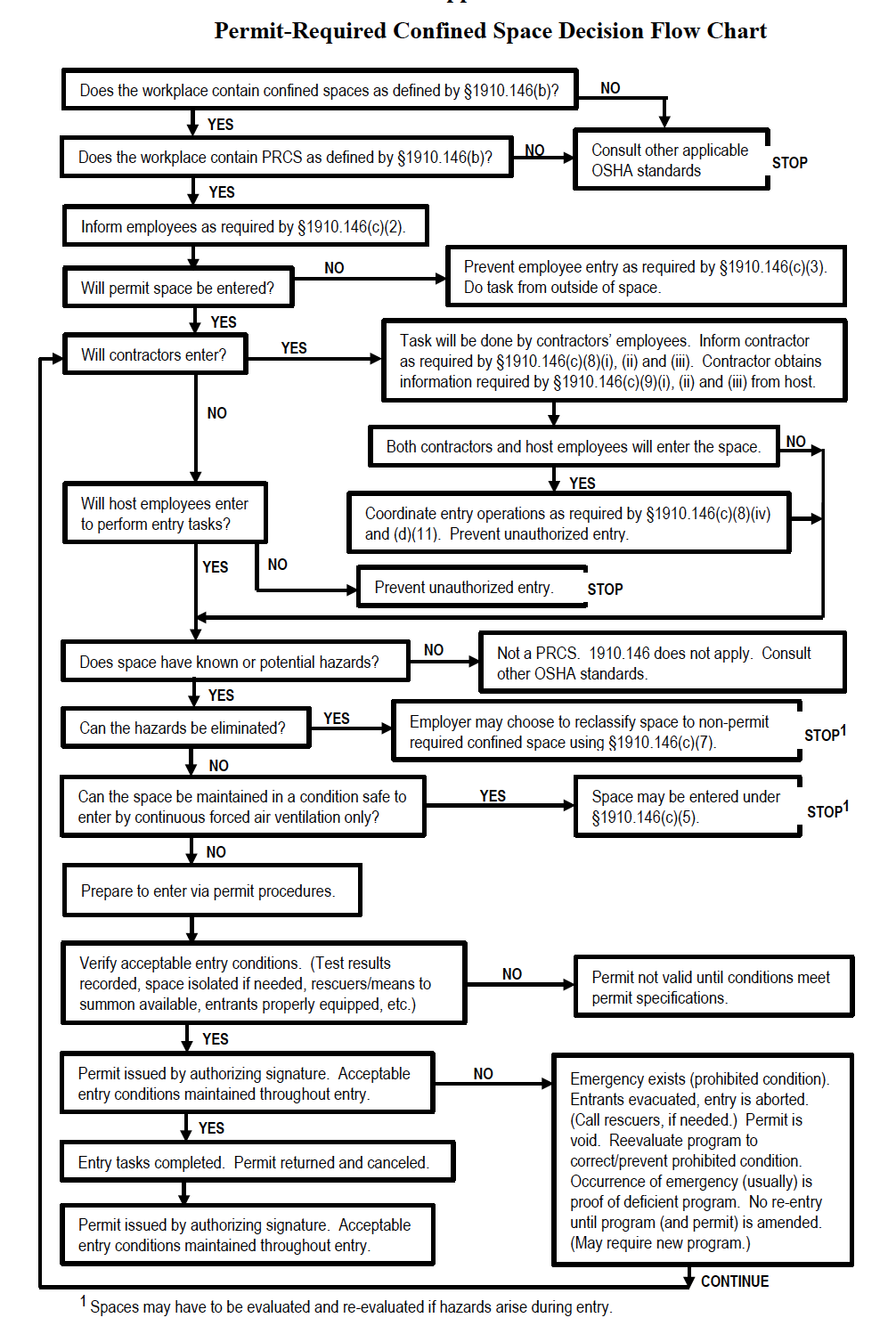
In your PRCS w/ sand, you would need to utilize one (1) of the three (3) acceptable energy isolation methods to ensure that the space is properly isolated from ALL potential physical hazards (e.g., more sand entering the space burying entrants, agitators/sweep arms/augers, etc.). We can look at OSHA’s revised LOTO CPL on pages 3-10, where they have finally made CRYSTAL CLEAR that ALL “flowable hazardous forms of energy” must be isolated using either:
- Double Block and Bleed,
- Blanking/Blinding, or
- Disconnect & Misalignment.
This means that ALL the lines/pipes/ducts/hoses going to and from the space MUST BE ISOLATED using one of these three (3) methods. Once we have isolated ALL the energy sources to and from the space, as well as those inside the space (e.g., sweep arms, augers, agitators, unguarded equipment, etc.) we are ready to reclassify the space from a PRCS to a non-permit status. 1910.146(c)(7) has one (1) more requirement that many overlook, and that is ALL of the actions we took to ELIMINATE the hazards must be documented and made available to the entrants.
This documentation must contain the following:
- the name/location of the space,
- the date of the recertification, and
- the signature of the person certifying the hazards have been ELIMINATED
I consider this to be a miniature “entry permit.”
Our sampling of the atm 5+ times is really no use for “reclassifying a PRCS.” Remember, OSHA states that ONLY those spaces with NO KNOWN or POTENTIAL hazardous atm can be reclassified using (c)(7). If you are sampling for a hazardous atm because of that potential, then the space can NOT be reclassified. I will say this, I ALWAYS check the atm and require continuous monitoring of the atm even after the space has been reclassified; just my requirement and not OSHA’s. The requirement for having a “historical record of sampling data” arises out of 1910.146(c)(5), which is for entering PRCS using “alternative procedures.” (c)(5) is for those PRCSs that are designated as such because they have ONLY a hazardous atm and NO OTHER hazards AND this hazardous atm can be “controlled” using forced air ventilation. This is not something you will need to do for your particular space.
One last thing about reclassifying a PRCS…
Although it is only mentioned in the preamble, OSHA states that no work can occur inside the “reclassified space” that could create a hazardous atm. They specifically mention using flammable/combustible gases and liquids and welding. These two activities obviously have the “potential” to generate a hazardous atmosphere, and I am assuming this is where OSHA is coming from, as (c)(7) clearly states that no employee can be inside the space if a hazardous atm appears.
Some of the previous posts to your question refer to rescue and entry/egress methods.
When a PRCS has been reclassified to a non-permit status meeting (c)(7), these issues are no longer in play. A space that has been reclassified using (c)(7) is NO longer required to meet sections 1910.146(d) through (k), except for (g), which is the training section of the standard. So no rescue setup is required, including non-entry and entry rescue. Means of egress are not a consideration because we are not disputing the space is a still “confined space”; we are just ELIMINATING the hazards that made the CS a PRCS, so the size or number of openings does not have a role in the reclassification.
I hope this helps.
Bryan

