
Here we sit in the year 2018 and here I sit posting about the use of “low-melting-point materials” for use in flammable liquids and flammable gases piping systems – oh the insanity, but this debate seems to happen far too often these days! I have been working with Hazardous Materials, most notably Flammable Liquids and Gases (FLAGs) since 1992 and from my very first fire science class and hazardous materials classes at Murray State University I was taught you NEVER EVER use “low-melting-point materials” for the conveyance of a flammable HAZMAT. And for those of you who are still fighting this fight, either in the PSM arena or just in ordinary uses, we have basic fire codes (even lower in the layers of code than OSHA) that have prohibited this design for decades. The IFC, Chapter 57 FLAMMABLE AND COMBUSTIBLE LIQUIDS states the following: (emphasis by me)
5703.6.2.1 Special materials.
Low-melting-point materials (such as aluminum, copper or brass), materials that soften on fire exposure (such as nonmetallic materials) and nonductile material (such as cast iron) shall be acceptable for use underground in accordance with the applicable standard listed in Table 5703.6.2.
Where such materials are used OUTDOORS IN ABOVE-GROUND PIPING SYSTEMS or WITHIN BUILDINGS, they shall be in accordance with the applicable standard listed in Table 5703.6.2 AND one of the following:
- Suitably protected against fire exposure.
- Located where leakage from failure would not unduly expose people or structures.
- Located where leakage can be readily controlled by operation of remotely located valves in a location provided with ready access.
In all cases, nonmetallic piping shall be used in accordance with Section 27.4.6 of NFPA 30.
Here is Table 5703.6.2, SAFTENG members can read my breakdowns of B31.3 and B31.5 standards as they relate to process safety.
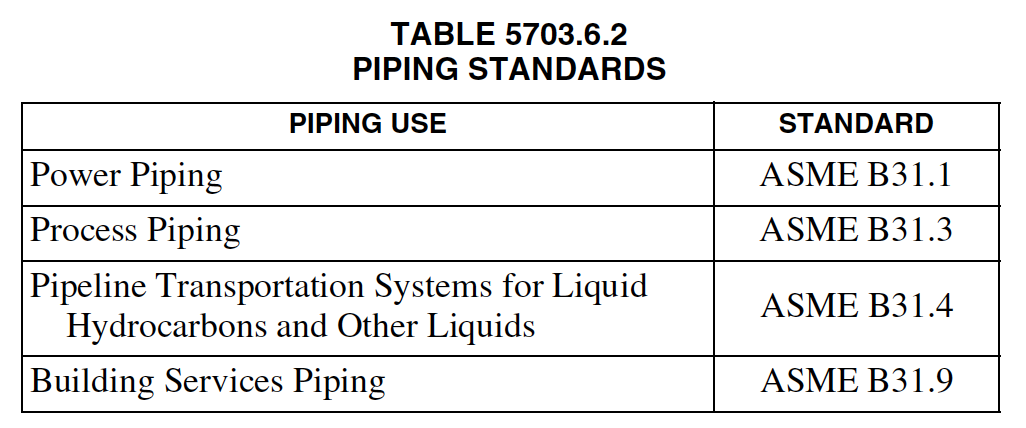
Now maybe your facility is located in a state that has not adopted a HAZMAT and/or flammable liquid code such as the IFC, don’t despair, as OSHA’s 1910.106 standard was based on 19060’s version of NFPA 30 which goes hand-in-hand with the IFC with regards to “low-melting materials”…
1910.106(c) “Piping, valves, and fittings” –
1910.106(c)(1) “General” –
1910.106(c)(1)(i) “Design.” The design (including selection of materials) fabrication, assembly, test, and inspection of piping systems containing flammable liquids shall be suitable for the expected working pressures and structural stresses. Conformity with the applicable provisions of Pressure Piping, ANSI B31 series and the provisions of this paragraph, shall be considered prima facie evidence of compliance with the foregoing provisions.
1910.106(c)(1)(ii) “Exceptions.” This paragraph does not apply to any of the following:
1910.106(c)(1)(ii)(a) Tubing or casing on any oil or gas wells and any piping connected directly thereto.
1910.106(c)(1)(ii)(b) Motor vehicle, aircraft, boat, or portable or stationary engines.
1910.106(c)(1)(ii)(c) Piping within the scope of any applicable boiler and pressures vessel code.
1910.106(c)(1)(iii) “Definitions.” As used in this paragraph, piping systems consist of pipe, tubing, flanges, bolting, gaskets, valves, fittings, the pressure containing parts of other components such as expansion joints and strainers, and devices which serve such purposes as mixing, separating, snubbing, distributing, metering, or controlling flow.
1910.106(c)(2) “Materials for piping, valves, and fittings” –
1910.106(c)(2)(i) “Required materials.” Materials for piping, valves, or fittings shall be steel, nodular iron, or malleable iron, except as provided in paragraph (c)(2)(ii), (iii) and (iv) of this section.
1910.106(c)(2)(ii) “Exceptions.” Materials other than steel, nodular iron, or malleable iron may be used underground, or if required by the properties of the flammable liquid handled. Material other than steel, nodular iron, or malleable iron shall be designed to specifications embodying principles recognized as good engineering practices for the material used.
1910.106(c)(2)(iii) “Linings.” Piping, valves, and fittings may have combustible or noncombustible linings.
1910.106(c)(2)(iv) “Low-melting materials.” When low-melting point materials such as aluminum and brass or materials that soften on fire exposure such as plastics, or non-ductile materials such as cast iron, are necessary, special consideration shall be given to their behavior on fire exposure. If such materials are used in ABOVE GROUND PIPING SYSTEMS or INSIDE BUILDINGS, they shall be suitably protected against fire exposure or so located that any spill resulting from the failure of these materials could not unduly expose persons, important buildings or structures or can be readily controlled by remote valves.
This IFC requirement applies to pipe that may fail under exposure to a fire as a result of heat reducing its material strength. The requirement is limited to specific installations and locations. Pipes that have “low melting points” can fail by sagging when exposed to fire. Sagging can cause a joint to separate or the pipes to burst if the piping is under pressure. These failures would result in the flammable and combustible liquids being exposed to the fire and air. The UNDERGROUND limitations on the use of these piping materials reduces their exposure to a fire.