
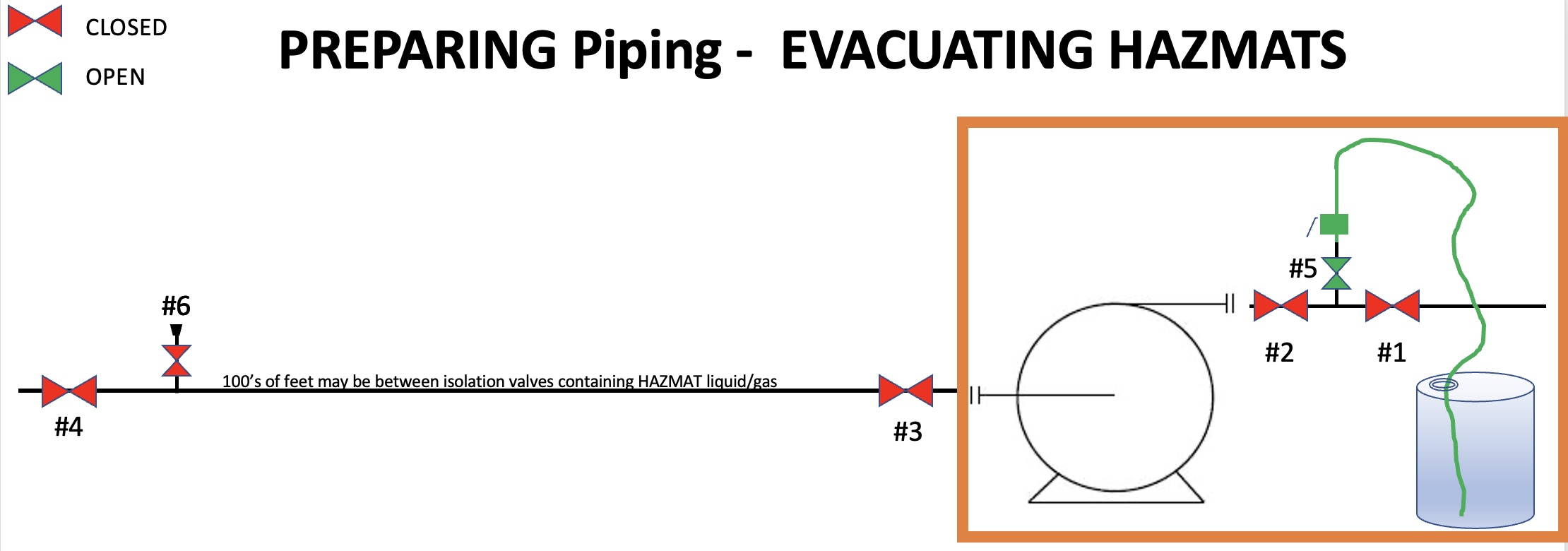
Establishing a Double Block and Bleed (DB&B) positive isolation is a critical safety protocol when preparing piping and equipment for opening, especially when dealing with Extremely Hazardous Substances (EHS). This process ensures that hazardous materials (HAZMAT) are effectively evacuated and isolated to protect workers from accidental releases.
Members can download my .ppt file at bottom of the page.
Phase 1: Preparing and Evacuating Piping
Before a piece of equipment, such as a pump, can be removed from a process, the system must be emptied of hazardous liquid/gas/vapor.
- Utilize Process Flows: Use existing flows to remove as much liquid as possible from the piping.
- Sequential Valve Operation: Close the primary feed valve (Valve #1) while the pump is still running. This pulls residual liquid out of the feed piping.
- Avoid Cavitation: Monitor the pump closely during this stage to ensure it does not cavitate.
- Final Shutdown: Once the liquid is minimized, stop the pump and close the secondary valve (Valve #2). While liquid levels should now be minimal, the area between the valves will still contain dangerous high-expansion HAZMAT gas or vapors.
Phase 2: Lockout and Bleed Setup
Once the valves are positioned, they must be secured to prevent accidental re-energization.
- Lockout/Tagout (LOTO): Apply lockout devices and locks to Valves 1 and 2 in the CLOSED position.
- Bleed Valve Preparation: Follow all Safe Work/Opening Permit requirements. While the bleed valve (Valve #5) is closed and locked out, carefully remove any caps, plugs, or gauges on the vent.
- Safety Awareness: Workers must remain vigilant and STAY OUT OF THE LINE OF FIRE during these maneuvers.
- Hardware Connection: Attach a “Dead-Man Valve” piping assembly to the threaded pipe connection using proper thread sealant and torque. Some assemblies may include a check-valve to prevent backflow into the process.
Phase 3: Scrubbing Gas and Vapors
Evacuating the trapped gas requires a scrubbing media to neutralize the HAZMAT.
- Media Estimation: For anhydrous ammonia ($NH_3$), ensure at least one gallon of solution (typically water) for every one pound of gas/vapor estimated to be between the valves. This may require a 5-gallon bucket, a 55-gallon drum, or a larger tote depending on the volume.
- Scrubbing Container Requirements:
- The container must be capable of handling a “liquid event” and the total volume of HAZMAT.
- It must be a closed-top container with the bleed hose fitting through the smallest possible bung.
- Both bungs must remain open to allow the container to breathe.
- The transfer hose should be weighted to remain at the bottom of the scrubbing solution.
Phase 4: The Evacuation Procedure
The actual transfer of gas must be handled with extreme caution.
- Leak Check: Slowly crack open the bleed valve (Valve #5) with the Dead-Man valve closed to check the assembly for leaks.
- Controlled Venting: If secure, open the bleed valve to 50% and then slowly open the Dead-Man valve.
- Gas-Only Verification: Vent gas or vapor only; do not fully open the Dead-Man valve until you are certain no liquid remains.
- Worker Positioning: The Dead-Man valve must be installed at the point-source, and the scrubbing container should be placed far enough away to allow the operator to escape should an incident occur.
- Monitoring: Keep all personnel away from the container. Watch for bubbles as an indication that the gas transfer is ongoing; when bubbles stop, the transfer is complete. Personnel checking for bubbles must wear PPE that protects against splash and inhalation hazards.
Phase 5: Final Verification and Isolation
After evacuation, the system must be verified as “Zero Energy” (ZES).
- Clearance Check: Close the bleed valve, remove the Dead-Man assembly, and then slowly re-open the bleed valve to 50% to double-check that the line is truly gas and vapor-free.
- Locking the Bleed: If the line is clear, open the bleed valve 100% and lock (or tag) it in the OPEN position.
- Completion: This establishes a DB&B isolation with verified ZES for the equipment opening. This process must be repeated on the other side of the break or opening.
Critical Warning: Nullifying Isolations
A DB&B isolation is only effective if it is absolute. The introduction of an auxiliary line—such as a 1/4″ caustic line—tying into the space between the isolation valves nullifies the positive means of isolation. Even if the auxiliary valve is locked closed, it is no longer considered a proper Double Block and Bleed. This type of setup is unacceptable unless the auxiliary line itself is isolated using its own Double Block and Bleed.
What specific chemical or process are you planning to isolate for your next equipment opening?