
1/165/15 UPDATE…
From an “OSHA Memorandum for Regional Administrators” dated 8/22/11 (THANKS Keith!)
| August 22, 2011 | |
| MEMORANDUM FOR: | REGIONAL ADMINISTRATORS |
| FROM: | JAMES G. MADDUX, Director Directorate of Construction |
| SUBJECT: | Fall protection on aerial lifts during construction activities. |
On January 14, 2009, OSHA issued a letter of interpretation regarding the use of a particular shock absorbing lanyard to satisfy the requirements found in §1926.453(b)(2)(v). The Directorate of Construction has received inquires from regional offices, area offices, and the public asking if the January 2009 letter banned the lanyard in question.
OSHA did not ban the particular lanyard but stated, based on the manufacturer’s instructions, which stipulated a minimum anchor point height of 18.5 feet, that it was likely that the lanyard’s use would not comply with OSHA standards at lower heights.
In such cases, use of the lanyard below 18.5 feet would apparently not provide adequate fall protection. This determination has raised questions about the use of body harnesses, typically married with appropriate lanyards, for fall protection in aerial lifts. To help avoid any confusion on the issue, DOC is rescinding the January 2009 letter, #20070823-7896.
Under subpart L, employers must ensure that employees tie off at all times when working from an aerial lift [§1926.453(b)(2)(v)]. Employers must ensure that employees using personal fall arrest systems while working on aerial lifts at heights six feet or more above a lower level comply with §1926.502(d) of subpart M, specifically:
Personal fall arrest systems, when stopping a fall, shall:
…
(iii) be rigged such that an employee can neither free fall more than 6 feet (1.8 m), nor contact any lower level. [§1926.502(d)(16)(iii)]
However, §1926.502(d) does not require employers to comply with manufacturer’s instructions when using personal fall arrest systems. To cite §1926.502(d)(16)(iii), the facts must show that the personal fall arrest system would permit a free fall of more than six feet or would permit contact with a lower level – and not base this conclusion solely on information provided by the manufacturer.
As has been the Agency’s longstanding policy, an employer may comply with OSHA’s fall protection requirements for aerial lifts in one of three ways:
- Use of a body belt with a tether anchored to the boom or basket (fall restraint system),
- Use of a body harness with a tether (fall restraint system), or
- Use of a body harness with a lanyard (fall arrest system).
If you have any questions regarding this memorandum, please contact Eric Harbin or me at (202) 693-2020.
The debate over the height at which fall protection begins in GENERAL INDUSTRY workplaces has been going strong for a number of years now, but now OSHA has “officially” stated the height is 4 feet! This has always been stated throughout 1910.23, but there are still many who believe it to be 6′ – like the construction industry. OSHA has now clarified this in their new FAQ in the “enforcement section” (https://www.osha.gov/OSHA_FAQs.html)…
What are the fall protection requirements?
OSHA requires employers to protect workers from falls. Falls can cause death and very serious injuries –and can be prevented. OSHA’s fall protection requirements are as follows: for general industry, fall protection must be used while working at heights of four or more feet (see www.osha.gov/SLTC/fallprotection/index.html). In maritime, specifically ship repair, fall protection is required at five feet or greater on vessels, and longshoring operations generally require fall protection at eight feet or greater (see www.osha.gov/dts/maritime/compliance.html). Fall protection can be accomplished through the use of guardrail systems, safety net systems, personal fall arrest systems, or similar systems.
For construction operations, fall protection generally must be used at heights of six feet or greater. Falls are the leading cause of death in the construction industry. Fall protection can be accomplished through the use of guardrail systems, safety net systems, or personal fall arrest systems. Certain worksite activities and/or locations may allow other methods (including, but not limited to positioning device systems, warning line systems, and controlled access zones) to be used. For further information on OSHA’s requirements for protecting workers from falls, please seeOSHA’s Fall Prevention Web page.
The following OSHA standards contain construction fall protection requirements:
- Fall Protection Standard Subpart M – www.osha.gov/pls/oshaweb/owasrch.search_form?p_doc_type=STANDARDS&p_toc_level=1&p_keyvalue=Construction#1926_Subpart_M
- Scaffolds Standard Subpart L – www.osha.gov/pls/oshaweb/owasrch.search_form?p_doc_type=STANDARDS&p_toc_level=1&p_keyvalue=Construction#1926_Subpart_L
- Steel Erection Subpart R – www.osha.gov/pls/oshaweb/owasrch.search_form?p_doc_type=STANDARDS&p_toc_level=1&p_keyvalue=Construction#1926_Subpart_R
- Ladders Standard Subpart X – www.osha.gov/pls/oshaweb/owasrch.search_form?p_doc_type=STANDARDS&p_toc_level=1&p_keyvalue=Construction#1926_Subpart_X
For further information on this subject, please see OSHA’s Fall Prevention Web page and Fall Protection in Residential Construction Web page.
Safety Tip: When a fall protection program calls for Personal Fall Arrest System (PFAS) at 4′, the traditional PFAS that includes a full body harness, 6′ lanyard, w/ deceleration device does NOT work! This traditional PFAS works ONLY when the anchor point is 18.5′ or higher off the lower level (OSHA Memo). Here is a nice image from a manuafctuerers showing the LIMITATIONS of the traditional PFAS:
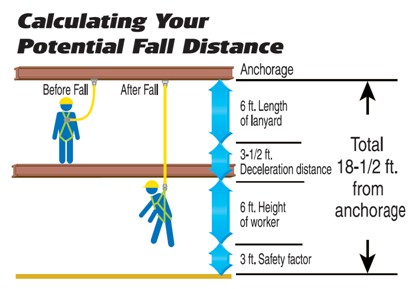
Image Source: http://safetyequipmentfaq.com/2014/01/19/shock-absorbing-lanyard-limitations/