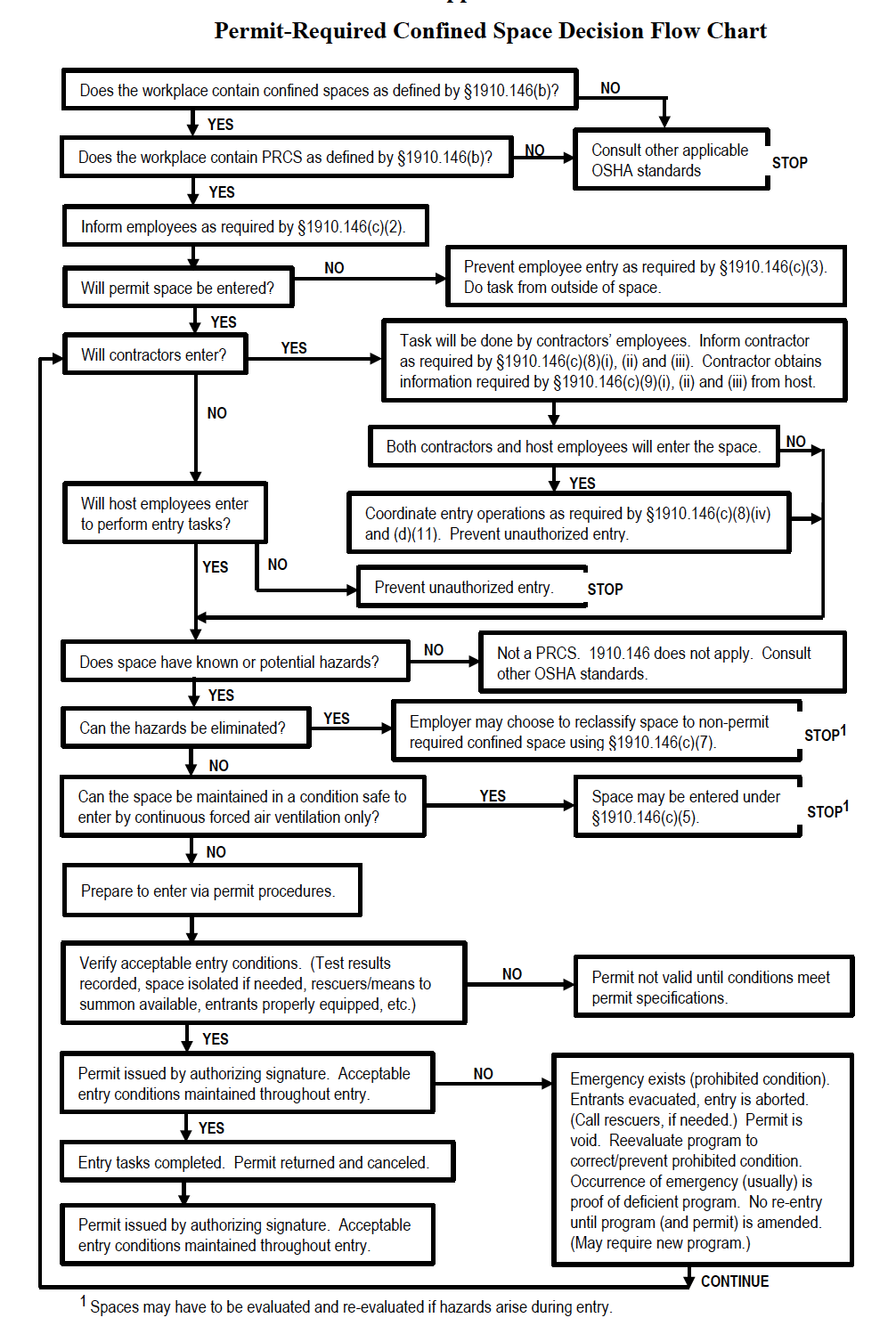
OSHA’s new Confined Space standard for Construction requires a “competent person” in two CRITICAL functions; I should also point out these two functions are also CRITICAL within the General Industry functions as well. These include EVALUATING spaces and RECLASSIFYING a PRCS to a non-PRCS.
Evaluation of Spaces
1926.1203(a) Before it begins work at a worksite, each employer must ensure that a competent person identifies all confined spaces in which one or more of the employees it directs may work, and identifies each space that is a permit space, through consideration and evaluation of the elements of that space, including testing as necessary.
…
1926.1203(f) When there are changes in the use or configuration of a non-permit confined space that might increase the hazards to entrants, or some indication that the initial evaluation of the space may not have been adequate, each entry employer must have a competent person reevaluate that space and, if necessary, reclassify it as a permit-required confined space.
Reclassification of a PRCS
1926.1203(g) A space classified by an employer as a permit-required confined space may only be reclassified as a non-permit confined space when a competent person determines that all of the applicable requirements in paragraphs (g)(1) through (4) of this section have been met:…
But does this mean that the same “competent person” who did the CS Evaluation(s) is also a “competent person” in the requirements to RECLASSIFY a PRCS to a non-Permit Space?
Both of these tasks are CRITICAL to ensuring the safety of workers involved with working in and around PRCSs, as any error, ever how small, can have disastrous effects. But did you notice the definition of a “competent person” in 1926.1202 includes a little kicker?
Competent person means one who is capable of identifying existing and predictable hazards in the surroundings or working conditions which are unsanitary, hazardous, or dangerous to employees, and who has the authorization to take prompt corrective measures to eliminate them.
Did you catch it… and who has the authorization to take prompt corrective measures to eliminate them. This is implying that the “competent person” must also have some level of authority so as to have “authorization to take prompt corrective measures to eliminate them”. As I noted in my last article about the “competent person” being a summer intern or a recent college graduate, this little add-on to the definition implies the “competent person” MUST be someone with some level of authority in which he/she can take “prompt corrective measures to eliminate” the hazards to the employees or maybe it is to remove the employees from the hazard!
But are the same set of skills used when performing the CS evaluation as are used when RECLASSIFYING a PRCS to a non-PRCS?
No WAY! One skill set merely relies on the ability to identify POTENTIAL HAZARDS and the other necessitates the ability to ELIMINATE hazards. Saying HAZARD IDENTIFICATION skills are the same as HAZARD ELIMINATION skills does an injustice to both skill sets. Granted, a lot of people may posses BOTH skill sets, BUT not everyone will and this is the point I am trying to make. We may need different “competent people” who poses different sets of skills to ensure EACH of these critical paths (e.g. CS Evals and Reclassification) are managed at the highest level of expectations.
I know in my years as a safety professional in the chemical industry, anytime a PRCS wanted to be “reclassified” there were many layers of review and approval before it could be done. But that was soon after 1910.146 came out (1993) and these days we are finding (c)(7) being used more and more; however, most are not being done correctly and this just makes me cringe at the thought of what could have gone wrong. Call it lack of knowledge or lack of proper skill set, we can not accept any errors/deviations when RECLASSIFYING a PRCS. Remember the reclassification process is taking a space in which the CS evaluator identified a hazard in that space that was so significant it rises to the level of requiring an “entry permit” and all those things associated with the permit before anyone could enter the space. Now we are going to ELIMINATE these hazards which made the CS a PRCS. Notice I used all caps to spell ELIMINATE; that’s because to reclassify a PRCS, ELIMINATION of the hazards is required. I have written many times about the difference between ELIMINATE and CONTROL and OSHA has made it very clear that for a space to be RECLASSIFIED the hazards MUST be eliminated. The skills necessary to identify and implement the ELIMINATION measures are entirely different from those necessary to identify the hazards. If you do not believe me, just do this at your next PRCS training session…. Ask the group to identify hazards associated with some of your PRCSs. And then ask the same groups to write down, as an individual, how they would personally ELIMINATE each hazard that was identified and then compare those answers to 1910.146 and CPL-147. What we will see is that most safety programs have emphasized the IDENTIFICATION of hazards by everyone on the plant site, but the manner in which the hazard gets managed has been left up to the safety and engineering groups. This means that the CONTROL/ELIMINATION techniques are not as well ingrained into our workforce yet and this can be a SERIOUS gap in skills needed to reclassify a PRCS.
So when we wave that “magic safety wand” over the heads of our workers and declare them a “competent person” for confined spaces, BE VERY CAREFUL as to what we are declaring, as one set of competency skills does not necessarily carry over to the other! And if you can’t find your “magic safety wand”, check with your maintenance manager… he/she probably used it last to “qualify” all his/her maintenance personnel as “qualified electrical workers”!!!!