
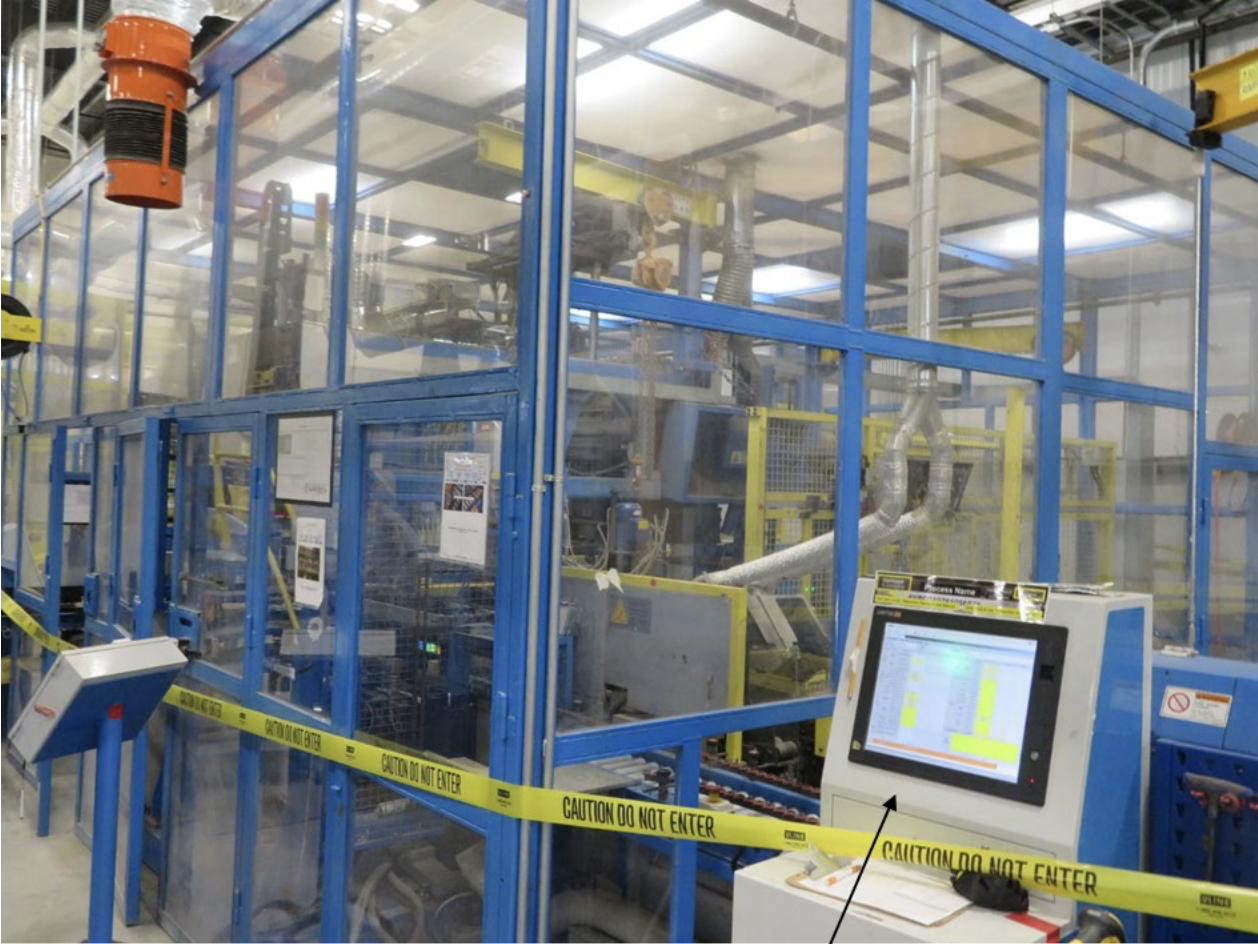
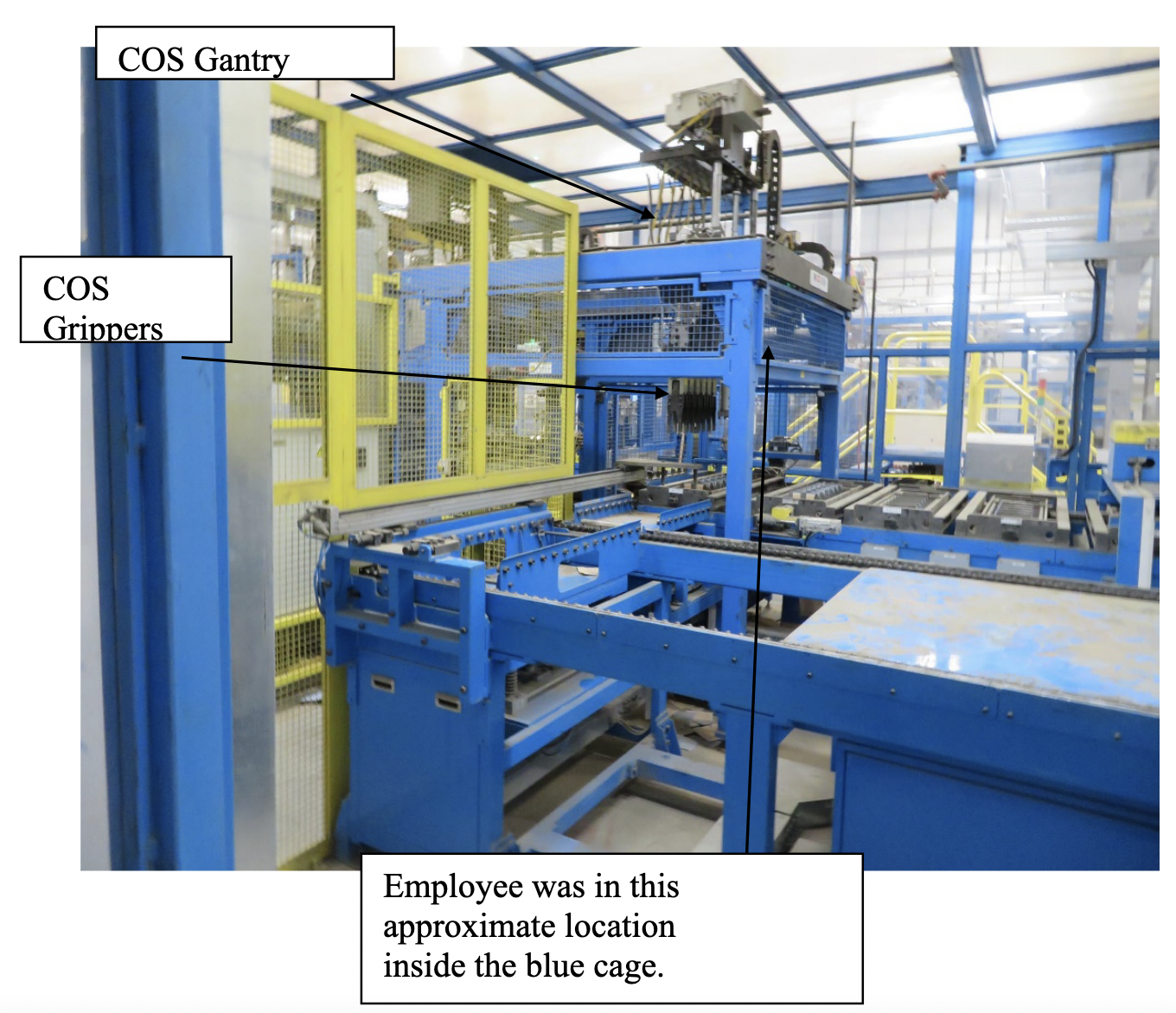
 A 48-year-old male employee was crushed inside a machine (COS) while adjusting the grippers that place lead cells into batteries. This employer is a battery manufacturer. On the day of the incident, the victim was called by the machine operator to troubleshoot the COS machine because the grippers were not working. It was determined that the operator would attempt to make the adjustments through manual mode alone. Still, if unsuccessful, maintenance will be called to enter the caged area to assist with the adjustment from inside the cage.
Employees are trained to put the COS machine in manual mode to prevent it from moving in normal production mode and leave the interlocking door open while in the caged area so the machine will not move or operate when they enter the caged area. However, interviews indicated that this procedure was only used when supplying or removing lead plates/posts and not for making adjustments to the grippers.
It was determined that to adjust the gripper fingers, a power supply was needed; therefore, LOTO was not used. When this additional step is required, the maintenance employees have to close the interlocked door to make the adjustments.
The victim called a contractor with WiTech to assist him in making the adjustments. (WiTech employees are contractors from Korea that worked in the employer’s Korean facility as maintenance employees on the same machinery.)
The victim entered the COS Machine through an interlocked door while the contractor and machine operator were outside the machine at the controls. The operator and the contractor manned the controls to make slight adjustments to the grippers, per the victim’s request from inside the cage. Additionally, they man the controls to ensure it stays in manual mode.
Management and employees stated that only the Korean maintenance employees enter the caged areas to make these adjustments to the gripper as they are familiar with the same equipment from the employer’s operations in Korea. The employer considers the machine and equipment still new to the American employees, so they rely on the Korean maintenance employees until they have more time to train the American techs.
The machine operator said she heard a noise and they rushed around to see that the victim had been struck in the chest by the COS Gantry which housed the grippers. There was no determination made as to movement of the gantry.
Citation 1 Item 1
Type of Violation: Serious $2,400
29 CFR 1910.147(c)(5)(ii): Lockout devices and tagout devices were not singularly identified; were not the only devices used for controlling energy; were used for other purposes, and did not meet the requirements of subparagraphs (A) through (D):
In that, lockout devices were used to take the COS Machine out of service after the fatality had occurred and not for LOTO purposes.
Citation 1 Item 2
Type of Violation: Serious $2,400
29 CFR 1910.147(c)(7)(i)(A): Authorized employee(s) did not receive training in recognition of applicable hazardous energy sources, the type and magnitude of the energy available in the workplace, and the methods and means necessary for energy isolation.
In that, maintenance employees that perform servicing and maintenance, such as but not limited to locking out electrical and pneumatic energy sources on the COS line, had not received training as authorized employees.
Citation 2 Item 1
Type of Violation: Willful-Serious $54,000
29 CFR 1910.147(c)(4)(i): Procedures were not developed, documented and utilized for the control of hazardous energy when employees were engaged in activities such as servicing and/ or maintenance of equipment.
In that lockout procedures were not utilized to control the hazardous energy when employees entered the COS Machine to adjust the grippers.