
In the world of Process Safety Management and processes containing flammable liquids and gases, the management of hazardous locations (HAZLOC) can be very difficult to manage; especially when a facility decides that some of their “Nonincendive” devices are acceptable. The use of “Nonincendive Equipment” is one (1) of the twelve (12) acceptable “protection techniques” offered by NFPA 70; however, it comes with one (1) very LARGE limitation…
500.7(G) Nonincendive Equipment. This protection technique shall be permitted for equipment in Class I, Division 2; Class II, Division 2; or Class III, Division 1 or 2 locations.
Did you see it? Or better yet, it is what you did NOT see.
The use of this protective technique is PROHIBITED for use in Class I and II, Division 1 HAZLOCs.
Now there is no official limitation from NFPA 70 regarding the use of this protection technique for “MOBILE/PORTABLE EQUIPMENT”, but in my years I learned this technique was reserved for FIXED EQUIPMENT that is PERMANENTLY located in a Class I or II, Div 2 HAZLOC. I was taught that this protective method was NEVER intended to apply to “mobile/portable equipment” which could find its way into a Class I or II, Division 1 HAZLOC.
So let’s take a look at where a Division 1 HAZLOC could be located so that we can understand how easy we could take mobile Nonincendive Equipment in one of these designated areas:
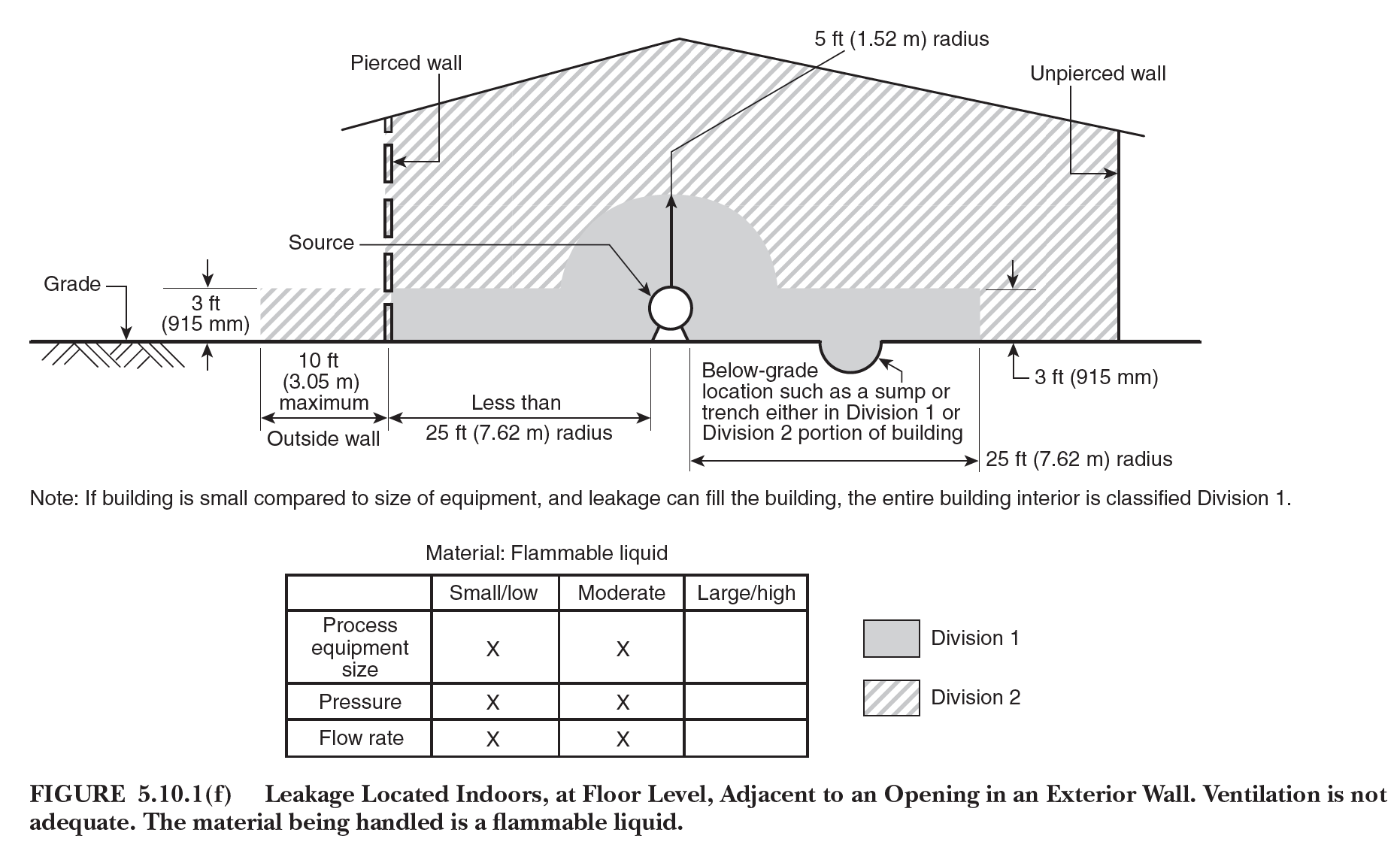
Source: NFPA 497 (2017)
As we can see, the Class I, Div 1 HAZLOC can be a 5′ bubble around the leak point and beyond the 5′ bubble the Div 1 HAZLOC will travel horizontally for 25′ (indoors – outdoors is 15′) at a height of 3′. In this Div 1 area we are PROHIBITED from using Nonincendive Equipment as a protection technique. So what does NFPA consider to be Nonincendive Equipment [as applied to Hazardous (Classified) Locations]
Equipment having electrical/electronic circuitry that is incapable, under normal operating conditions, of causing ignition of a specified flammable gas–air, vapor–air, or dust–air mixture due to arcing or thermal means.
In our travels, we see a lot of portable radios that carry the Nonincendive Equipment rating as these radios can be considerably less expensive than those carrying the Intrinsically Safe ratings. Portable radios (or any equipment) carrying the Nonincendive Equipment rating are perfectly acceptable AS LONG as they NEVER find their way into a Class I or 2, Div 1 rated area and as shown above and remember a Div 1 location usually includes the following locations (per NFPA 70):
-
- Where volatile flammable liquids or liquefied flammable gases are transferred from one container to another
- Interiors of spray booths and areas in the vicinity of spraying and painting operations where volatile flammable solvents are used
- Locations containing open tanks or vats of volatile flammable liquids
- Drying rooms or compartments for the evaporation of flammable solvents
- Locations containing fat- and oil-extraction equipment using volatile flammable solvents
- Portions of cleaning and dyeing plants where flammable liquids are used
- Gas generator rooms and other portions of gas manufacturing plants where flammable gas may escape
- Inadequately ventilated pump rooms for flammable gas or for volatile flammable liquids
- The interiors of refrigerators and freezers in which volatile flammable materials are stored in open, lightly stoppered, or easily ruptured containers
- ALL locations where ignitible concentrations of flammable vapors or gases are likely to occur in the course of normal operations
- The inside of inadequately vented enclosures containing instruments normally venting flammable gases or vapors to the interior of the enclosure
- The inside of vented tanks containing volatile flammable liquids
- The area between the inner and outer roof sections of a floating roof tank containing volatile flammable fluids
- Inadequately ventilated areas within spraying or coating operations using volatile flammable fluids
- The interior of an exhaust duct that is used to vent ignitible concentrations of gases or vapors
In other words, those areas mentioned above would be areas where Nonincendive Equipment would be PROHIBITED. If we can be confident that “administrative controls” can be effective in controlling our ignition sources in HAAZLOCs, then we could make an argument for the use of Nonincendive Equipment ratings for mobile/portable equipment. But it is my opinion we would not be meeting the Hierarchy of Controls by using “administrative controls” over “engineering controls” when allowing portable equipment carrying Nonincendive Equipment at facilities that have Div 1 HAZLOCs.
Lastly, for those who are in PSM/RMP covered processes, we need to define our protection techniques in our PSI…
1910.119(d)(3)(i)(C) Electrical classification
We should list the protection techniques permitted to be used in the covered process(s); as well as for those who have begun using “Zones” rather than Class and Division certain personnel must sign off on these specifications…
1910.307(g)(4) Special precaution. Paragraph (g) of this section requires equipment construction and installation that will ensure safe performance under conditions of proper use and maintenance.
1910.307(g)(4)(i) Classification of areas and selection of equipment and wiring methods shall be under the supervision of a qualified registered professional engineer.
And when someone wishes to use a “protection technique” that is NOT one of those listed in our Process Safety Information – Electrical Classification(s) they would have to complete a Management of Change to add a new “protection technique” that is acceptable for the HAZLOC.