
A few weeks back one of my good friends and a hell of a process safety professional contacted me about OSHA’s Hot Work (HW) referenced RAGAGEP, NFPA 51B. He wanted to be sure he was not missing something, as OSHA still references the Year 1962 Edition of NFPA 51B. Just to show how broken OSHA rulemaking is, NFPA 51B has been revised/updated eleven (11) times since!!! And each time OSHA tries to just update their “referenced” standard they get shut down by the rulemaking process. So it is easy for me to say the rulemaking process is broken and if there ever was evidence that OSHA is the “bottom of the safety barrel” it is with 1910.252, General requirements. I have written a lot about Hot Work because it is one of the 14 Elements of the PSM Standard and each year we see massive losses from improper HW practices. I have also sung the praises of FM Global, a SAFTENG Partner in Safety for many years, and their Property Loss Prevention Data Sheets as a world-class best practice that will far and exceed OSHA’s dated requirements. I have even suggested that many smaller businesses that fall under PSM/RMP and can not afford to by some of the rather expensive RAGAGEPS, to use these FREE Property Loss Prevention Data Sheets to raise their safety performance. And today I want to suggest that we leave the boundaries of 1910.252, General requirements and move into the 21st-century safety practices for HW and implement FM Global Property Loss Prevention Data Sheets 10-3, HOT WORK MANAGEMENT.
You no longer have to be a client of FM Global’s to gain access to their Data Sheets; you just have to register with your name and e-mail and job title and you have access to their entire library for FREE!!! I can not stress this enough – READ ALL of the ones applicable to your business as they are a gold mine of best practices. Today we will focus on HW…
So how big of a problem are HW fires? From 1995 to 2014 (a 20-year period), FM Global clients experienced 736 hot work ignited fires or explosions with a total indexed gross of US $1.9 billion in property loss and business interruption, and an average gross loss of US $2.6 million per incident. THAT IS JUST FM GLOBAL CLIENT LOSSES!!!!
He is the intro to FM Global Property Loss Prevention Data Sheets 10-3, HOT WORK MANAGEMENT…
(emphasis by me)
|
Improperly managed hot work remains a leading cause of large fires and explosions. Based on a review of FM Global loss history, the following conclusions were drawn regarding key factors in hot work losses:
The PRIMARY FOCUS of a hot work management program should be on PURSUING COLD WORK ALTERNATIVES OR, FAILING THAT, RELOCATING THE WORK TO A HOT WORK DESIGNATED AREA. If hot work is unavoidable, it is vital to REMOVE OR ISOLATE COMBUSTIBLE MATERIALS. Regardless of size, any hot work fire or explosion should be viewed as a failure of the hot work management program. The POST-WORK FIRE WATCH AND/OR FIRE MONITORING PERIOD SHOULD BE CONSIDERED A SECONDARY LAYER OF PROTECTION against the uncertainty of identifying and controlling all combustible materials within the hot work area. The appropriate post-work watch and monitoring duration require judgment based on the factors present within the hot work area, including
If the hot work area is unprotected (e.g., unsprinklered), post-work watch and monitoring along with manual fire-fighting required precautions become more critical. AT NO TIME SHOULD ANY LENGTH OF POST-WORK WATCH AND MONITORING BE CONSIDERED A SUBSTITUTE FOR PROPERLY PREPARING AND MAINTAINING THE HOT WORK AREA OR EQUIPMENT. A hot work management process should always BEGIN WITH AND FOCUS ON CONTROLLING COMBUSTIBLES in the hot work area. |
The one thing I do like about the FM practice is their section on “Low-energy hot work” which they define as
Any temporary or routine work (operation) capable of producing mechanical sparks, electrical or electrostatic sparks, or hot surfaces of sufficient energy to ignite ignition-sensitive materials commonly found in hazardous/classified electrical areas (e.g., low-flash point ignitable liquids, flammable gas/vapor, and some combustible dusts); or ordinary combustibles due to prolonged contact with hot surfaces. Examples of low-energy hot work operations include drilling, chiseling, mechanical abrasion (sandblasting), use of unrated equipment in hazardous/classified areas (e.g., mobile phones, laptop computers, tablets, portable instrumentation, or vehicles), electrically heated hot irons or hot-air blowers, and ungrounded personnel or equipment.
This type of HW would allow the fire-safe area to be smaller than the traditional 35′ radius. This is our #1 field audit finding with HW… combustibles within the 35′ fire-safe area. It is also our #1 or 2 question regarding HW practices… “Can we do the HW work with a smaller fire-safe area?”
See Section 2.6 Low-Energy Hot Work for more on this practice – I think you’ll find it very helpful.
(WARNING! This is NOT mentioned or officially recognized by OSHA, but a seasoned CSHO knows he/she has to show there is an exposure to a hazard in order to cite. If we have addressed this practice in our written program, training program, and we are following our practice to a “T” I have had many CSHO’s accept this practice. This practice has been around for nearly 20 years to my recollection.)
General HW Safety Practice (HW is the LAST RESORT!)
When planning hot work that requires a permit, begin the pre-work safety review by considering the following two options:
- Avoid hot work. Consider using an alternative cold work method. (See Section 3.1.3 for information on alternative cold work methods)
- Relocate the work to a hot work designated area
This has ALWAYS been the path to follow regarding HW Permits!!! I have been practicing HW Permitting for nearly 30 years and this has not changed…
If I need to do HW…
Can I do the work without doing HW?
If HW is absolutely needed, can I move the HW to an area DESIGNED and DESIGNATED for HW?
If I can not move the HW to an area DESIGNED and DESIGNATED for HW, then I MUST prepare the area and issue a HW Permit for the work.
The Designated HW Area
Oh, how I have come to hate these areas! They were a constant pain in my a_s when I was a safety engineer and manager in the chemical and semiconductor industries as they were almost NEVER maintained properly!!!
(emphasis by me)
DO NOT ASSUME outdoor locations are by default hot work designated areas because combustible construction and combustible material (yard storage) may be present. Apply the following recommendations to outdoor hot work designated areas when appropriate.
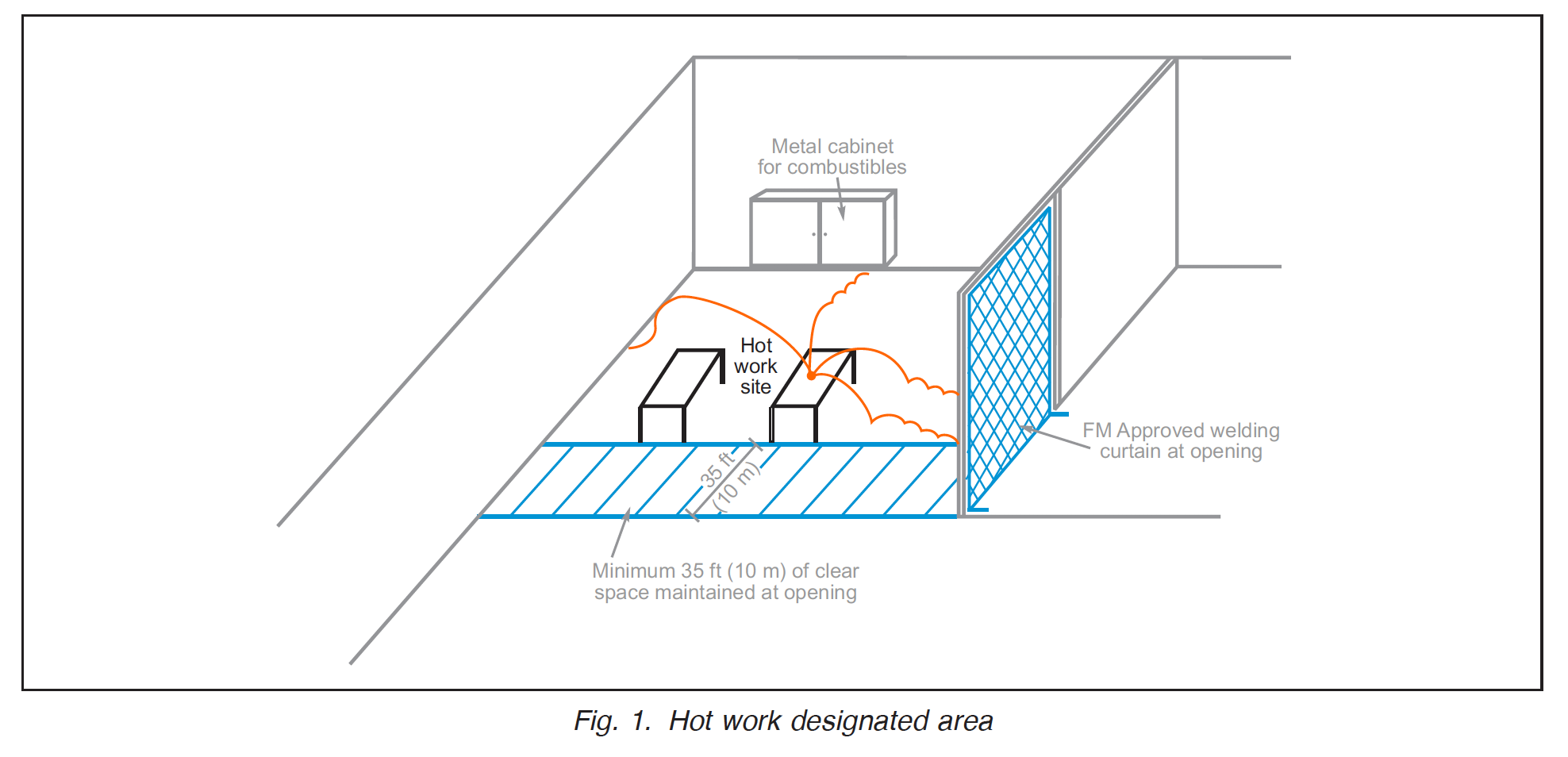
Enclose hot work designated areas in a cutoff room. Locate the cutoff room separate from high-risk areas that may contain commodity storage, ignitable liquid, flammable gas/vapor, and or combustible dust/lint. When fully-enclosing the hot work designated area in a cutoff room is not feasible, implement one of the following options to protect open walls or ceiling as shown in Figure 1.
-
- Employ temporary barriers, such as FM Approved welding curtains or blankets, to control ignition sources at unprotected openings in the cutoff rooms (e.g., open doorways or partial wall heights or lengths). Provide sufficient overlap and securement of the welding curtains or blankets. Label unprotected openings using signage.
- Maintain a minimum of 35 ft (10 m) clear separation distance at the open sides of the cutoff room. Label this separation distance using permanent marking (e.g., strips on the floor) and signage.
Construct cutoff rooms enclosing hot work designated areas of noncombustible construction. Install wall and ceiling/roof building assemblies that contain only noncombustible building materials. FM Approved Class 1 building materials are considered noncombustible.
Install facing materials on walls and ceilings that resist impact damage (e.g., corrugated steel paneling). Limit the use of brittle materials that are prone to mechanical impact damage (e.g., gypsum board).
Seal joints between floors, walls, and ceilings/roofs to prevent hot work ignition sources from escaping the designated area. Use FM Approved fire-stop materials.
Maintain hot work designated areas FREE OF COMBUSTIBLE, IGNITABLE, AND FLAMMABLE MATERIALS. If required for work, store combustible materials in metal cabinets, and ignitable and flammable materials in FM Approved storage cabinets for flammable and combustible liquids.
This next requirement is one of our Top 10 HW findings… ductwork not closed/covered to prevent the spread of sparks outside of the fire-safe area. This has ALWAYS been a requirement of OSHA’s, but for some reason, it rarely makes it onto the HW permit, program, or training. Global FM has captured these safety designs for the “Designated HW Areas” which is almost never the case in our experience.
Design and install HVAC systems per Data Sheet 7-78, Industrial Exhaust Systems. Incorporate the following into the system design:
A. Provide a dedicated HVAC system serving the hot work designated area.
B. Use noncombustible ductwork and insulation.
C. If particulate filtration is required, use an FM Approved Class 1 air filter.
Provide automatic sprinkler protection within hot work designated areas when the cutoff room wall or ceiling/roof assemblies contain combustible construction. Design and install sprinkler protection based on the occupancy within the room.
Provide SUPPLEMENTAL fire extinguishers within hot work designated area (i.e., in addition to those extinguishers required by local codes). Ensure the extinguishers are rated and sized appropriately for the hazard. Inspect, test, and maintain fire extinguishers.
Because of my frustrations with these “areas” we began requiring them to have a MONTHLY HW Permit issued. This meant that an AUTHORIZED PERMIT ISSUER was visiting these areas MONTHLY to ensure they were being maintained properly. On top of this, we conducted field audits regularly and these areas would get surprise audits monthly.
Conduct inspections of hot work designated areas to maintain the work area free of combustibles and contain hot work ignition sources within the work area. Conduct
inspections at least monthly. Maintain records for program auditing.
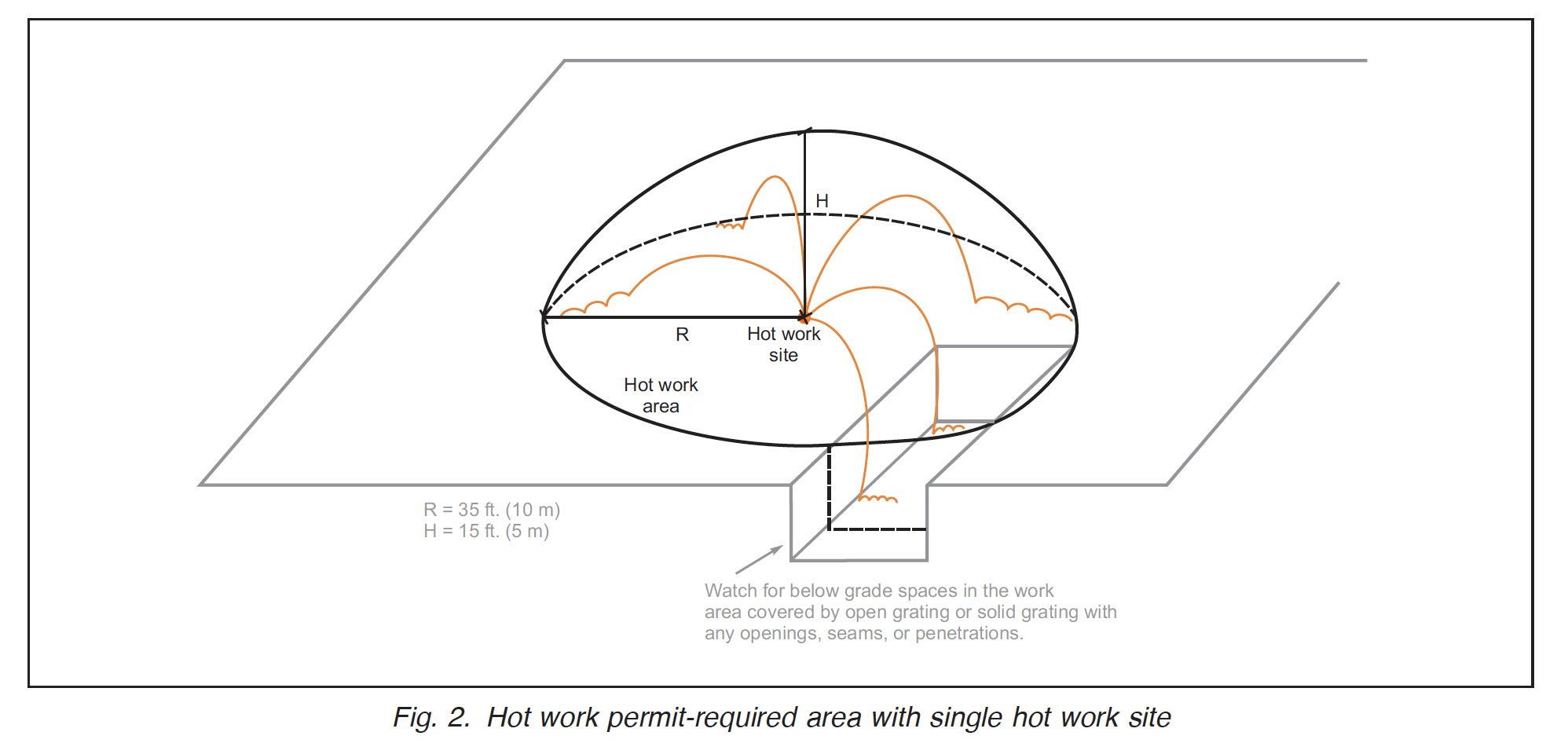
The Data Sheet has several EXCELLENT diagrams I encourage you to use!!! Like the one shown above, these are very well done and like they say “a picture is worth a thousand words”. The datasheet has the following diagrams showing fire-safe area setups and fire watch requirements:
- Hot work permit-required area with single hot work site
- Hot work permit-required area with multiple hot work sites
- Rooftop hot work permit-required area
- Elevated hot work permit-required area
My favorite figure is for Hot work permit-required area with single hot work site. Much like the diagrams in NFPA 51B, this gives us a bit different dimensions for our area, but ensures we are meeting safe distances. I always included these diagrams in my HW programs and training as they are just so effective at “painting a picture of what RIGHT looks like”!
The last topic and certainly NOT THE LEAST of importance is our number 1 issue for HW… FIRE WATCH! This single requirement was always my biggest issue when I was in the industry and it is still our biggest audit findings by numbers. I will be willing to bet any of you $100 that if I were to audit 100 of your HW Permits over a 12-month period that I would find issues with the Fire Watch aspect on at least 50% of the permits. If all of the permits audited were issued to contractors I would go as high as 75% of the permits would have issues with the Fire Watch. Keep in mind, our Fire Watch is a SECONDARY Layer of Protection – in other words it is a MITIGATION LAYER of PROTECTION. We MUST focus on PREVENTING HW fires, but the Fire Watch is a CRITICAL PATH to HW Safety. Sadly very few businesses recognize the importance of a good/capable fire watch so the job is usually given to the youngest/lowest paid worker on the crew. Often times, we find a FW who has never been trained on how to use a fire extinguisher (or the means of extinguishment provided to them). Heck, a lot of time we find the fire extinguisher is DEAD or has not been inspected in months or had annual maintenance in years; but there is sits at the feet of the untrained FW!!!!
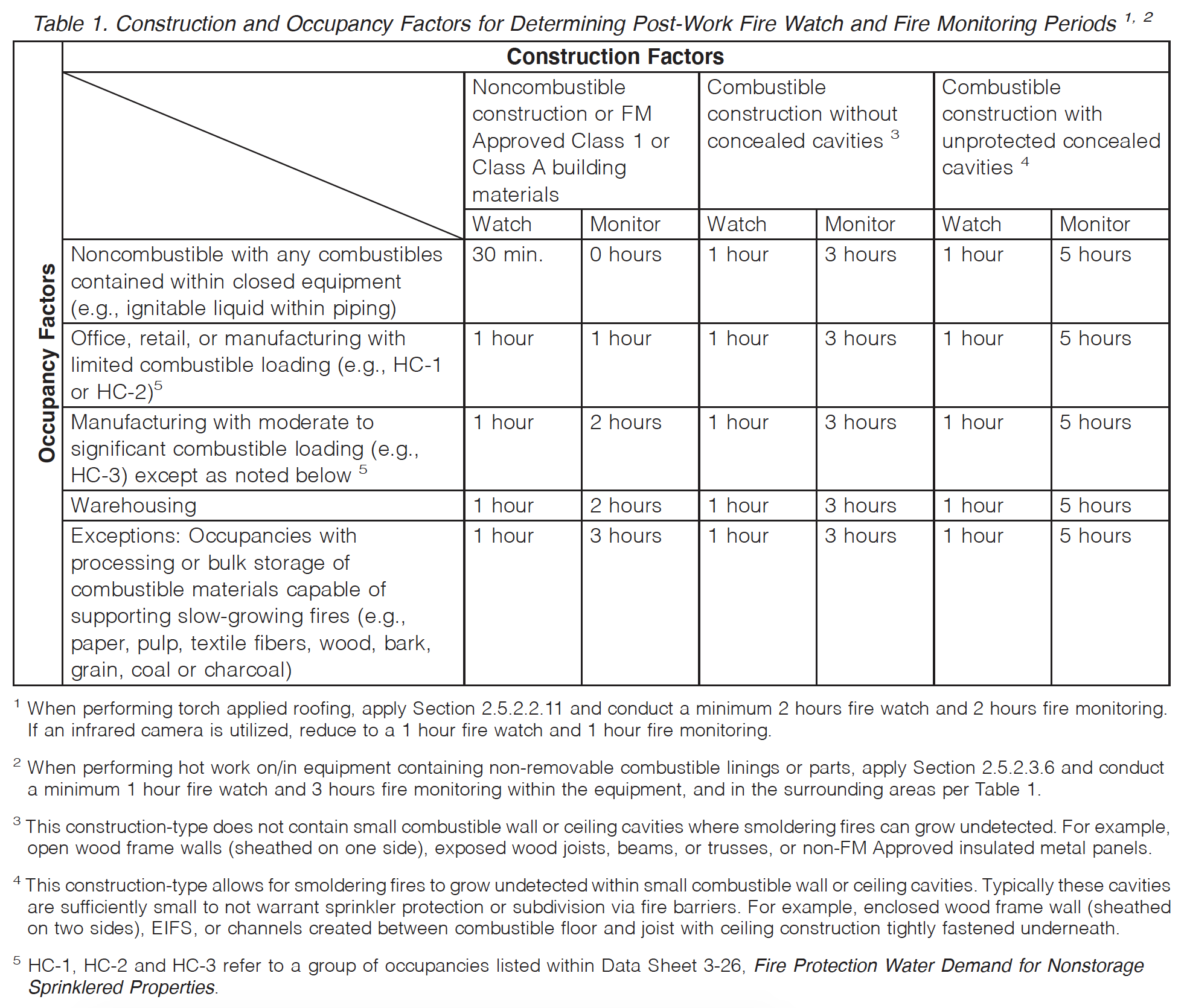
But the BEST WAY to improved HW Safety is to end the madness of the 30-minutes requirement. OSHA has always, and still does, require a FW to be maintained for at least 30-minutes after HW has ended. So many businesses (especially contractors) struggle to meet this most BASIC requirement so I can only imagine the horror when I suggest this 30-minutes should become 1-hour in most situations and include a “monitoring” requirement after the 1-hour, which could entail the HW area being “monitored” for up to 5-hours in some types of areas. I hear it all the time… “we want to exceed OSHA minimums”, well here is a great starting point for management to go beyond OSHA minimums. This FW requirement may seem like a “Low-Return on the Investment”, but wait until the $2.6 million HW fire occurs then that $15/hour monitoring will seem really cheap!!!! FM Global has created a very nice table for us to implement these requirements, which are based on the area where the HW is taking place and the type of construction in the area. I know this will be a hard sale for many of you, but I would suggest this would be worth the battles you would have to fight to get these implemented. Here is FM Global’s table:
This kind of guidance and instruction will never be found in an OSHA standard! One of the reasons why I wish OSHA would adopt the RAGAGEP practice for all of its standards. Their HW standard and flammable liquids standards are so outdated it is just SAD and don’t hold your breath waiting on the revisions! So when we want to go above and beyond OSHA MINIMUMS, FM Global offers us some of the most SOUND SAFETY ADVICE out there and it is ALL FREE for the taking – we just have to implement and manage them!