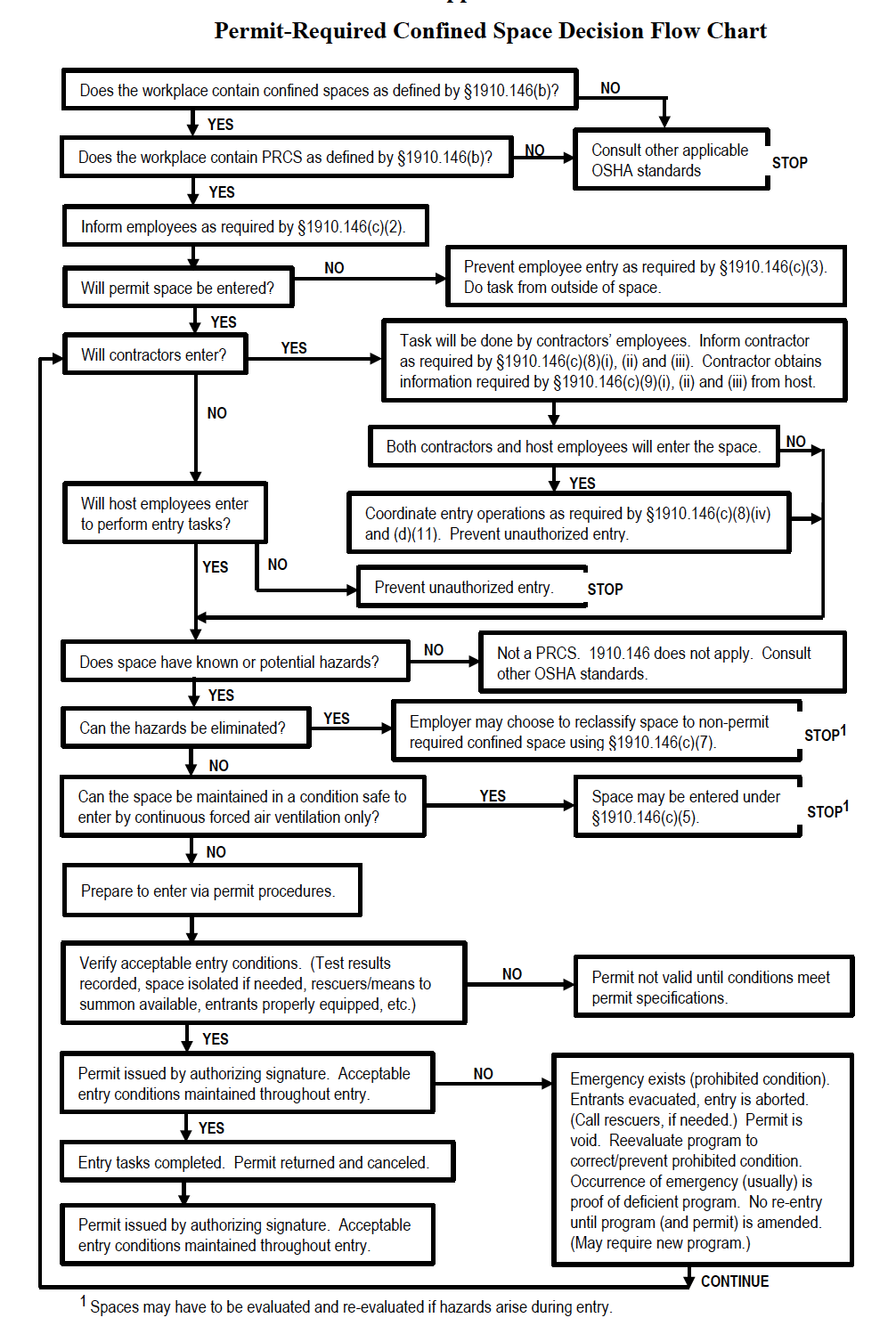
Employees risked potentially lethal suffocation caused by dangerous fumes as the company did not test the atmosphere and properly ventilate the air in food transport tankers before allowing workers to enter. After receiving an employee complaint, OSHA initiated an investigation on Aug. 6, 2014, at the tank-cleaning facility. The agency issued two willful and six serious safety violations involving permit-required confined spaces and fall hazards. The agency proposed fines of $179,000. OSHA’s investigation found that the facility did not ventilate the tankers to eliminate and control atmospheric hazards and failed to test and monitor the atmospheric conditions in the tankers before allowing workers to enter and clean them. Employees were also exposed to fall hazards of nearly 11 feet while cleaning the tankers, resulting in the issuance of the two willful violations. OSHA regulations require that the atmosphere in a confined space must be tested for oxygen, combustible gases, toxic gases and vapors. A confined space is one large enough for workers to enter and perform certain jobs, such as cleaning a food transport tanker, but it has limited or restricted means for entry or exit and is not designed for continuous occupancy. The agency determined that the facility failed to develop a confined space entry permit program to include training workers on hazards, procedures for summoning emergency services and providing monitors when an employee entered a confined space. Electrical safety violations were also noted. A total of six serious citations were issued for these violations. Here is a breakdown of the citations:

Citation 1 Item 1
Type of Violation: Serious; $7,000
29 CFR 1910.146(c)(4): When the employer decided that its employees would enter permit spaces, the employer did not develop and implement a written permit space entry program that complied with 29 CFR 1910.146:
At the workplace in the Wash Bay area, employees were assigned to perform cleaning operations inside food transportation tankers (permit-required confined spaces).
The employer’s written permit-required confined space entry program did not provide specific information to ensure compliance with all of the applicable elements under 1910.146(d) such as, but not limited to:
- Procedures to prevent unauthorized entry.
- Procedures to identify and evaluate the hazards of permit spaces.
- Procedures necessary for safe permit space entry operations (acceptable conditions for entry, providing entrants or their representatives with the opportunity to observe monitoring or testing of permit spaces, ventilating the permit space as necessary to eliminate or control atmospheric hazards, protection from external hazards, and verifying that conditions are acceptable for entry throughout the duration of entry).
- Procedures for providing testing and monitoring equipment, ventilating equipment, and rescue and emergency equipment.
- Procedures for evaluating permit space conditions when entry operations are conducted (testing and monitoring).
- Procedures for summoning rescue and emergency services, for rescuing entrants from permit spaces, for providing necessary emergency services to rescued employees, and for preventing unauthorized personnel from attempting a rescue.
- Procedures for preparing, issuing, using, and canceling entry permits.
- Procedures for reviewing and revising entry operations.
- Procedures for reviewing and revising the permit space program.
Citation 1 Item 2a
Type of Violation: Serious; $7,000
The employer shall develop and implement the means, procedures, and practices necessary for safe permit space entry operations including:
29 CFR 1910.146(d)(3)(i): Specifying acceptable entry conditions;
a. At the workplace in the Wash Bay area, the employer did not specify the acceptable and safe entry conditions for employees assigned to perform cleaning operations in the food transport tankers (permit required confined spaces).
Citation 1 Item 2b
Type of Violation: Serious
29 CFR 1910.146(d)(3)(vi): Under the permit-required confined space program required by 29 CFR 1910.146(c)(4), the employer did not develop and implement the means, procedures, and practices necessary for safe permit space entry operations, including, but not limited to: verifying the conditions in the permit space were acceptable throughout the duration of an authorized entry:
a. At the workplace in the Wash Bay area, the employer did not verify that entry conditions inside of food transport tankers were safe and acceptable for entry and throughout the duration of entry (permit required confined spaces).
Citation 1 Item 2c
Type of Violation: Serious
29CFR1910.146(d)(6): Under the permit-required confined space program required by 29 CFR 1910.146(c)(4), the employer did not provide at least one attendant outside the permit space into which entry was authorized for the duration of entry operations:
a. At the workplace in the Wash Bay area, an attendant was not provided outside the food transport tankers while an employee was inside the tankers performing cleaning operations (permit-required confined spaces).
Citation 1 Item 3
Type of Violation: Serious; $7,000
29 CFR 1910.146(d)(9): Under the permit-required confined space program required by 29 CFR 1910.146(c)(4), the employer did not develop and implement procedures for summoning rescue and emergency services, for rescuing entrants from permit spaces:
a. At the workplace in the Wash Bay area, the employer did not develop and implement procedures for summoning rescue and emergency services for employees performing cleaning operations inside food transport tankers (permit-required confined spaces).
Citation 1 Item 4
Type of Violation: Serious; $7,000
29 CFR 1910.146(e)(1): Before entry is authorized, the employer shall document the completion of measures required by paragraph (d)(3) of this section by preparing an entry permit:
a. At the workplace in the Wash Bay area, the employer did not complete entry permits for employees performing cleaning operations inside of food transport tankers (permit-required confined spaces).
Citation 1 Item 5
Type of Violation: Serious; $7,000
29 CFR 1910.146(g)(1): The employer shall provide training so that all employees whose work is regulated by this section acquire the understanding, knowledge, and skills necessary for the safe performance of the duties assigned under this section:
a. At the workplace in the Wash Bay area, employees performing cleaning operations inside food transportation tankers were exposed to impalement, slipping, and atmospheric hazards. The employer did not provide adequate permit required confined space training to entrants, attendants, and supervisors.
Citation 1 Item 6a
Type of Violation: Serious; $4,000
29 CFR 1910.305(a)(2)(x): Flexible cords and cables shall be protected from accidental damage, as might be caused, for example, by sharp comers, projections, and doorways or other pinch points:
a. At the workplace in the Wash Bay area, employees were exposed to a flexible cord that had energized, exposed copper wiring. The flexible cord was not protected against the sharp edges of the sheet metal wall it had been run through.
Citation 1 Item 6b
Type of Violation: Serious
Unless specifically permitted otherwise in paragraph (g)(1)(ii) of this section, flexible cords and cables may not be used:
29 CFR 1910.305(g)(l)(iv)(B): Where run through holes in walls, ceilings, or floors;
a. At the workplace in the Wash Bay area, employees were exposed to a flexible cord that had been run through a through a hole in a sheet metal wall.
Citation 2 Item 1
Type of Violation: Willful; $70,000
29 CFR 1910.132(a): Protective equipment, including personal protective equipment for eyes, face, head, and extremities, protective clothing, respiratory devices, and protective shields and barriers, shall be provided, used, and maintained in a sanitary and reliable condition wherever it is necessary by reason of hazards of processes or environment, chemical hazards, radiological hazards, or mechanical irritants encountered in a manner capable of causing injury or impairment in the function of any part of the body through absorption, inhalation or physical contact:
a. At the workplace in the Wash Bay area, employees were exposed to fall hazards of approximately 10’9″ while performing cleaning operations on top of food transport tankers and were not provided with fall protection.
Citation 2 Item 2a
Type of Violation: Willful; $70,000
29 CFR 1910.146(d)(3)(iv): Under the permit space program, the employer did not develop and implement the means, procedures, and practices necessary for safe permit entry operations, including, but not limited to, purging, inerting, flushing or ventilating the permit spaces as necessary to eliminate or control atmospheric hazards:
a. At the workplace in the Wash Bay area, employees were exposed to atmospheric hazards while performing cleaning operations inside food transportation tankers. The employer did not ensure forced air ventilation was used before and during employee entry into the permit-required confined spaces.
Citation 2 Item 2b
Type of Violation: Willful; Grouped
Permit-required confined space program (permit space program). Under the permit space program required by paragraph (c)(4) of this section, the employer shall:
29 CFR 1910.146(d)(5)(i): Test conditions in the permit space to determine if acceptable entry conditions exist before entry is authorized to begin, except that, if isolation of the space is infeasible because the space is large or is part of a continuous system (such as a sewer), pre-entry testing shall be performed to the extent feasible before entry is authorized and, if entry is authorized, entry conditions shall be continuously monitored in the areas where authorized entrants are working:
a. At the workplace in the Wash Bay area, employees were exposed to atmospheric hazards while performing cleaning operations inside food transportation tankers. The employer did not ensure atmospheric testing was performed prior to employees entering the permit-required confined space.
View the current citations at http://www.osha.gov/ooc/citations/REYNOLDSNATIONWIDE_989312_0130_15.pdf