













One of the finest men I ever worked for, Jim Krumholz, taught me this trick in 1999!
Manager MUST attend the “safety training” their employees attend! Even if this manager would never participate in an entry into PRCS, perform HW, or even participate in a lockout, they need to understand the expectations of their team members and how safety integrates with their team’s daily activities.
They...
Read More
On January 13, 2022, workers inside the company’s fabrication shop performed a “wet test” on a newly built tank truck to check for leakage. This entailed running diesel test fuel through different tank compartments and other truck components. This was a routine operation at the workplace. Workers knew never to use gasoline, and the company had a standard operating procedure that prohibited...
Read More
I have written several articles on the topic of when we store our flammable liquids BELOW their flash points with the aid of refrigeration and how that makes our “refrigeration/chiller” a critical utility if we wish to take credit for storing the flammable below its FP. I have also discussed processing a Class IIIB/Cat 4 flammable liquid within 30 degrees of its FP. However,...
Read More
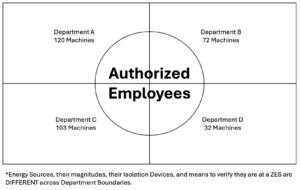
Managing our LOTO program requires considerable resources, and it requires a team approach! However, we see many failed attempts to control hazards through a facility’s LOTO program. One of the most common failures is how “authorized employees” are defined in terms of the skills they are trained on. Which Rabbit Hole you choose to go down and how far you go down depends on the...
Read More
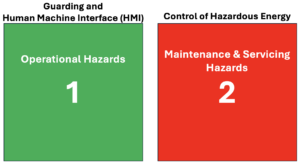
I put this image together for a friend struggling to demonstrate to their management that we can not discuss LOTO until Machine Guarding is in place. These two topics go hand in hand and trust me; if there are guarding issues, those hazards will be compounded when we attempt to frame up the LOTO program.
Guarding is for the OPERATIONAL safety of the machine/equipment and, if not done well, poses a...
Read More
An Ohio subsidiary of one of the world’s largest automotive suppliers could have prevented a 26-year-old employee in Franklin from being fatally crushed in October 2023 if the company had provided proper machine guarding. OSHA responded after being informed of the incident and learned the worker, on the job for about a year, was placing cardboard under a machine that bends vehicle exhaust pipes...
Read More
Are you tired of playing the OSHA Compliance game that requires us to “comply” with standards that are 50 years old? The International Fire Code (IFC) is an excellent resource for taking your hazardous materials handling systems/processes to the next level. The IFC is used or adopted in 42 states, including the District of Columbia, Guam, Puerto Rico, and the U.S. Virgin Islands.
This...
Read More
There are two (2) types of Asphyxiants:
Simple
Chemical also known as Systemic
These different types of asphyxiants behave differently and cause harm differently.
…
HomeRead More »
Read More
Chlorine is EXTREMELY HAZARDOUS, with an IDLH of 10 ppm and a TLV of 0.5 ppm (just above the odor threshold for most).
Chlorine is heavier than air (VD > 2.5), and when released, it forms a greenish-yellow gas with a pungent, irritating odor that follows the terrain at ground level.
The mean odor threshold for chlorine lies between 0.2 and 0.4 ppm.
Chlorine is a NON-FLAMMABLE gas; however,...
Read More
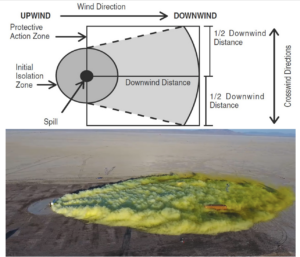
An image from my HAZMAT courses…
People wonder why the ERG Protective Action Distance diagram is shaped like it is. This image validates the model…
NOTE: Cl2 release image is from the Jack Rabbit testing project
Read More
Here is a GREAT “self-assessment” tool, just eight (8) questions, to evaluate your facility’s ability to investigate and perform causal analysis properly.
…
HomeRead More »
Read More
This is a crazy case! The mill hired a contractor to build scaffolding inside one of its Chlorine Dioxide (CLO2) tanks. The mill prepped the tank and even performed the initial air sampling of the space. Turned it over to one of the scaffolding contractor employees who would be the attendant for the entry. Three entrants and the attendant were wearing personal Cl2 air monitors. ...
Read More