








These sleeves/pouches are a really handy tool for managing work permits. SDSs, etc., while making them highly visible. In my facilities, we used contractor work permits to control entry, scope of work, and exit for our covered processes. But most contractors had to obtain additional safe work permits for their specific work. And most of those safe work permits also required us to provide the contractor...
Read More
As we have discussed before, this old saying is one that has stuck with me from the mid-1990’s when I learned it a process piping course. Catchy phrase – easy to remember. And I still use it, although my 2023 post made it clear it may be a thing of the past. So I asked AI to explain the saying “3-threads showing,” and I was delighted to see its response:
In the world of...
Read More
A little trick you can use when you think you have come across a misaligned flange. No special tools needed, just the key to your house! We recently came across this flange during a process walkdown and pointed it out. Some folks wanted to debate whether it was misaligned. I was 100% confident it was by simply looking at the bolting on the flange. Notice how one set of threaded rod and nuts had...
Read More
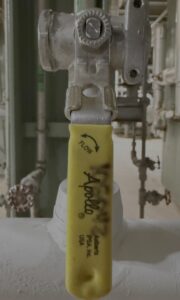
3-way valves have grown in popularity over the past 10-15 years, as they have begun to find their way into relief systems. Today, codes allow “relief trees” to be used, so Pressure Safety Valves can be changed out without emptying and degassing the vessel. The 3-way valve is the means by which the PSV is isolated from the process. This comes with some risks, as some folks are never trained...
Read More
Another crazy question that I was asked a few weeks back by a friend and up-and-coming safety pro. Again, the side bar group discussions ALL said NO, the authorized employee doing the LOTO must be the one to verify ZES of the LOTO, not the “affected employee” who has nothing to do with the LO or the maintenance servicing task(s). Here is what Gemini Plus said, which again I thought was...
Read More
This debate has been going on amongst a number of us, as a friend asked the question. 99% of of agreed – NO, it can not be reclassified when the COM DUST is inside the space. Cleaning it would be a Permit-Entry; once clean AND FREE of the COM Dusts, then we could discuss reclassifying the space. So tonight, continuing my testing of AI, I asked Gemini Plus the question, and it agreed with some...
Read More
If you can’t tell, I am having a ball playing with these AI systems. And to be honest, my numbers were a bit more conservative than Gemini and Grok, but darn, they were excellent answers that are SOLID nonetheless. These AI tools may make amazing tools for PRE-PLANNING for Pool Fires and FOAM INVENTORY needs. Here is Gemini’s answer:
To calculate the amount of foam concentrate needed...
Read More
My question:
How much water flow in GPM is necessary to cool a 1,000 gallon LPG tank that is involved in a pool fire to prevent it from experiencing a BLEVE?
Their answer…
Google Gemini is learning who I am!
Given your work with SAFTENG.net, you likely know that while 55 GPM is the "engineering" minimum for fixed systems, the NFPA 58 and API 2510 standards emphasize that if you cannot...
Read More
Yes, there are two (2) types of BLEVEs, and much like the myth that BLEVE’s only happen to Pressure Vessels with liquified flammable gases, COLD BELVEs account for nearly 25% of all BLEVEs. So what is the difference between the two? Super GROK explains it better than I could…
A BLEVE (Boiling Liquid Expanding Vapor Explosion) occurs when a vessel containing pressurized liquid above...
Read More

I continue to play with and test Google Gemini Plus and Super GROK in the OSH and Process Safety space. Today, my question to both was:
How much of a Class II flammable liquid will it take to burn under a 1,000-gallon LPG tank to cause a BLEVE?
BOTH of the systems had outstanding answers! Of course, both systems referenced SAFTENG.net as a source. Still not sure how it can read my BLEVE articles,...
Read More
I wrote about “focusing on our fundamentals” this week, which generated a lot of discussions offline amongst my friends and clients. The number 1 question asked was “What should we score in 2026?” My response was “at least 95%”. That means that in 100 LO inspections, we should have a failure rate across ALL items within each inspection of 5 out of 100.
Does anyone think this is an unreasonable expectation...
Read More
I am not sure who, where, and when this dirty little lie began, but we have been seeing an incorrect application of NFPA 70, 500.7(K) Detection System for Flammable Gases, item (3) Interior of a Building or Enclosed Space. It seems businesses are looking for any way out of having an electrically classified area and many are using this “out”; however, most of the time we find its application...
Read More