













Several years ago I was asked by a client to throw my name into the ring for a senior-level job at a large chemical company. They were a great client so I obliged and although I had no desire to give up SAFTENG, the interview process was so refreshing. It had such an impact on me, I use it today when a client asks me to be an interviewer in their interview process for a safety candidate.
This approach...
Read More
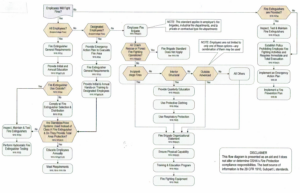
This flow diagram is presented as an aid and it does not alter or determine OSHA’s Fire Protection compliance responsibilities. The best source of information is the 29 CFR 1910, Subpart L standards. Many thanks to my Friend in Safety from OSHA, Mr. Walter Siegfried for sharing this aid.
…
HomeRead More »
Read More
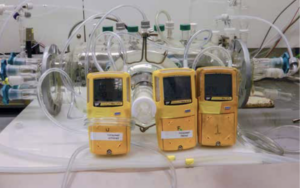
A fatal explosion at a chemical facility in 2018 killed a welder who was carrying out maintenance work on a mixing vessel. The HSE investigation found that toluene vapors had leaked into the vessel from faulty valves, producing a flammable atmosphere. Workers had checked the atmosphere with a flammable gas monitor before their work began. However, the gas monitor had failed to detect the presence of...
Read More
More on near misses and unsafe acts that result in no consequence- remember this is from the 1930s and 40s
“It needs but little thought for the average person to conclude that the no-injury accident ratio herein expressed is not exaggerated. How many drivers of automobiles would care to assert that they had never had narrow escapes from injury when driving across railroad grade crossings without...
Read More
This Notice cancels STD 01-12-002 Guidelines For Robotics Safety, which has been replaced by the OSHA Technical Manual Section IV: Chapter 4 –Industrial Robot Systems and Industrial Robot System Safety. The 1987 STD 01-12-002 Guidelines For Robotics Safety was outdated. The 2021 update to the OSHA Technical Manual Section IV: Chapter 4 – Industrial Robot Systems and Industrial Robot System...
Read More
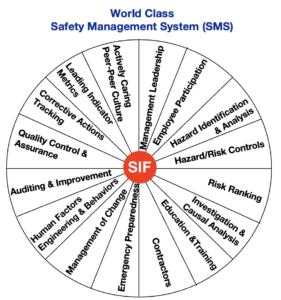
Lots of talk about SIF (Serious Injuries & Fatalities) these days. It even has a new acronym some of you may have seen being used… STKY (Stuff [or Sh_t] That Kills You). Leave it to the safety profession to package this risk management approach into a “program” that can be marketed and sold as another silver bullet to fix all of our struggles. Hence, SIF has many catchphrases...
Read More
Heinrich wrote this in 1941. So many want to decry his belief that unsafe acts play a significant role in accidents. In my earlier posts, I shared his position that unsafe acts are a reflection on management and not so much on the worker who carried out the unsafe act. In this quote from his book, we can see that he was a believer in engineering controls as a major means to prevent accidents.
“The...
Read More
One of my pet peeves in safety is emergency egress lighting. From not having any to having some serious deficiencies in the setup and functioning of the lighting. OSHA has failed to establish a minimum lighting intensity for this emergency lighting. OSHA has established the brightness for EXIT signs, but when it comes to the egress path lighting OSHA has not QUANTIFIED its minimum...
Read More
“Very few unsafe acts will result in damage or injury. In a highly protected system, the probability that the consequences of an isolated action will penetrate the various layers of defense is vanishingly small. Several causal factors are required to create a ‘trajectory of opportunity’ through these multiple defenses. Many of the causal contributions will come from latent failures in the organizational...
Read More
The Entry Supervisor is an ABSOLUTE CRITICAL PATH in safely performing entries into PRCSs. With that said, if entry supervisors simply attend the same training that everyone else attends, we have FAILED them. We were asked to assist with a 2012 PRCS fatality incident where the abject failure of the facility to train its entry supervisors was undoubtedly the root cause of the tragedy. ...
Read More
What is an Injury & Illness Prevention Program (I2P2)? It is a very basic, 8-element, safety management system (SMS). It is OSHA’s attempt to fundamentally change from the complaince model to an SMS model to manage workplace safety and health. OSHA has been talking about I2P2 for nearly 20 years and has faced relentless pushback from the industries. But it is time...
Read More
We hear it all the time… “yes of course we have a safety management system.” Then we ask one simple question, “can we see your OSH auditing plan for the year/3-years/5-years?” The most common response we get is “OSHA does not require us to conduct overall workplace audits.” That is true and it is also evidence that the facility does NOT have...
Read More