









An OSHA safety investigation has found another rail car products and services provider did not follow federal safety standards for working in permit-required confined spaces after two workers died from inhaling toxic fumes. OSHA determined that an employee became unresponsive after entering a natural gasoline rail car with the intent of cleaning the space on Aug. 12, 2020. A second employee entered...
Read More
A construction company has been fined $14,400 after all three (3) employees were killed while working on a utility project. The three employees, 48, 21, and 43, all of whom were killed on August 25, 2020, in an accident while working about 20 feet below ground inside a manhole. They died from asphyxia associated with a low-oxygen environment and subsequent drowning. Two of the deceased were Father...
Read More
I studied this incident closely while at MSU and I have never forgotten the dramatic images of what 18,000 gallons of a flammable liquid can do in a sewer!
On Feb. 13, 1981, at 5:16 a.m. a series of explosions occurred in the sewer lines of Louisville, KY. The explosions happened after a soybean extraction plant had a chemical spill of hexane which made it to the sewer. Ultimately investigators...
Read More
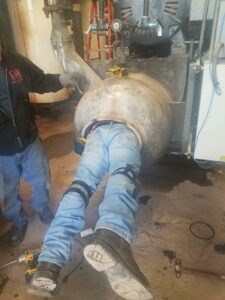
To continue with the articles I have written about Permit-Required Confined Spaces found in mechanical refrigeration processes, today I want to discuss the Compressor Oil Separator. SAFTENG Members can read my earlier post on Evaporative Condenser(s) and Sprial Freezers. Over the last several years I have shared several pics of workers halfway inside these separators and this week another...
Read More
The Respondent operates a wastewater treatment plant where Chlorine, propane, and sulfur dioxide (anhydrous) are present above their thresholds. The Respondent operates a wastewater chlorination process at the stationary source. 40 C.F.R. § 68.130 specifies a 2,500-pound threshold for chlorine, a 10,000-pound threshold for propane, and a 5,000-pound threshold for sulfur dioxide (anhydrous). The Respondent’s...
Read More
Respondent operates a gas plant where flammable mixtures and propane were present above their thresholds. The Respondent lists one process in its Risk Management Plan (RMP) with the process number 1000054282. The covered process is subject to the “Program 3” requirements of the RMP regulations and must, among other things, comply with the Program 3 Prevention Program of 40 C.F.R. Part 68,...
Read More
As I have said, this is all about the “environmental movement” to reduce the regulatory burdens on flammable refrigerants and not about worker safety! You can read OSHA’s own words about by they are proposing this change…
OSHA is proposing several changes to the Flammable Gases hazard class (Appendix B.2). Most significantly, OSHA is proposing to subdivide Category 1 of...
Read More
With last week’s horrible tragedy in GA involving liquid nitrogen, I have received a number of inquires about what actually happens when a liquid cryogenic, such as Nitrogen, makes contact with someone’s skin. And this video probably does as good of a job as any “official” training video.
PLEASE REMEMBER, these chemicals are EXTREMELY DANGEROUS and NONE of the things you...
Read More
Let’s face it, the “green movement” is here to stay and in some situations, going green may be great for the environment, but sometimes this “going green” can introduce significant hazards in our workplaces. Hydrogen is becoming the last hydrocarbon fuel source of the “green movement” if you’re not going solar. Hydrogen is a GREAT FUEL, as...
Read More
Most insurers these days require this type of management program, although they may be called something else. The idea is that BEFORE a fixed system is removed from service, someone will notify the insurer about the removal from service. The insurer will then require a host of actions to be taken during the time the system is out of service, most notably- NO HOT WORK is permitted in the area, as well...
Read More
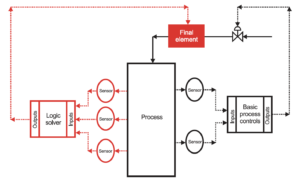
It is the year 2021 and OSHA’s Process Safety Management standard will be 29 years old this May. Most processing facilities have come a long way in improving their process safety, but most still lack a comprehensive WRITTEN management program for their Safety Controls, Alarms, and Interlocks (SCAI). These safety instrumented systems (SIS) play a critical role in almost all of the...
Read More
The gaps in the defense arise for two reasons – active failures and latent conditions – occurring either singly or in diabolical combinations. They are devilish because, in some cases, the trajectory of accident liability needs only exist for a very short time, sometimes only a few seconds:
…
HomeRead More »
Read More