











Respondent stores and uses ammonia at the facility in parts of the storage and refrigeration process. Respondent’s storage and refrigeration process contains more than the threshold quantity (10,000 pounds) of ammonia. Respondent’s storage and refrigeration process does not meet the eligibility requirements for Program 1 under 40 C.F.R. § 68.10(b) and is subject to the OSHA process safety...
Read More
SPECIAL NOTE: This is the first time I have seen a penalty reduction from the COVID-19 impacts on the business.
Respondent operates an ammonia refrigeration process with 15,416 pounds of anhydrous ammonia. The Respondent has one RMProgram level 3 covered process, which stores or otherwise uses a toxic substance in an amount exceeding its applicable threshold of 10,000 pounds. On December 11,...
Read More
I am sharing this OSHRC decision to demonstrate how a citation can be vacated with PROPER supervision and training on machine hazards, guarding, and LOTO. In this case, an employee opened a guard, reached into the machine to clean/clear breading and the machine started – grabbed his smock and caused serious injuries to his right arm and hand. The business won BOTH times (in front...
Read More
LOTO locks can be keyed alike. For example, equipment/field locks can all be keyed to a SINGLE key; however, personal/individual locks MUST BE individually keyed (e.g., 1 key – 1 lock). Before starting work ask yourself this simple but very important question: Do I have EXCLUSIVE/SOLE control of each and every isolation device protecting ME?
This is the fundamental premise...
Read More
Respondent owns and operates a beet sugar manufacturing facility.
…
HomeRead More »
Read More
NOTE: this incident happened long BEFORE OSHA had 1910.146 in place…
At about 3:30 p.m. on October 10, 1986, Employee #1, a self contractor, arrived to inspect the sawmill’s fire protection sprinkler system backflow valve located in an underground vault 8 ft deep by 6 ft wide by 12 ft long with a 31 in. manhole opening. At about 4:20 p.m. a truck driver saw Employee #1 laying in 14 in....
Read More
A petrochemical refinery was undergoing a turnaround. A contractor crew had been assigned the job of sandblasting the inside surfaces of a reactor vessel (permit-required confined space). Although UNWRITTEN COMPANY POLICY called for the use of air compressors for supplying respirator air, this crew, with the supervisor’s knowledge, had previously used plant air to supply breathing air.
…...
Read More
WELDING on USED drums!
At 12:00 p.m. on November 5, 2019, Employee #1 was making a small spot weld on a piece of metal. He was performing the weld on a drum of that contained flammable windshield washer fluid. There was an explosive reaction, and the cover of drum hit the employee’s face. Liquid splashed on the employee and was ignited by the explosion. Employee #1’s clothes caught on fire....
Read More
At 10:45 a.m. on January 11, 2020, Employee #1, employed by an oil and gas operation company, was overseeing a heater treater welding repair. Employee #2 emptied the remaining fluids in the heater treater. Employee #1 power washed the heater treater to remove any remaining flammable materials and ensure that it was safe for welding. After Employee #1 finished washing the heater treater he notified...
Read More
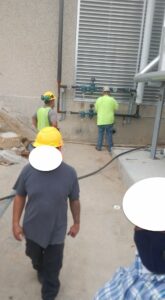
I am not sure what it is about fresh air intake for exhaust ventilation systems, but we should call them “Rodney”, as in Rodney Dangerfield, because they get no respect. As I said in 2016 and 2018 in my articles:
The Ventilation Design Basis begins with our intakes
FRESH AIR intakes for a ventilation system need to be from a source of FRESH AIR!
Here are two (2) photos of a person...
Read More
Respondent owns and operates an agricultural storage, feed, and supply business. On or about August 13, 2019, EPA conducted an inspection of Respondent’s Facility to determine compliance with Section 112(r) of the CAA and 40 C.F.R. Part 68. Information gathered during the EPA inspection revealed that Respondent had greater than 10,000 pounds of anhydrous ammonia in a process at the Facility. Respondent...
Read More
Many consumers may have never heard of “nitriding”, but just about every metal component in heavy equipment will go through a “nitriding process” to strengthen the metal. And it is this nitriding process that many businesses have a HIGHLY CONFIDENTIAL/PROPRIETARY blend for their process. Seems everyone has a slightly different blend and they hold this recipe near...
Read More