










I have discussed the phrase “at least” in 39 articles I have posted over the 30 years of SAFTENG’s existence. Most of my references are to process safety matters, but it is also widely used in OSH standards and codes. And still today, it is as big a “trap” as it was when I started my professional safety career in 1993. For example, two (2) of the RAGAGEPs I spend a...
Read More
Yes, having threaded rods of inconsistent lengths on a single flange is a mechanical integrity concern. While it may seem like a minor aesthetic issue, it directly impacts the ability to achieve a secure, uniform pressure boundary.
Why Inconsistent THREADED Rod/Bolt Lengths are a Problem
…
HomeRead More »
Read More
In an early post this morning, I discussed the need for “rain caps” and “weep holes” on our Pressure Safety Relief systems. And a dear friend and great ChemE reminded me that “weep Holes” are not just for draining rainwater. For example, this week I was working with an NH3 client, and I must state that NH3 gas can absolutely condense into liquid in the vent discharge...
Read More
Yes, we still need to consider drainage at the low point of our discharge piping, even with a “rain cap”. While a rain cap is designed to deflect direct vertical precipitation from entering the discharge lines/piping, it is not a hermetic seal. Over time, moisture can still enter the discharge piping through condensation, wind-driven rain, or melting frost/snow.
Looks look at ASME Section...
Read More
During a maintenance shutdown at a wood pellet plant, three workers employed by a mill machinery service company were working at the mill to clean the burner. The workers were standing at the opening of a burner door when an explosion occurred in the dryer system. The three workers were knocked backward by the force of the explosion and suffered burn injuries.
…
HomeRead More »
Read More
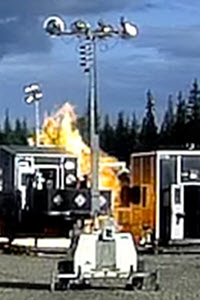
At a wellsite, two workers operating a vacuum truck were vacuuming and cleaning fluids, sludge, and sediment from a low-pressure separator vessel (LPS). Other workers opened two hatches on the LPS and inserted their vacuum hose into a debris-catch opening. Suddenly, an explosion occurred inside the LPS, resulting in a flash fire. One of the two workers was thrown against an adjoining vessel by the...
Read More
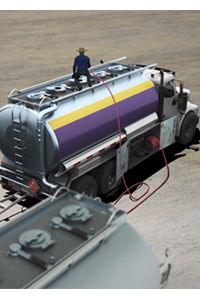
A worker was standing on top of a tanker truck to transfer gasoline from a tanker trailer to the tanker truck. The tanker truck’s engine was running, and the pumping system was engaged. The worker opened access hole covers to a compartment in the truck that held diesel and to another that was empty. Some diesel remained in the hose (mounted on a reel in a cabinet on the side of the truck) because the...
Read More
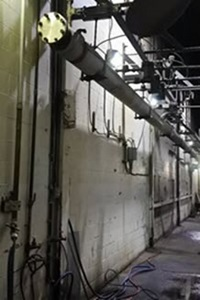
In a steam plant at a plywood mill, two (2) workers were attempting to replace a leaky nipple and gasket at the end of a condensate header. As they were loosening or removing nuts from the outer flange at the end of the header, one worker was sprayed with steam and condensate (hot water). The worker sustained serious injuries.
…
HomeRead More »
Read More
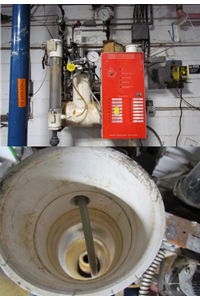
At a poultry-processing plant, a worker (engineer) was responding to an ammonia leak from an air purger (equipment that removes air and other non-condensable gases from the refrigeration system to improve efficiency). He described the signs of the problem to a refrigeration mechanic over the telephone. While waiting for the mechanic to arrive, the worker was splashed with ammonia-saturated water (ammonia...
Read More
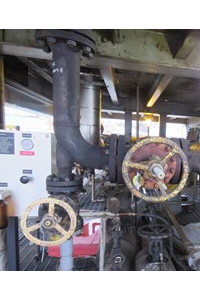
A worker on a contracted maintenance crew at an oil refinery partially unbolted a flange on a live crude oil heat exchanger. An undetermined volume of oil was released. Another worker, a refinery employee who participated in the incident response, was exposed to the resulting crude oil vapors, which are believed to have contained hydrogen sulfide (H2S). The second worker sustained injuries from the...
Read More

An auto repair worker was walking toward his mobile service vehicle, which contained an oxyacetylene welding system, to start work for the day. When he was approximately 32 ft. away, he clicked a button on the key fob to unlock the vehicle remotely. The vehicle immediately exploded and burst into flames. No one was injured in the explosion; however, surrounding vehicles and property were extensively...
Read More
To accurately understand pressure measurements in industrial safety and process engineering, it is essential to distinguish between absolute pressure and gauge pressure, as well as the units commonly used for low-pressure monitoring (such as draft gauges or vacuum systems).
The following table provides the conversion relationships between these units, referenced against standard atmospheric pressure...
Read More