









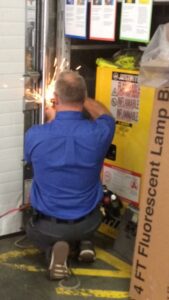
1910.252(a)(2)(vii) Relocation of combustibles.
Where practicable, all combustibles shall be relocated at least 35 feet (10.7 m) from the work site. Where relocation is impracticable, combustibles shall be protected with flameproofed covers or otherwise shielded with metal or asbestos guards or curtains.
Read More

There is so much to learn from this video!
Transferring a flammable liquid using gravity without a dead-man valve is NOT allowed and for the reason shown below (they lost contents from BOTH totes!). (See 1910.106(e)(2)(iv)(d)
PROPER GROUNDING AND BONDING is an absolute MUST when transferring flammable liquids. (See 1910.106(e)(6)(ii)
SPLASH FILLING should NEVER be permitted...
Read More
OSHA’s and EPA’s process safety standards require the host facility to “explain to contract employers the applicable provisions of the emergency action plan” (1910.119(h)(2)(iii), which is a REQUIRED PLAN for all facilities with a PSM/RMP covered process. But what does OSHA/EPA mean when they use the phrase “applicable provisions of the emergency action plan“?
We...
Read More
A seafood distribution company that formerly operated in Boston, Mass. will pay a cash penalty, subject to court approval, settling allegations by the U.S. EPA that the company violated federal environmental laws relating to the use of anhydrous ammonia, sulfuric acid, and lead at its facility. Under the settlement, the company has agreed to pay $700,000 in civil penalties. The settlement agreement...
Read More
NOTE: The overall value of this settlement exceeds $160 million, which makes it the largest settlement in the history of the EPA’s enforcement of the Risk Management Plan Rule under Clean Air Act Section 112(r). This is also the first case in which the United States and a state have jointly brought suit to enforce these provisions.
The U.S. Department of Justice, the U.S. Environmental Protection...
Read More
The 2017 Top 10 violations, from both General Industry and Construction, are:
#1 – Fall Protection, Duty to provide (29 CFR 1926.501): 7,270 violations
#2 – HAZCOM (29 CFR 1910.1200): 4,552 violations
#3- Scaffolds – general requirements (29 CFR 1926.451): 3,336 violations
#4 – Respiratory Protection (29 CFR 1910.134): 3,118 violations
#5 – Lockout/Tagout (29 CFR...
Read More
As November is just around the corner, we are reminded of a couple of OSHA Due Dates regarding the revised Walking and Working Surface Standards. Coming up next month we have:
…
HomeRead More »
Read More
Respondent operates a facility where it processes fish to produce ingredients used by pet food manufacturers. The Facility is located in a designated industrial area within approximately 300 feet (0.05 mile) of JFK Memorial Highway, less than 500 feet (0.09 mile) from the nearest residence, and approximately 600 feet (0.11 mile) from Buzzard’s Bay. At the time of the violations alleged herein,...
Read More
Respondent operates a chemical manufacturing which has 2,400,000 pounds of ammonia in onsite storage. Respondent has one RMProgram level 3 covered process. On August 16, 2017, the EPA conducted an onsite inspection of the RMProgram related records and equipment for the purpose of assessing the compliance with the RMProgram requirements and the implemented recognized and generally accepted good engineering...
Read More
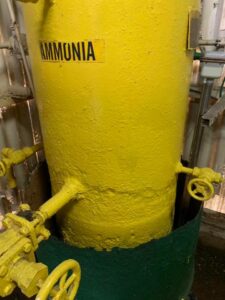
Simply put, “corrosion allowance” is an extra amount of thickness added to the thickness of the pipe/vessel wall based on the expected exposure the pipe/vessel may see during its lifespan. Typically, my experience has been that corrosion allowance has a safety factor equivalent to 2 when the vessel/pipe was knowingly going to be exposed to external and/or internal corrosive conditions....
Read More