








Way back in the early 1990’s I learned a valuable lesson the “hard way,” and to this day, facility siting means something altogether different than how most view it. Those that work with me know I hate having combustibles such as empty pallets around chemical processes, especially flammable processes. But even non-flammable processes, such as NH3 and Cl2, are at severe...
Read More
For many of us, it will be coming! Most states in the USA adopt the International Fire Code (IFC) as their Fire Code and HAZMAT Code; although most adopt a “revised” version of the IFC and most states run anywhere from 5-15 years behind the actual IFC. For example, my home state of OH just revised their Fire Code in December 2017 by adopting a revised 2015 IFC. But the...
Read More
When I was growing up in the profession, PSM was the king standard we lived by. Everything we did revolved around our Process Safety Management System. One thing that I continue to find is facility personnel not assigned to the process and contractors working within the covered process “battery limits” and never knowing what they were working next to or in. Almost a 100% bet I will find...
Read More
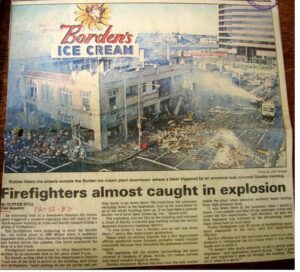
UPDATED on 7/21/2018
For SAFTENG Members – On Scene News Report Video from ABC13 Houston
…
HomeRead More »
Read More
As you know, I love using some of the State OSHA Plan standards as they can be more protective and offer some explanations as to their requirements. The state of Michigan just renewed its 1910.151 standard as it relates to Eyewash/Shower Equipment and in doing so has offered some excellent insight into their revisions. Whereas the federal OSHA standard offers little explanation…
1910.151(c)...
Read More
EPA has begun limiting the use of refrigerants that have high global warming-potential properties. The refrigerant manufacturing industry has responded by developing a number of replacement refrigerants. One of the characteristics of most of these products is that they are minimally flammable as compared to other flammable refrigerants. Different protection schemes exist for lesser risk products which...
Read More
In the 2018 edition of the International Fire Code (IFC), which is the code, most of the states revise and adopt in some format. As I have said for nearly 20 years now, this fire code is an EXCELLENT resource for those looking to improve their design and construction of their processes that handle hazardous materials. I even like them more than using OSHA standards, as these codes are updated...
Read More
This video is an excellent demonstration of the power within a compressed gas cylinder. This was an ammonia cylinder; actually, one of the more tamer compressed gases (as far as energy goes) of HAZMATs in cylinders. But look at the damage to the side of this shipping container – peeled open like someone used a can opener on it.
Read More
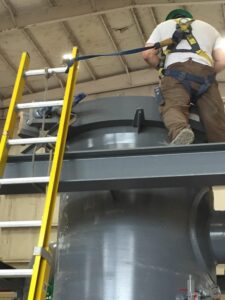
At 11:00 a.m. on July 7, 2017, Employee #1was attempting to dislodge a 24-inch rubber plug from a 2foot diameter sewer pipe located inside a 24foot deep wet well. The workers were outside the well pulling on a 1/4-inch nylon rope that was attached to the 24-inch diameter plug. The plug was lodged inside a T-shaped PVC fitting from the force of the wastewater emptying into the well. Without conducting...
Read More