









Recently I posted an article about the IIAR’s new Maintenance Standard that was going to allow bench testing of a “sampling” of our Relief Valves (RVs) as an alternative to the 5-year cycle. I have written numerous times about this practice, but I could never compete with the National Board’s article(s) on the topic. Their 2018 Winter edition of “The Bulletin”...
Read More
The Federal EPA just updated their RMP User Manual. This is the go-to manual to find all the answers to your RMP submittal questions when using RMP eSubmit Software. The manual “unofficially” also provides much insight into all the submittal data you are being asked to provide. It even explains how the WCS and ARS should be managed and presented in your submittal(s). ...
Read More
Sen. Chuck Schumer announced today that OSHA, the Environment Protection Agency (EPA), and Homeland Security (DHS) have agreed to create new protocols requiring notifications and coordination with local governments & emergency services when a company is cited with serious violations in wake of the deadly chemical explosion and fire at a cosmetic factory. In January, Sen. Schumer launched...
Read More
If you are a LOTO fanatic, you most likely have heard the “rumor” that OSHA is considering some significant changes to the application of LOTO. These changes center around using “interlocks” in lieu of locking out the machine/equipment. In essence, there are some who are “lobbying” OSHA to allow interlocks to be used in situations other than “minor...
Read More

Since around 2003, the International Fire Code (IFC), section 5704 – Storage, has required that ALL above-ground storage tanks, regardless of capacity, be provided with an approved means or method of overfill prevention. In this article we will look at what the code prescribes as the flammable liquid tank’s safe upper limit and the requirement for the “over-fill” prevention. ...
Read More
To quote the IFC committee, “the purpose of performance-based design criteria is to promote innovative, flexible and responsive solutions that optimize the expenditure and consumption of resources while preserving social and economic value.” Section 5001.3 Performance-based design alternative is intended to be compatible with EPA’s RMP and OSHA’s PSM requirements,...
Read More
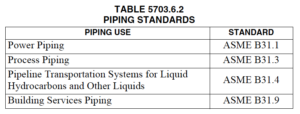
You may have heard that low melting-point materials such as aluminum, copper or brass should not be used for flammable liquids and gases. This is due to the concern these materials may fail under fire conditions, so we have some minimum requirements to meet IF we choose to use these types of metals…
…
HomeRead More »
Read More
Respondent operates a dairy plant and has on-site, 13,000 pounds of anhydrous ammonia which is used in its ammonia refrigeration process. Respondent submitted a single RMPlan that included an accidental release prevention program, to the EPA for its stationary source. At its stationary source, the Respondent has one RMProgram level 3 covered process. On January 27, 2015, the EPA conducted...
Read More
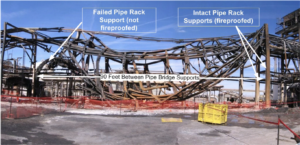
If you follow the CSB investigations, you may remember an incident from years ago where a fire impacted a pipe rack and the supports that were treated for fire resistance withstood the fire and the ones not treated/protected failed, causing the collapse of the structure leading to a much larger fire which then impaled three (3) 1-ton Chlorine cylinders, one of which ultimately failed due to the jet...
Read More
We visit this topic again and again, the short answer is NO!
According to ASME Section VIII, Division 1 (UG-135) and API RP 520, Pressure Safety Valves (PSVs) must be installed in a vertical position with the spindle (stem) oriented upright. Installing a valve horizontally is considered a significant deviation from engineering standards and can lead to dangerous malfunctions.
Here is why vertical...
Read More