














Ever wonder why OSHA saw fit to define entry as:
… as soon as any part of the entrant’s body breaks the plane of an opening into the space.
Here is a 2001 fatality involving a worker reaching into a PRCS and died…
…
HomeRead More »
Read More
Some safety professionals think the stories of workers dying in air-supplied respirators hooked into an inert gas supply are “urban safety myths”. Granted, these incidents are rare, but they do happen and they almost always result in a fatality. Here are some of the OSHA Case files from such incidents…
…
HomeRead More »
Read More
At approximately 3:15 pm on may 9, 1986, employees started to charge the number 1 line carbo-cooler, using a cylinder containing 150 pounds of anhydrous ammonia at 129 psi (room temperature). Employee #1, in an effort to speed the charging process, was adding water at 132 degrees to the ammonia cylinder (to raise the internal pressure). Employee #2 was working on 2 magnetic switches located near the...
Read More
A hole was being drilled in the plant’s No. 8 Generator in order to remove a bore plug on a rotor undergoing maintenance. As workers were drilling the first hole, flames emanated from the drilled hole and injured a worker. A Ministry of Labour investigation found that the flames resulted from the release of hydrogen from pressurized containment inside the rotor core. The...
Read More
I read a lot of OSHA case files and sometimes I find the narrative very interesting. This one, I found to be darn near impossible to have occurred as written…
At approximately 2:30 p.m. Employee #1’s coworker, a refrigeration technician, was troubleshooting a compressor shutdown and opened a valve which vented anhydrous ammonia into Engine Room #3. A small fire started after...
Read More
At 3:10 p.m. on February 7, 2017, an employee was making preparations to replace the relief valve of a 1,000 gallon ammonia (NH3) nurse tank. The incident investigation reported that the tank was empty of liquid NH3. However, it contained approximately 80 psi of vapor pressure. The employee set up a 30 gallon drum that contained water and affixed it to the nurse tank by way of a hose. He then turned...
Read More
At 7:15 a.m. on May 10, 2017, vapor phase anhydrous ammonia was released in an uncontrolled manner from a high-pressure line. The release took place when an employee drilled a 5/32-inch diameter pilot hole into a 3-inch schedule 40 seamless steel pipe containing anhydrous ammonia. The pilot hole was drilled as a starter hole for a ?-inch diameter pipe connection for a new auto-purger. No injuries or...
Read More
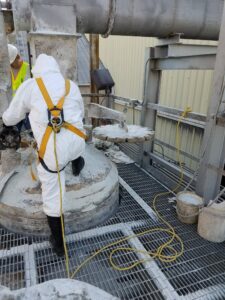
So the permit says I have to have on a harness with a “lifeline” attached and the other end attached to a fixed point outside the PRCS, so here’s how I feel about my “lifeline”…
Read More
OSHA’s Slings Standard (29 CFR 1910.184) specifies several paperwork requirements, depending on the type of sling
paragraph (e) of the Standard covers alloy steel chain slings;
paragraph (f) covers wire rope slings;
paragraph (g) covers metal mesh slings;
paragraph (h) covers natural and synthetic fiber-rope slings; and
paragraph (i) covers synthetic web slings)
The purpose of...
Read More
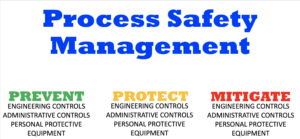
To make this simple, I like to use this slide from my Process Safety course for a visual aid in how we should be “looking at process safety”…
It also does a decent job of outlining what a HCA could look like. More on HCA’s later…
…
HomeRead More »
Read More