












Respondent owns an ice production operation and two refrigerated warehousing storage operations which consist of two separate ammonia closed-loop refrigeration system processes. Both processes have refrigerated and frozen storage space using industry standard mechanical refrigeration designs including multiple cooling coils (evaporators), heat rejection towers (condensers), rotary screw compressors,...
Read More
The U.S. Department of Transportation’s Pipeline and Hazardous Materials Safety Administration (PHMSA) has been made aware of concerns regarding newly adopted requirements in Section 180.209(e) of the Hazardous Materials Regulations (HMR; 49 CFR Parts 171-180). Prior to a January 21, 2016 Final Rule [Docket No. PHMSA-2013-0042 (HM-233F)], the requalification period corresponding to volumetric...
Read More
The IRSST (Canada) just published a new research report to contribute to confined space accident prevention by helping companies apply existing regulations. Researchers wanted to gain a better understanding of confined space risk management and identify issues based on the literature and field observations, and develop a confined space risk analysis and work categorization tool that meets the needs...
Read More
On November 1, 2016 through November 4, 2016, representatives from the U.S. Environmental Protection Agency (EPA) Region IX conducted an inspection of a refinery to determine compliance with the Risk Management Program (RMP). The preliminary findings of the inspection and additional information request were sent to the refinery and several agencies on March 27, 2017. EPA’ s inspection was conducted...
Read More
Here is an EXCEL spreadsheet with the “Severe Injuries” reported to OSHA from 1/1/2015 through 9/30/2016. These reports make great content for safety discussions and awareness efforts. You can sort by Hospitalized, Amputation, Injury Nature, Part of Body, Source, Secondary Source. You can also download the full data sheet from OSHA. CLICK...
Read More
Those who manage Lockout-Tagout (LOTO) in a “processing operation” know first-hand how different LOTO is as compared to how its done in an “assembly line” style operation. I have always picked up some “Best Practices” for LOTO at the companies I worked for over the years and as a consultant, I have seen many more at some of my world-class...
Read More

VIEWER DISCRETION ADVISED!
Read More
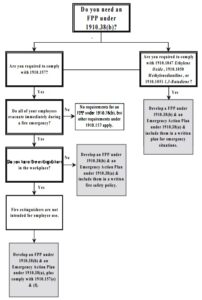
Much like the Emergency Action Plan (EAP) requirements, a WRITTEN FPP is ONLY required when your business/facility falls under some other OSHA standard. And in the case of FPPs, there are ONLY three (3) OSHA standards requiring a FPP:
Ethylene Oxide, 1910.1047
Methylenedianiline – 1910.1050
1,3-Butadiene – 1910.1051
Here is a nice flowchart from OSHA on making your decision:
…...
Read More
So what exactly does OSHA mean when they say…
Develop and implement the means, procedures, and practices necessary for safe permit space entry operations, including, but not limited to, the following:…1910.146(d)(3)(iii) Isolating the permit space
It is not uncommon to find spaces entered with NO isolation of the space and there tends to still be some “behind scene” arguements/debates...
Read More
Back when OSHA was writing their Permit-Required Confined Space standard (1910.146) their review of accident data indicated that most confined space deaths and injuries were caused by atmospheric hazards. And yet, still today, we see entrant, attendants, and entry supervisors; and even safety personnel, not understanding the atmospheric hazards associated with PRCSs. I hope to shed some...
Read More