













Three distinct elements of a flanged joint must act together to provide a leak-free joint:
the flanges,
the gasket, and
the bolting
Factors that affect performance include the following:
…
HomeRead More »
Read More
The revisions to 2015 IFC, Section 606.12 clarify the code requirements and add references to two (2) International Institute of Ammonia Refrigeration (IIAR) standards and one American Society of Heating, Refrigerating and Air-Conditioning Engineers, Inc. (ASHRAE) standard for design and operation of ammonia refrigeration systems. This edition of the IFC also pulls in a lot of Ammonia Refrigeration...
Read More
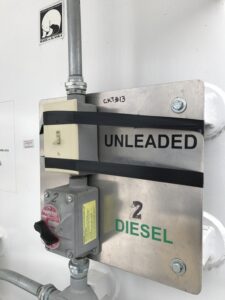
Can you spot the hazard/code violation? This is at a fueling station for work trucks at a facility. This facility has many HAZLOCs so in general, “they should have known better”; but this is what happens when you contract out maintenance to unqualified and untrained contractors. Work Order said… “Switch at gas pump not working”, this is how it was fi...
Read More
On Wednesday, surveillance footage captured the moment that a 10-meter-high section of scaffolding, which was carrying three workers, suddenly toppled down in Mianyang city in southwest China’s Sichuan Province. Seconds after the collapse, some passersby ran to the scene to rescue the workers trapped underneath. More than 20 people eventually joined in to help with the rescue effort. These...
Read More
I have written several times about “vehicle impact protection” for our hazardous materials processes and systems and these articles have garnered a lot of attention, as it seems a lot of folks were not aware there was an actual design basis for these protective members. Here is a video (WARNING! MUTE the sound!!) that shows us how these protective members work when DESIGNED,...
Read More
A major hazard involved with the transfer of non-conductive flammable liquids is the build-up of static electricity with the potential for discharge resulting in fire and subsequent loss of primary containment, an LOPC event. Certain non-polar liquids can be charged (e.g., while flowing through pipes and hoses). Detectable and hazardous charges must be expected if the specific resistance of the liquid...
Read More
In an effort to provide you with the new language I have presented this material, cut from EPA’s early release document which was several hundred pages. Here is what is actually changing in the rule:
…
HomeRead More »
Read More
My good friend and Ammonia Refrigeration PSM extraordinaire, Brian Chapin with RCE, has allowed me to share his work here. I figured I could not have done any better on this breakdown so I asked if he minded I share this at SAFTENG, we lucked out and he said yes! This is an excellent breakdown, as he summarizes what has to be done for the new requirement AND provides us with a timetable...
Read More
EPA recently updated their Risk Management Plan (RMP) rule in several key areas: 1) accident prevention program requirements, 2) emergency response requirements, and 3) improvements to the public availability of chemical hazard information. In this article, I will break down the NEW Emergency Response requirements and some serious barriers to fully complying with these new requirements....
Read More
EPA in response to Executive Order 13650, is amending its Risk Management Program regulations. The revisions contain several changes to the accident prevention program requirements including an additional analysis of safer technology and alternatives as part of the process hazard analysis for some Program 3 processes, third-party audits and incident investigation root cause analysis for Program 2 and...
Read More
Today, the U.S. Environmental Protection Agency (EPA) finalized a rule amending its Risk Management Program (RMP) regulations to reduce the likelihood of accidental releases at chemical facilities and improve emergency response activities when those releases occur. This rule is the latest in a series of actions the federal government has taken in consultation with industry, local and state governments,...
Read More
The 2015 IFC section 312.3 now provides performance criteria for vehicle barriers instead of prescriptive design that was missing an impact velocity.
…
HomeRead More »
Read More