







Background: 29 CFR 1910.178(l)(2)(iii) states: All operator training and evaluation shall be conducted by persons who have the knowledge, training, and experience to train powered industrial truck operators and evaluate their competence.
Question #1: Can a person who has the knowledge, training, and experience to train powered industrial truck operators and evaluate their competence, clarified in...
Read More
OSHA answers two (2) Respiratory Protection Program questions:
To what extent does OSHA's Respiratory Protection standard, at 29 CFR § 1910.134(e), require that the PLHCP's medical evaluation for respirator use include consideration of factors beyond respiratory protection that affect fitness to safely perform the expected job tasks while wearing a respirator?Is there a reasonable expectation that...
Read More
On the evening of Christmas Eve, the Jackson Fire Department was alerted to a worker trapped inside a hopper at a local factory. Jackson Police Department, Jackson County EMS, Jackson Sheriff’s Office, Liberty Fire, and Jackson Fire units, including Jackson’s Rescue, Tower, and two engines, responded to the scene.
The worker was attempting to retrieve a dropped cell phone when he fell approximately...
Read More
Where piping is to be opened for servicing, addition, or modification, the section to be worked on shall be isolated from the supply at the nearest convenient point, and the line pressure vented to the OUTDOORS. The remaining gas in this section of pipe shall be displaced with an inert gas.
Prior to placing the system into operation, the air in the piping system shall be displaced with inert gas....
Read More
December 23, 2025, Washington, D.C. — The U.S. Chemical Safety and Hazard Investigation Board (CSB) today issued two interim safety recommendations in connection with the agency’s ongoing investigation into the August 11, 2025, fatal explosion at U.S. Steel’s Clairton Coke Works facility in Clairton, Pennsylvania.
The explosion occurred when coke oven gas was released from process piping in the Battery...
Read More
The company is a structural fabricator of aluminum, steel, and metals used in water and wastewater plants across the United States. OSHA selected the facility from a random list for inspection pursuant to its National Emphasis Program (NEP) to minimize amputation hazards. Following the inspection on May 13, 2024, OSHA issued the facility a Citation and Notification of Penalty (Citation) alleging:1)...
Read More
PLEASE NOTE: The law protects the company – NOT the worker. This is a “legal” decision that flies in the face of a recognized hazard. It is also laughable that the FRA would enforce the safety needs for this recognized hazard at a private business that is using its own trackmobile to move the cars in and out of the building. But this is the legal system; NOT a safety management...
Read More
Respondent owns and operates an ammonia refrigeration system at its bakery. The Facility maintains an amount of anhydrous ammonia within its system that is above the 10,000 lbs threshold quantity that is set forth in Table 1 at 40 C.F.R. § 68.130. The Facility is subject to Program 3 because the covered process is subject to the OSHA process safety management standard, 29 C.F.R. § 1910.119, in accordance...
Read More
At 2:30 p.m. on August 28, 2019, employees were removing a flange blank on caustic liquid pipeline that was supposed to be evacuated but wasn’t. The employees were sprayed with caustic liquid and suffered chemical burns to their face and eyes. Two of the employees required hospitalization for treatment and three others were injured but did not require hospitalization.
…
HomeRead More...
Read More
Three (3) workers were exposed to hydrogen sulfide (H2S) while cleaning a chemical pit at a company, leaving two dead and one hospitalized. Two (2) workers died, and a third was rescued.
…
HomeRead More »
Read More
NOTE the focus on PRESSURE TESTING after a repair/alteration!
Today, the U.S. Chemical Safety and Hazard Investigation Board (CSB) released a new safety video on its investigation into the massive April 8, 2021, explosion and fire that fatally injured one worker at the Yenkin-Majestic Paint Corporation facility in Columbus, Ohio. The CSB’s new safety video, titled “Low Pressure, Fatal Consequence:...
Read More
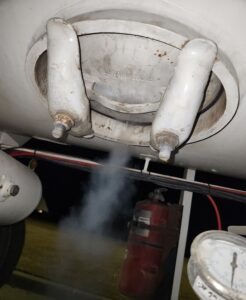
This information is preliminary and subject to change.
On November 12, 2025, about 9:16 p.m. local time, a cargo tank transporting Anhydrous Ammonia experienced a leak while parked in Weatherford, Oklahoma. The driver had stopped at a Holiday Inn Express and Suites for the evening when he noticed the manway cover underneath the cargo tank was leaking. The driver tried to stop the leak but was...
Read More