










Events are caused. Typically, they are triggered by human action. In most cases, the human action causing the event was in error. However, the action could have been directed by a procedure; or it could have been a shortcut to get the job done—a violation. In any case, an act initiates the undesired consequences. On a plant-by-plant basis, experience has shown that significant events tend to occur...
Read More
Here are the most up-to-date numbers regarding “RMP Covered” facilities as of 12/20/15), broke down by:
Industry
Program Level
Small vs. Large
…
HomeRead More »
Read More
Over the past several years car manufacturers have been making the change over to their new GW reduction refrigerant which just happens to be a Category 1 Flammable Gas, thus making this material a Highly Hazardous Chemical in the eyes of OSHA. And when we have over 10,000 pounds of this HHC in our “process” this process becomes a PSM Covered Process. This article is an attempt to explain...
Read More

Over 12,900 exclusive unsafe acts/conditions and accident/injuries photosand over 1,300 ppt’s & doc’s from more than 2,800 contributors!
11/12/2015 UPDATE
FREE Bob Cornett – MSHA Folder with 41 files
MEMBERS AREA with 429 Shocker Photos
MANY THANKS to my RENEWING “Partner in Safety” for their continued support!
since 2007
since 2015
since 2004
NOTICE!
These...
Read More
The simple and short answer is YES. In fact, OSHA covers “dispersal of inventory” in their 1994 Compliance Directive: 29 CFR 1910.119, Process Safety Management of Highly Hazardous Chemicals — Compliance Guidelines and Enforcement Procedures. In this directive OSHA asks and answers the following questions regarding “dispersal of inventory”:
Can an employer who keeps threshold...
Read More
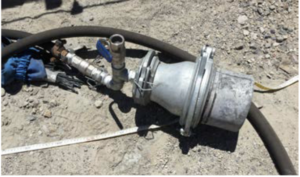
While performing a pressure test on a length of plastic pipe, a pipe blanking cap struck a worker after the crimped connection between the ferrule and pipe failed. The injured worker suffered severe leg and hand injuries and was taken to hospital by ambulance. The incident occurred on the night of 26 November 2015 at about midnight and the conveyor adjacent to the test area was in operation at...
Read More
NFPA 350: Best Practices Guide for Safe Confined Space Entry and Work, 2016 Edition, Table A.10.9.1 – Confined Space Rescue Team, Staffing Decision Table, may be the most important Confined Space document published in 2015. And that is saying a lot, seeing how OSHA also published their Construction Confined Space standard this summer. But in all my years as a rescuer, a rescue...
Read More
NFPA has published their much anticipated guide on Confined Spaces, NFPA 350: Best Practices Guide for Safe Confined Space Entry and Work, 2016 Edition. It became effective on December 4, 2015. This first edition of NFPA 350, Guide for Safe Confined Space Entry and Work, establishes best practices and “how to” for confined space entry and work, translating what is required in regulations into practical...
Read More
Repair work for liquefied carbon dioxide at a low-temperature storage tank (CE) in a steel mill was carried out. At the time, the main block valve below the safety valves was closed, while liquid CO2 remained in the tank. In addition, the heat source from the tank heater was still active. Therefore, in the tank, the temperature rose and pressure increased, and the low-temperature storage tank exploded....
Read More
1910.146 is pretty clear as to when “entry” has taken place, and 1926.1202 even expands the definition to make it clear that even UNINTENTIONAL breaking of the plane is an “entry. But why did OSHA say “any part of the body” and not “the head” since the majority of accidents are atmospheric related? I have written about this and point anyone interested...
Read More
On December 19, 2007, a runaway chemical reaction during the production of a gasoline additive destroyed T2 Laboratories in Jacksonville, Florida, killing four people and injuring 32 others. The blast, equivalent to about 1400 pounds of TNT, damaged buildings and injured office workers hundreds of feet away.
Read More