









Question: Under OSHA regulations 29 CFR 1926.95(a) who is responsible for the laundering of fire retarding clothing that is provided to employees?
Answer: Criteria for Personal Protective Equipment – Title 29 CFR 1926.95(a) section states:
(a) Application. Protective equipment, including personal protective equipment for eyes, face, head, and extremities, protective clothing, respiratory devices,...
Read More
Each label is REQUIRED to include the following components:
Abbreviation for ammonia system components
The physical state – either liquid, vapor, or both
The marker body containing the word “ammonia”
The pressure level – high or low
The flow direction
Many thanks to Steve Stephenson
Read More
Respondent owns and operates a pulp and paper mill. Respondent operates the pulp mill using the Kraft process to digest wood chips under pressure in batch digesters for pulp production. The finished cooked Wood chips are blown to blow tanks, Which reduce the pressure and separate steam and digester gases from the pulp. Uncondensed steam and gases generated by this process include regulated substances...
Read More
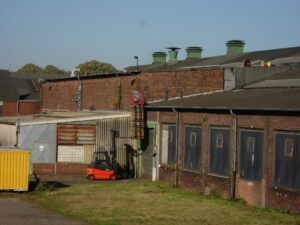
One day a safety professional was walking his job site when he came across two workers using a forklift and stack of pallets unsafely. He/She intervened and instrcuted the workers and their supervisor that they would need to use the forklift basket to lift the worker(s) safely. They all agreed and the safety professional went on his way, assuming that the workers and supervisor would...
Read More

Over 12,500 exclusive unsafe acts/conditions and accident/injuries photos
and over 1,300 ppt’s & doc’s from more than 2,797 contributors!
Many THANKS to my NEW and RENEWING “Partners in Safety“
since 8/2015
since 7/2015
since 2008
since 2009
since 2013
2015 Fatality Tracker
Electrical
30
(2014 =55)
(2013 = 32)
(2012...
Read More
In my emergency response training around the country it is always an interesting discussion when Anhydrous Ammonia (NH3) comes up and the level of PPE necessary for a “safe response”. I have always stuck to my 25 years of training that NH3 qualifies for LEVEL A as it meets all the LEVEL A criteria. However, there are a lot of folks who challenge me on this level of protection...
Read More
OSHA’s PSM standard requires Operating Procedures to address “special or unique hazards”
1910.119(f)(1)(iii) Safety and health considerations:…1910.119(f)(1)(iii)(E) Any special or unique hazards.
This item is often not necessary with many of the PSM standard’s Highly Hazardous Chemicals; however, HFO-1234yf has a unique property that falls into this requirement. ...
Read More
Pride: “Don’t insult my intelligence.”
Heroic: “I’ll get it done, by hook or by crook.”
Invulnerable: “That can’t happen to me.”
Fatalistic: “What’s the use?”
Bald Tire: “Gone 60K miles without a flat yet.”
Summit Fever: “We’re almost done.”
Pollyanna: “Nothing bad will happen.”
Read More

Cases of Stress Corrosion Cracking (SCC) in steel vessels using NH3 have been reported by members of the ammonia refrigeration industry. When NH3 is used as a refrigerant, it is kept at -33° C (-28° F). While it was once believed that NH3 SCC)could not occur at such low temperatures, both practical experience and experimental studies have shown otherwise. The Industrial Refrigeration...
Read More